RTI INTERNATIONAL
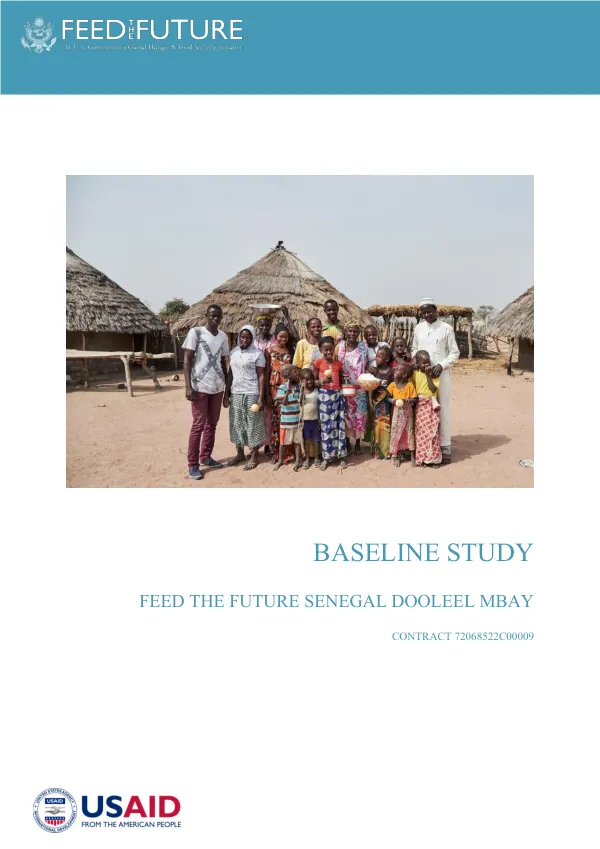
Baseline Study Feed The Future Senegal Dooleel Mbay
The Feed the Future Senegal Value Chain Services - Baseline Study was conducted in January 2023 to assess the agricultural development initiative in Senegal.
2023 · 199 pages
Sign in to readA free account is required to download.
Abstract
The study focused on the Dooleel Mbay region, which is part of the Kolda Region. The study aimed to gather data on the characteristics of farm households, their use of land capital, input use, cultivation practices, and storage, as well as their production and marketing of various crops. The study population consisted of farm households in the Dooleel Mbay region, with a total of 2,400 households surveyed across the region. The households were selected using a stratified sampling technique, with the sample distributed across different regions and value chains. The data collection team consisted of 20 interviewers and 5 supervisors, who were trained to collect data using a standardized household survey instrument. The study collected data on various aspects of farm households, including sociodemographic characteristics, socioeconomic characteristics, household credit and savings, household poverty level, and characteristics of the producers. The data also included information on the use of land capital, input use, cultivation practices, and storage, as well as the production and marketing of various crops, including vegetables, cereals, mangoes, and small ruminants. The results of the baseline survey showed that the majority of farm households in the Dooleel Mbay region were headed by men, with a median age of 45 years. The households had a median size of 7 members, with a majority of the members being women. The households had a median level of education, with 40% of the household heads having completed primary education. The study found that the majority of farm households in the region relied on rain-fed agriculture, with a small proportion using irrigation. The households used a variety of inputs, including fertilizers, pesticides, and seeds, with a majority of the households using organic fertilizers. The study also found that the households used a range of cultivation practices, including crop rotation, intercropping, and mulching. The study found that the majority of farm households in the region produced vegetables, cereals, and mangoes, with a small proportion producing small ruminants. The households sold their produce through various channels, including markets, wholesalers, and processors. The study found that the majority of farm households in the region faced various challenges, including soil degradation, limited access to credit, and limited market access. The study also found that the level of women's empowerment in agriculture was low, with a majority of the women not participating in decision-making in agricultural production. The study recommended that interventions be designed to improve the level of women's empowerment in agriculture, as well as to address the challenges faced by farm households in the region. The study's findings have implications for the design of interventions aimed at improving agricultural development in the Dooleel Mbay region. The study's results highlight the need for interventions that address the challenges faced by farm households, including soil degradation, limited access to credit, and limited market access. The study's findings also highlight the need for interventions that improve the level of women's empowerment in agriculture.
Related documents