USAID DEC
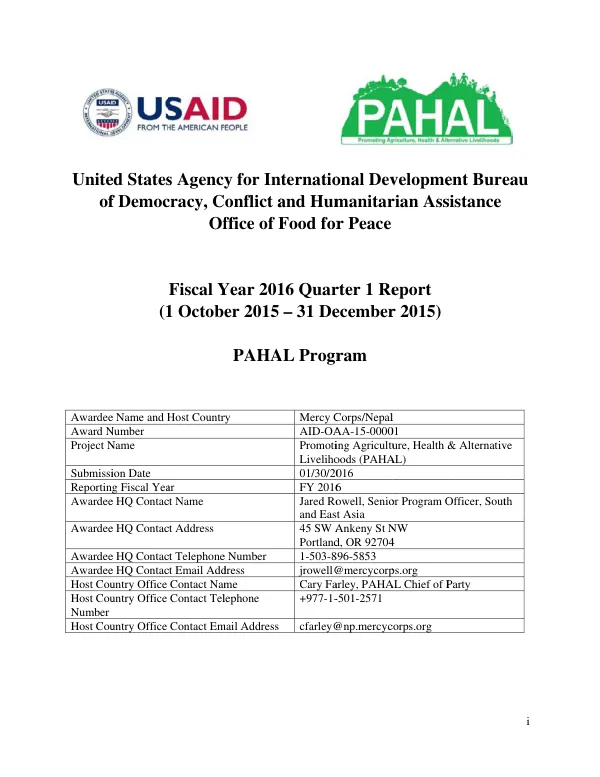
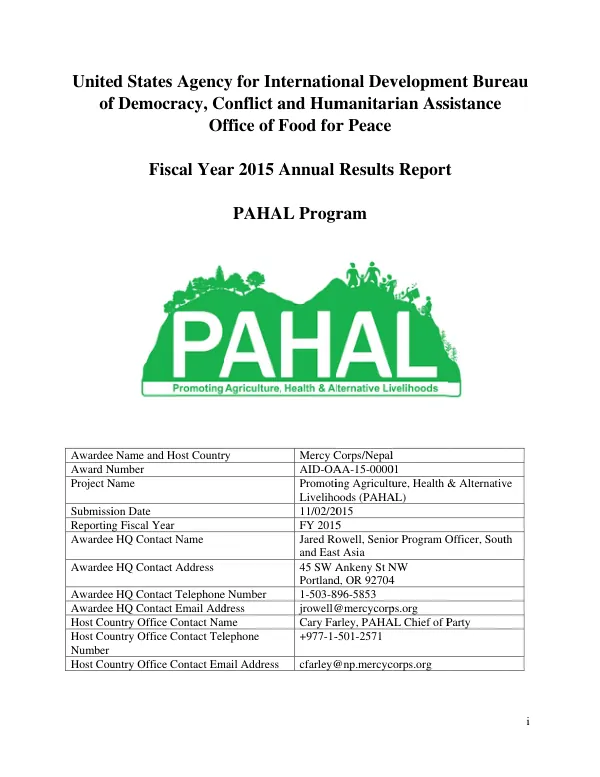
Promoting Agriculture, Health and Alternative Livelihoods (PAHAL) Program Annual Report FY 2015
Sign inGEOHAZARDS INTERNATIONAL
Promoting Agriculture, Health and Alternative Livelihoods (PAHAL) Program Annual Report FY 2015
The Promoting Agriculture, Health and Alternative Livelihoods (PAHAL) program is a $37 million, five-year initiative designed to achieve food security among vulnerable populations in 14 districts in the middle and high hills of Far Western and Mid-Western Nepal.
2015 · 20 pages
Sign in to readA free account is required to download.
Abstract
The program is a Development Food Assistance Project under the Bureau for Democracy, Conflict and Humanitarian Assistance (DCHA)/Office of Food for Peace (FFP) of the United States Agency for International Development (USAID). The Consortium, led by Mercy Corps, consists of international partners International Development Enterprises (iDE), Plan International, Tufts University's Feinstein International Center (FIC), and GeoHazards International (GHI), national non-governmental organizations (NGOs) Rupantaran, the Resource Identification and Management Society (RIMS-Nepal), Support Activities for Poor Producers in Nepal (SAPPROS), the Nepali Technical Assistance Group (NTAG), and the National Society for Earthquake Technology (NSET), and local district-level NGOs (LNGOs) for direct implementation. The program takes a multi-dimensional, systems approach to address the underlying socio-political, economic, and ecological constraints, and the related shock and stress exposure that drive food insecurity in Nepal. It is the first program to fully integrate resilience into its Theory of Change (TOC), baseline, monitoring and evaluation (M&E), and activities related to improved health and nutrition status for vulnerable households, increased income for vulnerable households, and increased food availability among vulnerable communities. Mercy Corps defines resilience as the capacity to learn, cope, adapt, and transform in the face of shocks and stresses. The program's sub-purpose forms the resilience pathway to enable people in vulnerable communities to better cope with and absorb shocks and stresses, and to adapt and transform in the face of these challenges. The program's activities are designed to improve health and nutrition status, increase income, and increase food availability among vulnerable communities. The program's Theory of Change (TOC) outlines the expected outcomes and impact of the program, and the monitoring and evaluation (M&E) plan is designed to track progress and identify areas for improvement. The program is being implemented in 14 districts in the middle and high hills of Far Western and Mid-Western Nepal, where communities are facing significant challenges related to poverty, food insecurity, and vulnerability to shocks and stresses. The program's Consortium is working closely with local stakeholders, including district-level NGOs, to ensure that the program is tailored to the specific needs and context of each district. The program's budget is $37 million, and it is expected to run for five years. The program's activities are designed to be sustainable and to build the capacity of local stakeholders to continue the work of the program after it is completed. The program's monitoring and evaluation (M&E) plan is designed to track progress and identify areas for improvement, and to ensure that the program is meeting its expected outcomes and impact. The program's Consortium is working closely with local stakeholders, including district-level NGOs, to ensure that the program is tailored to the specific needs and context of each district. The program's budget is $37 million, and it is expected to run for five years. The program's activities are designed to be sustainable and to build the capacity of local stakeholders to continue the work of the program after it is completed.
Related documents