USAID DEC
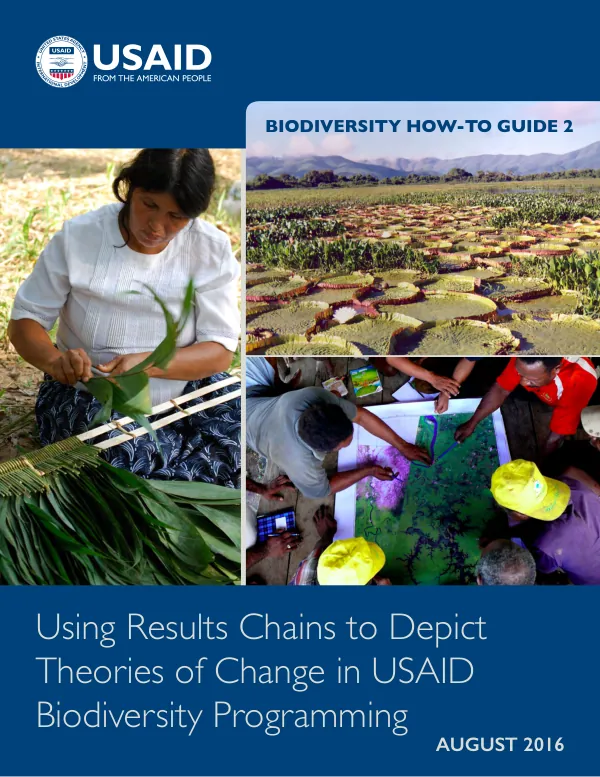
Biodiversity How-To Guide 2: Using Results Chains to Depict Theories of Change in USAID Biodiversity Programming
Sign inENVIRONMENTAL INCENTIVES, LLC
Biodiversity How-To Guide 2: Using Results Chains to Depict Theories of Change in USAID Biodiversity Programming
The USAID Biodiversity Programming How-To Guide, published in August 2016, provides a comprehensive framework for developing and using Results Chains to depict Theories of Change in biodiversity programming.
2016 · 30 pages
Sign in to readA free account is required to download.
Abstract
The guide is a result of a collaborative effort between USAID, Environmental Incentives, LLC, Foundations of Success, and ICF International. The guide begins by defining the purpose and scope of Results Chains, which are visual representations of a Theory of Change. A Theory of Change is a logical framework that outlines the assumptions, activities, and outcomes of a program or project. Results Chains are useful tools for clarifying assumptions, measuring effectiveness, and developing a common framework for cross-site learning. The guide outlines a 13-step process for developing a Results Chain, starting with defining the purpose and sub-purpose statements and ending with verifying that the Results Chain meets the criteria of a good Results Chain. The steps involve selecting and separating relevant components from the situation model, adding key missing drivers, brainstorming strategic approaches, prioritizing and selecting draft strategic approaches, and converting selected strategic approach components into desired results. The guide also highlights the importance of Results Chains in biodiversity programming, citing their ability to clarify assumptions, measure effectiveness, and facilitate cross-site learning. It provides examples of how Results Chains can be used to depict Theories of Change in various contexts, including community capacity building and forest resource management. The guide includes several figures and boxes that illustrate the concepts and provide additional information on software programs for designing Results Chains, criteria for a good purpose statement, and different types of assumptions. The guide concludes by emphasizing the importance of developing Results Chains as a tool for effective biodiversity programming. The guide's authors, Caroline Stem and Marco Flores, are experts in biodiversity programming and have extensive experience in developing and implementing Results Chains. The guide is a valuable resource for anyone involved in biodiversity programming, including program managers, evaluators, and practitioners. The guide's focus on Results Chains as a tool for clarifying assumptions and measuring effectiveness is particularly relevant in the context of biodiversity programming, where complex systems and uncertain outcomes are common. By providing a clear and structured approach to developing Results Chains, the guide enables practitioners to better understand the relationships between their activities and outcomes, and to make data-driven decisions that support effective biodiversity programming. The guide's emphasis on cross-site learning and collaboration is also noteworthy, as it highlights the importance of sharing knowledge and best practices across different contexts and programs. By developing a common framework for Results Chains, practitioners can learn from each other's experiences and adapt their approaches to better address the complex challenges of biodiversity programming. Overall, the USAID Biodiversity Programming How-To Guide is a comprehensive and practical resource for anyone involved in biodiversity programming. Its focus on Results Chains as a tool for clarifying assumptions, measuring effectiveness, and facilitating cross-site learning makes it an essential tool for effective biodiversity programming.