AVENIR HEALTH
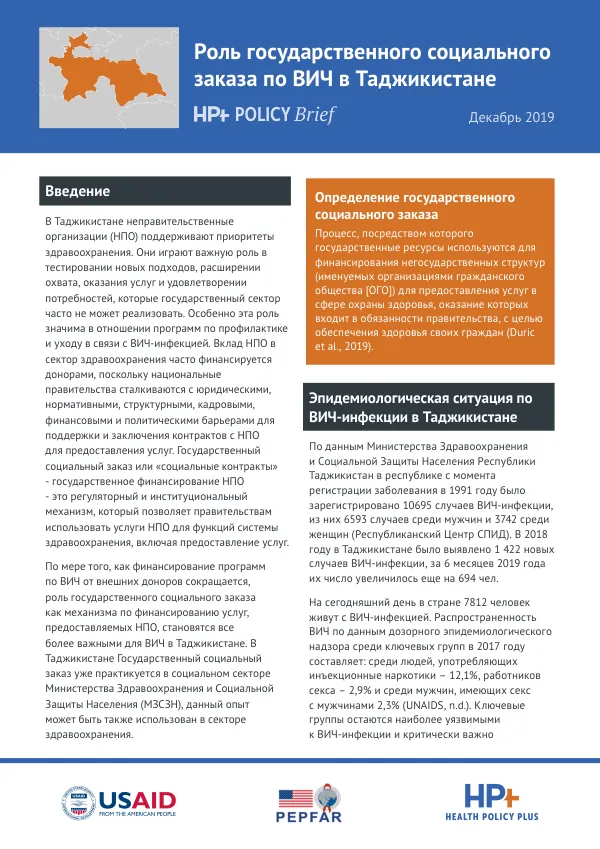
The Role of Government Social Contracting for HIV in Tajikistan
The Role of Government Social Contracting in HIV Prevention in Tajikistan In Tajikistan, nongovernmental organizations (NGOs) play a crucial role in implementing national health priorities, particularly in HIV prevention and care.
2019 · 2 pages
Sign in to readA free account is required to download.
Abstract
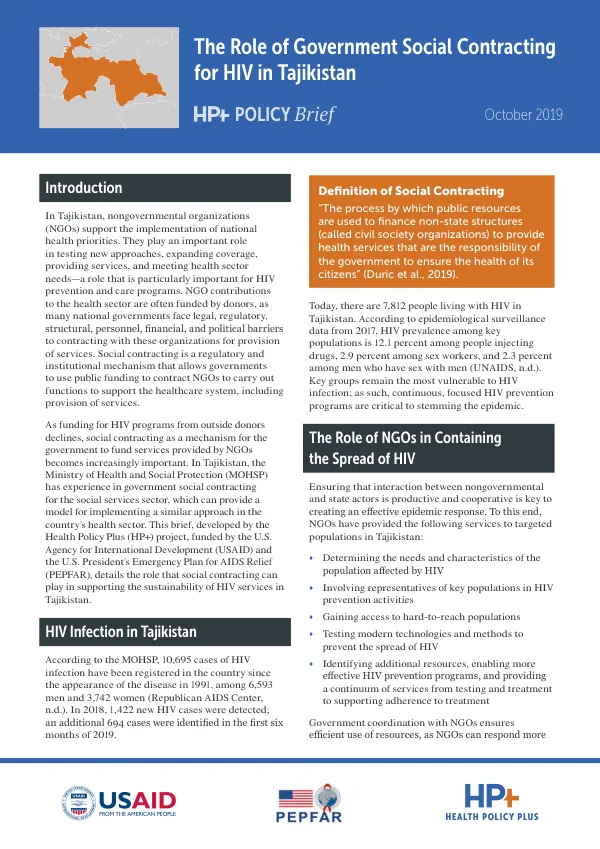
They provide essential services, including testing, expanding coverage, and providing a continuum of services from testing and treatment to supporting treatment adherence. However, many governments face various barriers when contracting with NGOs, including legal, regulatory, structural, personnel, financial, and political challenges. Social contracting is a regulatory and institutional mechanism that enables governments to use public funding to finance NGOs to provide health services. This approach is particularly important in Tajikistan, where funding for HIV services from outside donors is declining. The Ministry of Health and Social Protection (MOHSP) has experience in government social contracting for social services, which can serve as a model for implementing a similar approach in the country's health sector. According to the MOHSP, 10,695 cases of HIV infection have been registered in Tajikistan since the appearance of the disease in 1991. In 2018, 1,424 new HIV cases were detected, and an additional 694 cases were identified in the first six months of 2019. Today, there are 7,812 people living with HIV in Tajikistan. The HIV prevalence among key populations is 12.1 percent among people who inject drugs, 2.9 percent among sex workers, and 2.5 percent among men who have sex with men. NGOs have provided essential services to targeted populations in Tajikistan, including determining the needs and characteristics of the population affected by HIV, involving representatives of key populations in HIV prevention activities, gaining access to hard-to-reach populations, testing modern technologies and methods to prevent the spread of HIV, and identifying additional resources to enable more effective HIV prevention programs. The government of Tajikistan has introduced social contracting as a regulatory and institutional mechanism to finance NGOs to provide health services. This approach allows the government to approach governance objectives through the purchase of social services from legal entities, including commercial and non-profit organizations. Favorable conditions exist for the implementation of social contracting in Tajikistan's health sector, with the Government Social Contracting Act (2008) laying the legal and organizational framework for social contracting. The Roadmap for the Implementation of Sustainable Measures for Combating HIV through Government Funding for Programs Run by NGOs in Tajikistan was developed in July 2019, based on an analysis of existing legislation. The roadmap outlines the steps needed to support the implementation of social contracting mechanisms for HIV efforts in Tajikistan. By stakeholder group, these steps include finalizing and approving the roadmap, committing to implement the activities outlined in the roadmap, and setting aside funding to support social contracting. The implementation of social contracting requires the cooperation of government, donors, and NGOs. The government must finalize and approve the roadmap, commit to implementing the activities outlined in the roadmap, and set aside funding to support social contracting. Donors must support capacity development of government and NGOs to implement social contracting and provide technical assistance for the implementation of the roadmap. NGOs must advocate for funding for government social contracting and cooperate with the MOHSP to implement the roadmap and ensure accountability. In the context of Tajikistan's concentrated HIV epidemic, particularly among people who inject drugs, social contracting with NGOs that serve the needs of and have connections with key populations can help identify people living with HIV and connect them to care and treatment programs. The groundwork for social contracting is in place, and it is up to stakeholders to work together to ensure that this mechanism supports the fight against HIV in Tajikistan.
Related documents