GOVERNMENT OF TAJIKISTAN
Pakistan – Complex Emergency and Floods Fact Sheet #1, Fiscal Year (FY) 2012
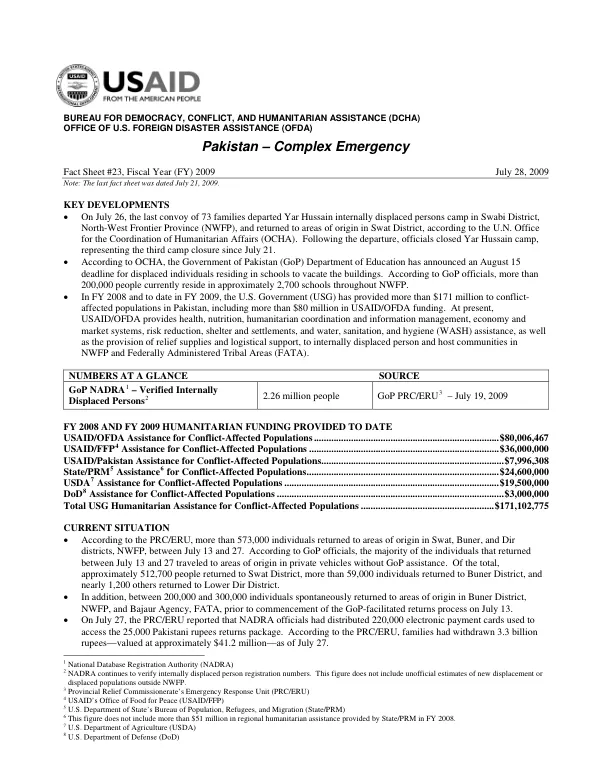
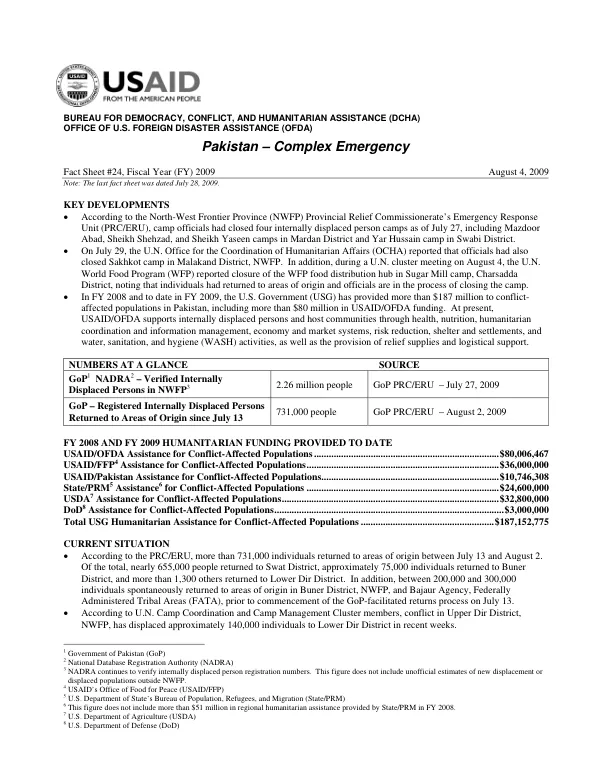
Conflict in northwest Pakistan's Federally Administered Tribal Areas (FATA) has resulted in the displacement of over 108,000 families, or 734,400 people, as of March 5, 2012.
2012 · 4 pages
Sign in to readA free account is required to download.
Abstract
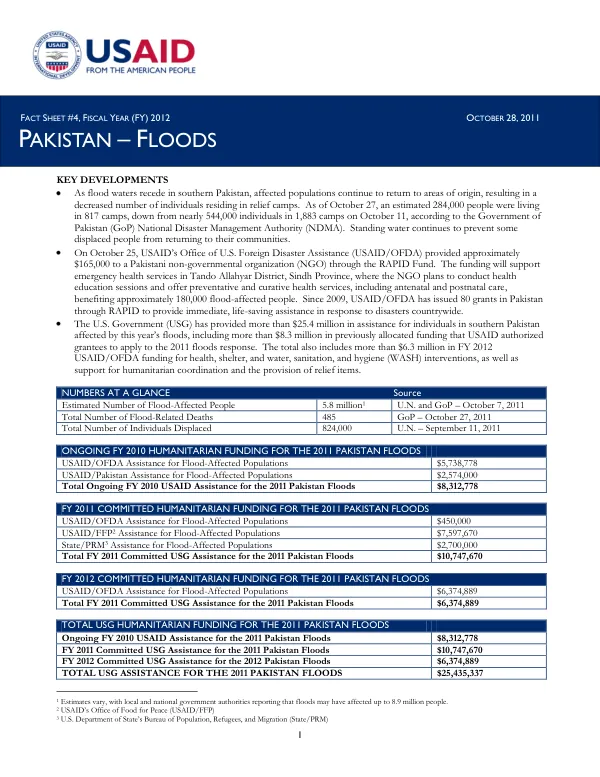
This number represents a decrease of nearly 14,000 families since November 2011. The majority of displaced families are residing within FATA and Khyber Pakhtunkhwa (KPk) Province. Instability and ongoing security operations in Khyber Agency, FATA, have displaced an estimated 6,900 families since January 2012. The Government of Pakistan (GoP), in coordination with U.N. agencies, continues to operate three camps in FATA and KPk, housing approximately 11,800 internally displaced families. In addition to conflict-related displacement, approximately 13,000 people remain displaced by the 2011 floods in Pakistan's southern provinces of Balochistan and Sindh. The 2011 floods affected an estimated 5.2 million people, with 520 reported deaths. Heavy monsoon rains resulted in flooding in all districts in Sindh Province and nine districts in Balochistan Province, displacing an estimated 1.8 million people. The floods also destroyed up to 1.6 million houses and more than 2.1 million acres of agricultural land. As of February 27, 2012, more than 1.2 million people displaced by floods had returned to areas of origin. The Government of Pakistan and U.N. agencies launched the Pakistan Floods 2011 Early Recovery Framework on February 21, requesting approximately $440 million to continue the flood response and support early recovery activities for a nine-month period. USAID's Office of U.S. Foreign Disaster Assistance (USAID/OFDA) continues to respond to humanitarian needs across Pakistan, providing over $2.2 million in February for shelter and food security activities, and nearly $12 million in total funding in FY 2012. The U.S. Department of State's Bureau of Population, Refugees, and Migration (State/PRM) has provided nearly $3.9 million to the Office of the U.N. High Commissioner for Refugees (UNHCR) for camp coordination and management, protection, and shelter activities, as well as the distribution of relief commodities. In total, the U.S. Government has provided approximately $78.6 million in humanitarian assistance to Pakistan in FY 2012. Between January and March 2012, GoP security operations in the Shalobar area of Khyber Agency, FATA, displaced an estimated 6,900 families, with approximately 4,700 families residing in host communities and 1,900 families in the Jalozai camp. As of March 5, an estimated 7,500 families in total were residing in the Jalozai camp. Approximately 1,000 families were living in the Togh Sarai camp, while more than 3,000 families resided in New Durrani camp. In Sindh and Balochistan provinces, more than 1.2 million people displaced by floods have returned to home areas. The Shelter Cluster continues to assess conditions in temporary settlements and areas of return, with approximately 2,500 families remaining in 95 temporary settlements as of February 27. Factors preventing returns to home areas include standing water, a lack of resources to rebuild houses, and limited means to restart livelihoods. To address the humanitarian needs of flood-affected individuals in Sindh Province, USAID/OFDA provided approximately $1.5 million to an implementing partner in February 2012 to distribute transitional shelter materials and provide shelter assistance in flood-affected areas. State/PRM also provided funding to UNHCR to support shelter activities for Pakistan's conflict-affected individuals. Preventing the spread of and reducing the health risks from water- and vector-borne disease remain priority activities, particularly in flood-affected areas. Through the Pakistan Floods 2011 Early Recovery Framework, the Water, Sanitation, and Hygiene (WASH) Cluster is targeting 2.5 million beneficiaries for the provision of safe drinking water and sanitation services, in addition to hygiene skills and supplies. As of February 29, WASH Cluster members had provided safe drinking water to more than 1.6 million people in Sindh and Balochistan provinces primarily through household water treatment and the installation of hand pumps.
Related documents