ABT ASSOCIATES
Building Synergies with Businesses to Prevent Gestational Diabetes
The Alliance for Gestational Diabetes Screening was formed in September 2009 by 4th Sector Health, in partnership with Bristol-Myers Squibb, Johnson & Johnson, and Project HOPE.
2012 · 2 pages
Sign in to readA free account is required to download.
Abstract
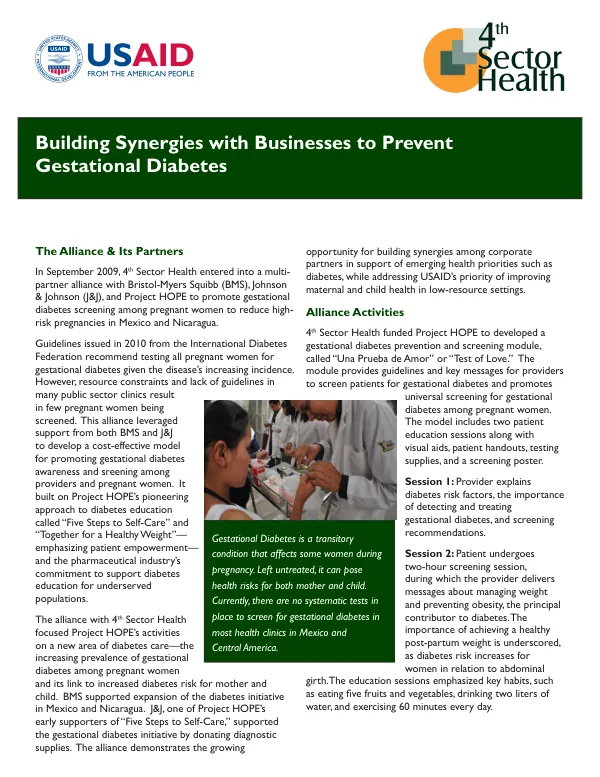
The alliance aimed to promote gestational diabetes screening among pregnant women in Mexico and Nicaragua to reduce high-risk pregnancies. The International Diabetes Federation issued guidelines in 2010 recommending universal testing for gestational diabetes due to its increasing incidence. However, resource constraints and lack of guidelines in public sector clinics resulted in few pregnant women being screened. The alliance leveraged support from BMS and J&J to develop a cost-effective model for promoting gestational diabetes awareness and screening among providers and pregnant women. This model built on Project HOPE's pioneering approach to diabetes education, emphasizing patient empowerment. The alliance focused on a new area of diabetes care, the increasing prevalence of gestational diabetes among pregnant women and its link to increased diabetes risk for mother and child. BMS supported the expansion of the diabetes initiative in Mexico and Nicaragua, while J&J donated diagnostic supplies to support the gestational diabetes initiative. Project HOPE developed a gestational diabetes prevention and screening module, called "Una Prueba de Amor" or "Test of Love." The module provides guidelines and key messages for providers to screen patients for gestational diabetes and promotes universal screening for gestational diabetes among pregnant women. The model includes two patient education sessions, visual aids, patient handouts, testing supplies, and a screening poster. The education sessions emphasize key habits, such as eating five fruits and vegetables, drinking two liters of water, and exercising 60 minutes every day. During the pilot, Project HOPE trained 57 health workers in the new gestational diabetes module in eight primary care centers in Mexico and Nicaragua. The trained clinics intend to continue the screening established during the pilot, and Project HOPE estimates that more than 400 women per year will be screened by these facilities. The feedback received from both mothers and healthcare providers was extremely positive, with many expressing gratitude for the information and education provided. The alliance demonstrates the feasibility of identifying overlapping interests of multiple corporate partners, developing innovative solutions to address critical gaps in women's healthcare, and creating synergies with USAID's priority health areas. The alliance's success has led to the scaling up of the introduction of the module for inclusion in prenatal care guidelines in Mexico and Nicaragua. Project HOPE is working with health centers and local governments in each country to implement the module, with the goal of reducing high-risk pregnancies and improving maternal and child health outcomes. The alliance's model promotes universal screening for gestational diabetes in low-resource settings, highlighting the importance of addressing this critical gap in women's healthcare.
Related documents