USAID DEC
Business Drivers for Food Safety: Barriers to Adopting Safer Fish Smoking Practices among Senegalese Artisanal Processors
Sign inUNIVERSITY OF RHODE ISLAND
Business Drivers for Food Safety: Barriers to Adopting Safer Fish Smoking Practices among Senegalese Artisanal Processors
The artisanal fish processing sector in Senegal is a significant contributor to the country's economy and diet.
2021 · 12 pages
Sign in to readA free account is required to download.
Abstract
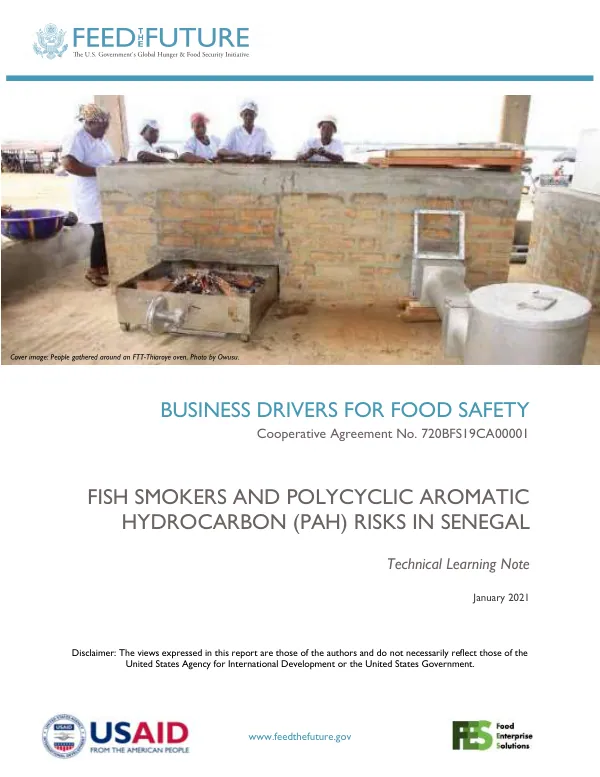
In 2018, nearly 40,000 tons of fish were processed, worth an estimated $47.5 million USD. The main types of processed fish include kéthiakh, guédji, tambadjang, and methora, with kéthiakh representing 63% of the total. Fish processing is labor-intensive and provides many jobs, making it an important source of income generation in coastal communities that often suffer high levels of poverty and unemployment. Women represent over 90% of workers in the fish processing associations, and they typically contribute more of their income to household well-being and nutrition than their male counterparts. The artisanal fish processing sector in Senegal is associated with several health risks, including smoke inhalation during processing, consuming contaminated or spoiled products, and the consumption of polycyclic aromatic hydrocarbons (PAHs). PAHs have genotoxic, carcinogenic, and teratogenic effects, and they are particularly prevalent in smoked and braised fish products. The main types of processed fish that contain high levels of PAHs are kéthiakh and methora, which are braised and smoked, respectively. Guédji and tambadjang, which are fermented and dried, do not contain PAHs. Feed the Future Business Drivers for Food Safety (BD4FS) is a project that aims to improve food safety in the artisanal seafood sector in Senegal. The project is building on the findings and frameworks from previous research and outreach activities, including the University of Rhode Island's Sustainable Fisheries Management Project in Ghana. In 2020, BD4FS conducted a Food Safety Situational Analysis (FSSA) of the artisanal seafood sector in Senegal, which confirmed that traditional smoking of fish remains a common practice. The project also completed a desk review of the health risks associated with consuming smoked products, the different types of fish smokers, and the levels of PAHs produced by each smoker. Focus group discussions (FGDs) were held with women's associations of artisanal fish processors in Senegal to better understand their knowledge of PAHs and to identify gaps and barriers within the food system that need to be overcome in order to improve the health and well-being of processors and consumers. The FGDs were held at processing sites within the greater Dakar region and in the Petite Côte area south of Dakar in early spring 2021. The key objectives of the FGDs were to assess the knowledge, attitudes, and practices of artisanal fish processors regarding PAHs in smoked and braised products, to examine the processes and viability of introducing new fish smokers/ovens to the processing communities, to better understand why processors resort back to traditional processing techniques, and to understand why many donor-funded projects fail to achieve lasting impacts on the processing communities. The FGDs revealed that traditional smoking technology has been studied extensively, and many modifications have been made or attempted to improve efficiency and product quality. However, many of the newer types and even some older models of ovens have been abandoned by processors and have fallen into disrepair. The oven models mentioned in the roundtable discussions included the traditional basic brick oven, a modified brick oven, the Altona oven, and the FAO Thiaroye oven, which reduces PAH creation. The only oven that is still being widely used is the traditional brick oven, which is preferred by processors due to the quantity of fish that can be processed in one batch.
Related documents