USAID DEC
Feed the Future Business Drivers for Food Safety: mSafeFood - A Mobile Learning Platform
Sign inUSAID
Feed the Future Business Drivers for Food Safety: mSafeFood - A Mobile Learning Platform
Feed the Future Business Drivers for Food Safety (BD4FS) is a program implemented by Food Enterprise Solutions (FES) and funded by the United States Agency for International Development (USAID).
2023 · 17 pages
Sign in to readA free account is required to download.
Abstract
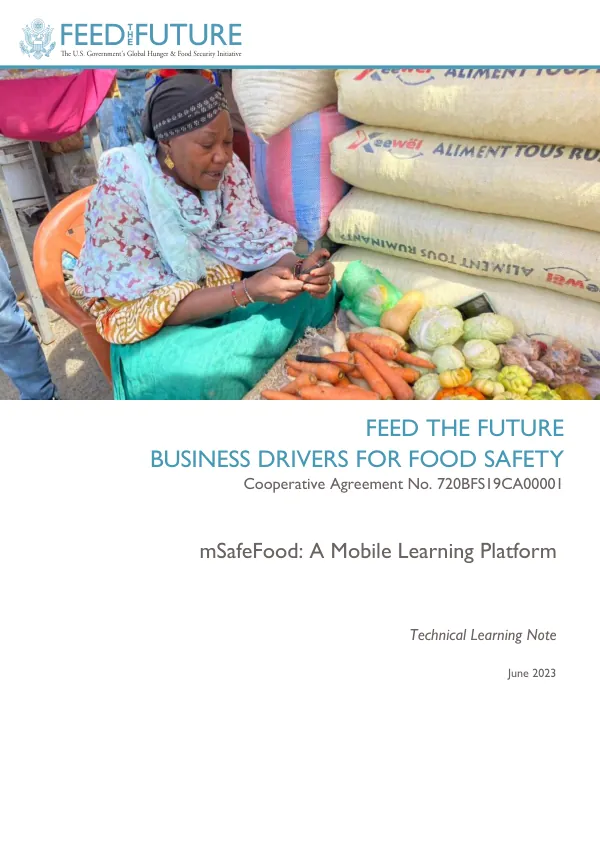
The program aims to strengthen the food safety culture within a country through active engagement with the business community. BD4FS partners with growing food businesses (GFBs) to upgrade their food handling practices, improve food safety, and reduce food loss, ultimately resulting in better market access and improved revenue flow. BD4FS supports GFBs with training, technical assistance, business support, access to financing, and information sharing through multi-channel communication. The different communication channels include print media, radio and television, social media, in-person training, remote webinar-based training, and mSafeFood – a mobile learning platform. mSafeFood is designed to complement and reinforce other program components, providing timely information to food business owners and operators, frontline food handlers, and consumers through digital messaging and recorded content. Key food safety messages are distributed using interactive voice response (IVR) technology accessible through basic mobile phones as well as smartphones. mSafeFood consists of three components: (1) Green Line information hotline, (2) Wanji Game interactive game-based learning, and (3) Learning Activities that contain topical lessons with pre- and post-evaluations of knowledge. These are offered at no cost to participants and are available in French and three other national languages – Wolof, Pulaar, and Serer. Since its launch in October 2021, BD4FS has engaged more than 3,000 food business entrepreneurs and other food system actors in Senegal through mSafeFood. Consumers and youth made up 21 percent of participants – important demographics to reach for raising food safety awareness. mSafeFood conveyed nearly 30,000 key food safety messages through Green Line and 92 percent of participants reported that the information received was useful to them. The Wanji Game was particularly popular to play from the business entrepreneur perspective, with 65 percent completing the game. The Learning Activities measured an increase in knowledge by comparing the pre- and post-evaluations, with a 6.5 percent average increase in correct responses across the eight survey questions. BD4FS has successfully sparked the interest of participants as demonstrated by their high completion rates and by choosing to call back more than once. The program has also partnered with Viamo, a global communications technology company, for technical support in building and implementing mSafeFood. This report describes BD4FS development and implementation of mSafeFood to date and outlines future directions for this mobile learning platform. The program's focus on food safety and its primary audience of food business entrepreneurs makes mSafeFood a unique and valuable resource for the food industry in Senegal. By providing timely and relevant information to food business owners and operators, frontline food handlers, and consumers, mSafeFood has the potential to improve food safety and reduce food loss, ultimately resulting in better market access and improved revenue flow for GFBs.
Related documents