DUKE-NATIONAL UNIVERSITY OF SINGAPORE
Cambodian Journal of Natural History 2016 (1)
Cambodian bee diversity is characterized by a lack of historical studies, with few collections made prior to this study.
2016 · 17 pages
Sign in to readA free account is required to download.
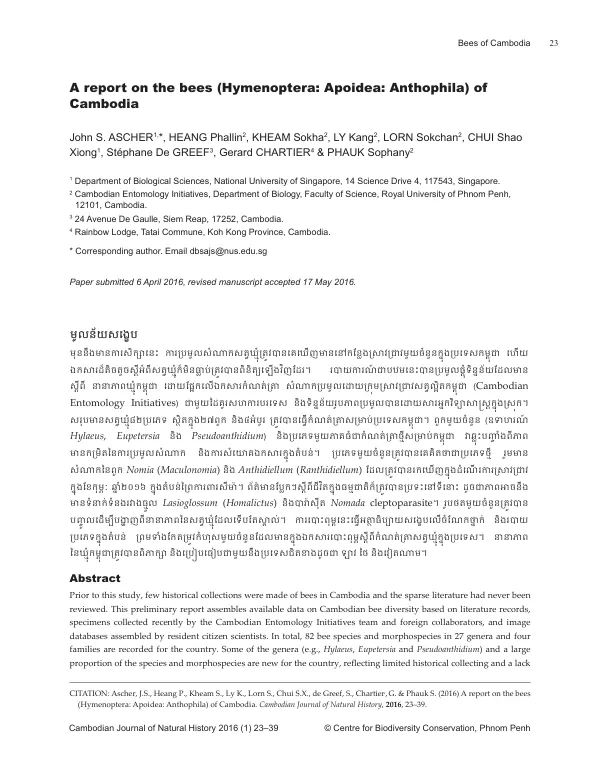
Abstract
The sparse literature on the subject has never been reviewed. This preliminary report assembles available data on Cambodian bee diversity based on literature records, specimens collected recently by the Cambodian Entomology Initiatives team and foreign collaborators, and image databases assembled by resident citizen scientists. A total of 82 bee species and morphospecies in 27 genera and four families are recorded for the country. Some of the genera, such as Hylaeus, Eupetersia, and Pseudoanthidium, and a large proportion of the species and morphospecies are new for the country, reflecting limited historical collecting and a lack of comprehensive regional revisions. Documentation of the bee fauna of Thailand has been more extensive, with a series of publications by T.D.A. Cockerell documenting the results of a collecting expedition during 1928-1929. A large-scale survey conducted from 2006-2009 by the Thailand Inventory Group for Entomological Research (TIGER) yielded large samples of bees from national parks across Thailand, many of which have been identified by specialists and sequenced for COI as a contribution to the global Bee Barcode of Life project. Results of the TIGER project for apoid wasps are a major advance in knowledge of this group, with 22 new genera recorded for Thailand. The few notable studies of bee diversity in Cambodia in the 20th century were mostly undertaken by Japanese researchers in the late 1950s. Professors T. Sato and T. Takayama, members of the 1957 Hyogo University of Agriculture Expedition to Cambodia, collected bees in Stung Treng Province and a few other places. Cambodian bees obtained by this expedition were evidently few overall, and Hirashima's (1962) report does not mention any. However, Cambodian samples of stingless and other bees obtained in 1958 by K. Yoshikawa in Kampong Cham Province and Oudong, Kampong Speu Province, were included in Sakagami's (1978) review of Tetragonula stingless bees of continental Asia. Bees (Apoidea: Anthophila) are important pollinators and play a crucial role in plant reproduction in natural and agricultural ecosystems. Their populations must be maintained to ensure food security and because bees are also of very great value as a source of honey and hive products. In Cambodia, bees provide a source of protein through consumption of their larvae. Although Cambodia is known to have high diversity in other taxa such as birds, knowledge of its bees other than the relatively well-studied highly eusocial hive bees (Apini and Meliponini) remains very limited and inaccessible. Documentation of the Southeast Asian bee fauna is generally poor, and many groups lack modern revisions. Recent taxonomic studies on the Indochinese fauna have focused largely on stingless bees, whereas ecological studies have focused on plant-pollinator interactions rather than taxonomic diversity. The review of the conservation and management of pollinators for sustainable agriculture in Laos is also relevant to Cambodia. Several species are believed to be new to science, including specimens of Nomia (Maculonomia) and Anthidiellum (Ranthidiellum) discovered on an expedition in February 2016 to Seima Wildlife Sanctuary. Novel life history information was also obtained there, including a probable host-parasite association between a tiny Nomada cleptoparasite and its presumed Lasioglossum (Homalictus) host. Photographs document some of the newly detected bee diversity. This paper briefly comments on the taxonomy and distribution of regional species and corrects some erroneous country records in the literature. Cambodian bee diversity is discussed and compared to the neighboring countries of Laos, Thailand, and Vietnam.
Related documents
Documents in this collection
 2014
2014USAID DEC
Supporting Forests and Biodiversity: Seventh Quarterly Report
Open record 2016
2016USAID DEC