USAID DEC
Technical Report: Conservation Enterprises: Using a Theory of Change Approach to Synthesize Lessons from USAID Biodiversity Projects
Sign inENVIRONMENTAL INCENTIVES, LLC
Technical Report: Conservation Enterprises: Using a Theory of Change Approach to Synthesize Lessons from USAID Biodiversity Projects
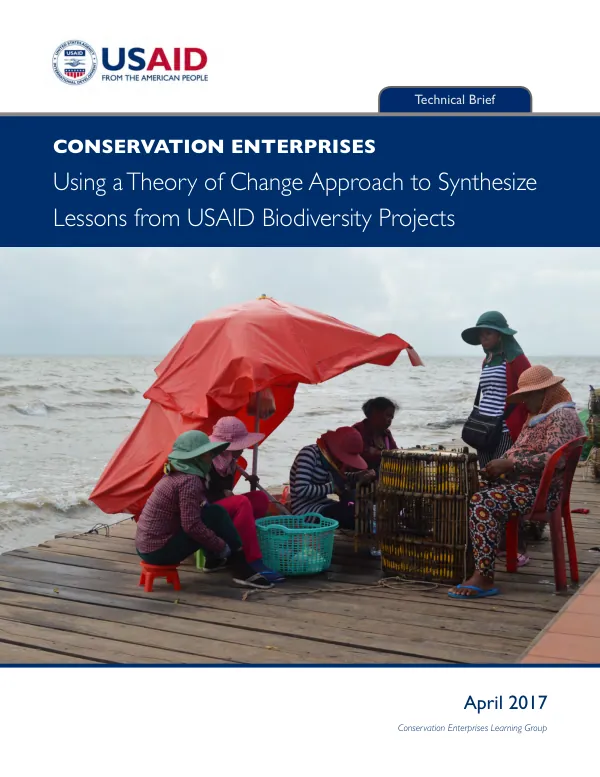
Conservation enterprises provide income to participants through the production and sale of goods and services such as ecotourism, beekeeping, and crafts.
2017 · 14 pages
Sign in to readA free account is required to download.
Abstract
The hypothesis is that if participant income is increased, then that provides motivation and ability for participants to discontinue unsustainable practices and exclude others from uses that result in threats to biodiversity. Supporting or establishing conservation enterprises with participants is often one element of an overall strategy to promote sustainable or alternative livelihoods, or to support community-based natural resources management (CBNRM) as part of a conservation project. These approaches generally seek to change behavior of people that induce threats to biodiversity by enabling a new benefit-generating activity that exceeds the benefit of the threat-inducing activity. In the case of conservation enterprises, the primary benefit is presumably the income generated from the enterprise. A generalized theory of change for conservation enterprises follows a specific logic: if projects support conservation enterprises, then the enabling conditions for enterprises (such as market demand and participant capacity) are in place; if enabling conditions are in place, then benefits (such as more income or improved governance) are realized by participants; if benefits are realized, then participants' behavior (such as hunting or illegal logging) is changed and threats to biodiversity are reduced, and biodiversity will be ultimately conserved. Assessing the soundness of these assumptions will help inform what works, what doesn't, and under what conditions. Enabling conditions are context-specific and may vary widely from site to site. The conservation enterprises themselves, participants, threats, and other conditions may differ significantly. Nevertheless, there is a common hypothesis underlying all actions implemented by partners as part of this strategic approach: that supporting conservation enterprises will ultimately lead to improvement in the status of biodiversity at the sites. The USAID biodiversity funding supports conservation enterprises, but the evidence that these enterprises lead to conservation is mixed. In an effort to increase understanding of conservation enterprise approaches and outcomes and to improve the effectiveness of biodiversity programming, this brief synthesizes lessons from USAID-funded efforts to support conservation enterprises. A number of USAID programs have supported conservation enterprises, including the Biodiversity Conservation Network (BCN), the Global Upgrading Program, the Sustainable Conservation Approaches in Priority Ecosystems Program (SCAPES), TransLinks, the Forests, Climate, and Communities Alliance, and the Central Africa Regional Program for the Environment (CARPE). Each USAID biodiversity-funded program, as well as each site where a conservation enterprise strategic approach is implemented, has a unique set of circumstances. From site to site, the conservation enterprises themselves, participants, threats, and other conditions may vary widely. Nevertheless, there is a common hypothesis underlying all actions implemented by partners as part of this strategic approach: that supporting conservation enterprises will ultimately lead to improvement in the status of biodiversity at the sites. The results chain depicting the generalized theory of change and learning questions under the Conservation Enterprises Learning Agenda is as follows: if projects support conservation enterprises, then the enabling conditions for enterprises (such as market demand and participant capacity) are in place; if enabling conditions are in place, then benefits (such as more income or improved governance) are realized by participants; if benefits are realized, then participants' behavior (such as hunting or illegal logging) is changed and threats to biodiversity are reduced, and biodiversity will be ultimately conserved. The theory of change for supporting conservation enterprises is as follows: for this summary, a theory of change was used to illuminate the logic and assumptions underlying the use of a conservation enterprise approach and to structure the lessons learned from past experience. A theory of change is used to test assumptions about the relationships among the actions and the expected outcomes by exploring learning questions. Below is a generalized theory of change for supporting conservation enterprises. The ultimate outcome – biodiversity conservation is represented by the green oval. The strategic approach – support conservation enterprises – is represented by the yellow hexagon. Blue boxes represent intermediate results, and the purple box is the expected reduction in threats. Arrows indicate assumptions that a factor or result will lead to a subsequent one.