USAID DEC
Can family-centered programing mitigate HIV risk factors among orphaned and vulnerable adolescents? Results from a pilot study in South Africa
Sign inMICHIGAN STATE UNIVERSITY FOUNDATION
Can family-centered programing mitigate HIV risk factors among orphaned and vulnerable adolescents? Results from a pilot study in South Africa
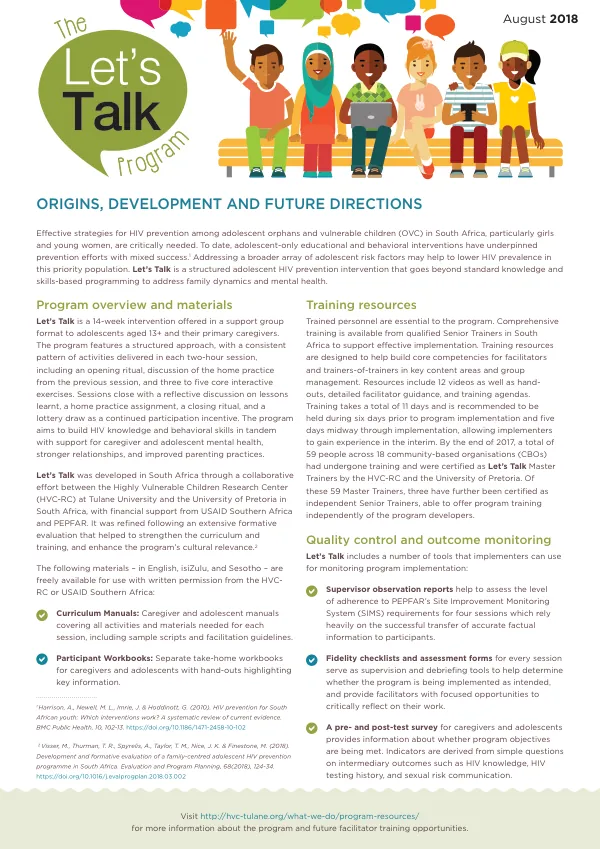
The highly vulnerable children research center at Tulane University School of Social Work, in collaboration with the University of Pretoria, developed a family-centered adolescent HIV prevention program called Let's Talk.
2018 · 10 pages
Sign in to readA free account is required to download.
Abstract
The program was designed to address individual HIV transmission risk factors common among orphaned and vulnerable adolescents in South Africa, including elevated risk for poor psychological health and sexual risk behavior. Key components of the program were adapted from evidence-based programs successfully implemented in the US and South Africa. Let's Talk is a structured, manualized HIV prevention intervention offered in a support group format to adolescents aged 13 and above and their primary caregivers. The program aims to build core HIV knowledge and behavioral skills in tandem with support for caregiver and adolescent mental health, stronger relationships, and improved parenting practices. Cognitive behavioral therapy-based components for adolescents and caregivers emphasize goal-setting, challenging negative thoughts, and problem-solving skills, as well as adolescent-caregiver communication and condom and sexual refusal negotiation. A pilot study of Let's Talk was conducted in Gauteng and Kwa-Zulu Natal provinces, South Africa, with 12 groups, each serving approximately 10 families. Face-to-face interviews were conducted among participating caregivers and adolescents at baseline and three months post-intervention to explore the potential effects of the program on intermediate outcomes that may support HIV preventive behavior. Specifically, generalized estimation equations were used to estimate average change on HIV prevention knowledge and self-efficacy, caregiver and adolescent mental health, and family dynamics. Among the 105 adolescents and their 95 caregivers who participated in Let's Talk and completed both surveys, statistically significant improvements were found for adolescents' HIV and condom use knowledge as well as condom negotiation self-efficacy, but not sexual refusal self-efficacy. Both caregivers and adolescents demonstrated significantly better mental health at post-test. Adolescent-caregiver connection and communication about healthy sexuality also improved. These preliminary results highlight the potential of HIV prevention interventions that engage caregivers alongside the vulnerable adolescents in their care to mitigate adolescent HIV risk factors. Growing evidence links poor mental health to HIV risk behaviors among young people in Sub-Saharan Africa, including higher numbers of sexual partners, inconsistent or low rates of condom use, transactional sex, and age-disparate sexual relationships. Caregiver mental health problems have also been associated with increased sexual risk behavior among adolescents in the US. These findings highlight the potential of HIV prevention interventions that provide psychological support to both adolescents and their caregivers. Engaging caregivers as co-participants also affords the opportunity to optimize other protective factors, including the quality of the caregiver-adolescent relationship and sexual health communication. A systematic review from the US concluded that parent-child connectedness, including communication about sexuality, predicts adolescent sexual and reproductive health outcomes. Similarly, research from sub-Saharan Africa suggests that the quality of the parent-adolescent relationship and parent-adolescent communication about sex are associated with lower sexual risk behavior among adolescents. The Let's Talk program was modeled on an existing evidence-based program for HIV-affected families in the US, Teenagers and Adults Learning to Communicate, with content also derived from evidence-informed HIV prevention and parenting curriculums in South Africa. This paper provides preliminary data on the program's potential effects on key intermediate outcomes that may support HIV prevention behavior in the target population.