USAID DEC
Caracterización Biofísica, Social y Cultural en el Marco de la Aplicación de la Ruta Declaratoria de Áreas Protegidas para el Distrito de Conservación de Suelos y Aguas del Caquetá
Sign inUSAID DEC
Caracterización Biofísica, Social y Cultural en el Marco de la Aplicación de la Ruta Declaratoria de Áreas Protegidas para el Distrito de Conservación de Suelos y Aguas del Caquetá
The Distrito de Conservación y Suelos del Caquetá (DCSAC) is a region located in the southern part of Colombia, spanning across the departments of Caquetá and Putumayo.
2018 · 37 pages
Sign in to readA free account is required to download.
Abstract
The area covers a total of 272,687 hectares and is bounded by the municipalities of Morelia, San José del Fragua, Belén de los Andaquíes, Montañita, Florencia, El Paujil, El Doncello, Puerto Rico, and San Vicente del Caguán. The region is characterized by a unique bio-physical environment, with a mix of tropical and subtropical climates, and a diverse range of ecosystems, including tropical rainforests, savannas, and cloud forests. The geology of the area is complex, with a history of tectonic activity that has shaped the landscape over millions of years. The region is characterized by a mix of igneous, metamorphic, and sedimentary rocks, including gneiss, granites, and sandstones. The terrain is rugged, with a mix of mountains, valleys, and plateaus, and is influenced by the presence of several major rivers, including the Caquetá and Putumayo rivers. The region is home to a diverse range of ecosystems, including tropical rainforests, savannas, and cloud forests. The tropical rainforests are characterized by a high level of biodiversity, with a mix of tree species, including mahogany, cedar, and kapok. The savannas are dominated by grasses and shrubs, and are home to a range of wildlife, including jaguars, pumas, and capybaras. The cloud forests are characterized by a high level of humidity and a mix of tree species, including bromeliads and orchids. The region is also home to a range of indigenous communities, including the Paez and the Andoque. These communities have a rich cultural heritage, with a mix of traditional practices and modern influences. The region is also home to a range of economic activities, including agriculture, mining, and tourism. The DCSAC is an important region for conservation, with a range of protected areas, including national parks, wildlife refuges, and indigenous reserves. The region is also home to a range of biodiversity hotspots, including the Caquetá and Putumayo rivers, which are home to a range of aquatic species, including dolphins, manatees, and caimans. The region is also characterized by a range of environmental challenges, including deforestation, habitat fragmentation, and climate change. These challenges have a range of impacts on the environment, including the loss of biodiversity, the degradation of ecosystems, and the displacement of indigenous communities. Overall, the DCSAC is a unique and complex region, with a rich cultural heritage and a diverse range of ecosystems. The region is home to a range of economic activities, including agriculture, mining, and tourism, and is an important region for conservation. However, the region is also characterized by a range of environmental challenges, including deforestation, habitat fragmentation, and climate change.
Related documents
Documents in this collection
 2014
2014USAID DEC
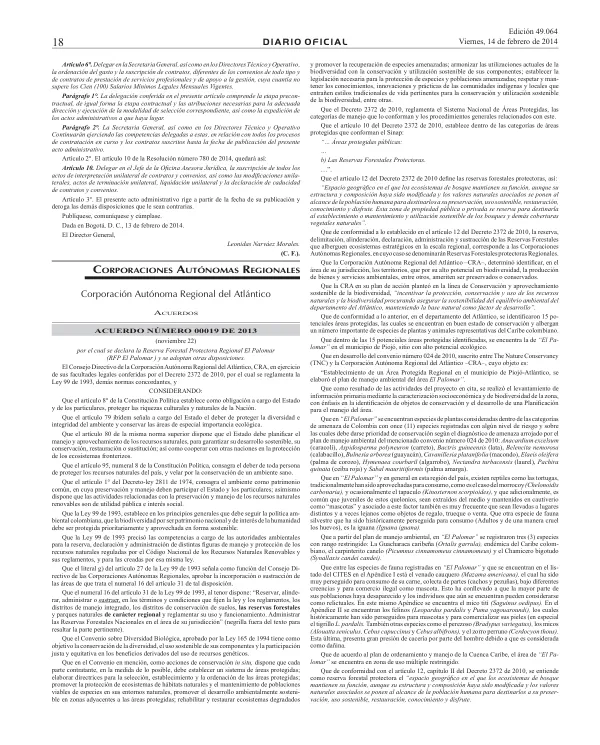
Acuerdo Número 00019 De 2013 Por El Cual Se Declara La Reserva Forestal Protectora Regional El Palomar (RFP El Palomar) Y Se Adoptan Otras Disposiciones
Open record 2020
2020USAID DEC