ECODIT, INC.
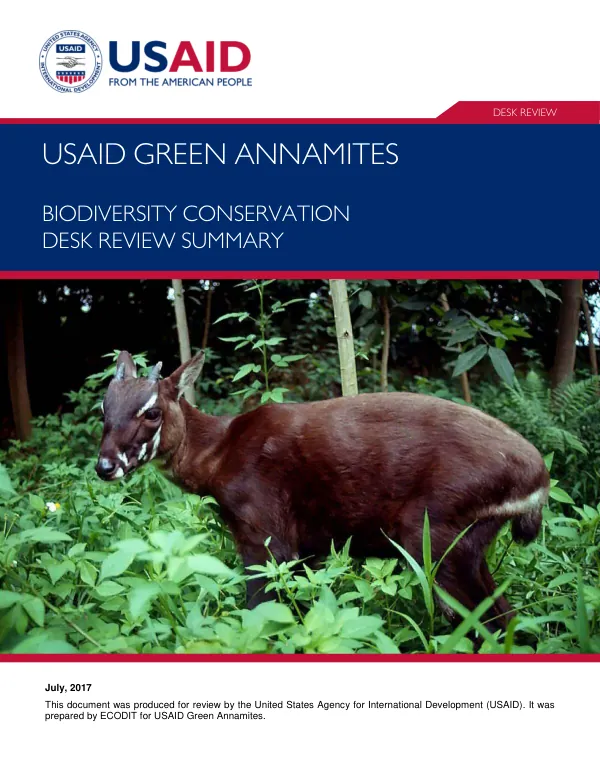
USAID Green Annamites - Biodiversity Conservation Desk Review
Forests play a critical role in Vietnam in protecting watersheds, preventing soil erosion, mitigating climate change, and building resilient communities.
2017 · 32 pages
Sign in to readA free account is required to download.
Abstract
Forests in the Annamites region of Vietnam are home to rare and endemic species found nowhere else in the world. Unfortunately, these forests and habitat areas are being depleted at an alarming rate due to destructive economic development activities such as shifting cultivation, unsustainable livelihood activities, and population pressure. The USAID Green Annamites project supports Vietnam's transition to climate-smart, low emission, and resilient development that protects the people, landscapes, and biodiversity of central Annamites, with a focus on Quang Nam and Thua Thien Hue provinces. The project aims to achieve three results: increased application of low emission land use, strengthened biodiversity conservation, and increased resilience for vulnerable communities. To achieve these results, the project will support the provinces of Quang Nam and Thua Thien Hue to conserve and enhance their carbon stocks, reduce or stop carbon emissions from deforestation, forest degradation, and unsustainable agricultural practices, and increase carbon sequestration from restoration of degraded landscapes. The project will also promote a landscape approach in biodiversity conservation, create alternative livelihoods for local communities to reduce negative impacts on biodiversity, and build capacity for key stakeholders. Vietnam is home to an amazing diversity of plants and animals, with approximately 275 mammal species, 826 bird species, 260 reptile species, 82 amphibian species, 500 freshwater fish species, 2,000 marine fish species, and 12,000 plant species identified. Many of these species are rare, valuable, endangered, and endemic. The need for conservation and rehabilitation of the natural environment was not recognized by the Vietnam government until the end of the 1970s, when the focus was on providing areas for settlement of war veterans, chemical detoxification, and reforestation. Currently, the system of terrestrial protected area in Vietnam has 180 protected areas, including 30 national parks, 58 biosphere reserves, 16 species and habitat conservation areas, 56 landscape protection areas, and 20 research and experiment areas, established under the Forest Development and Protection Law. The active establishment of new protected areas in Vietnam was part of the obligations under the UN Convention on Biological Diversity, with Vietnam committing to increase special use forest areas to 2 million ha and doubling the network of protected areas. Although there is an extensive network of PAs in Vietnam, these protected areas were selected in an ad hoc manner and are not a comprehensive representation of Vietnam habitats. In some protected areas, biodiversity representation is limited, such as semi-evergreen forest, while in others, biodiversity representation is overrepresented, such as the montane forests. Successful species-focused conservation interventions have been implemented, but metapopulation dynamics focusing on the integration of species into landscape-scale conservation has not been fully addressed. The USAID Green Annamites project will build adaptive capacity for GVN stakeholders, including the Department of Natural Resources and Environment, the Department of Agriculture and Rural Development, and key stakeholders from the private sector and civil society. The project will also promote a landscape approach in biodiversity conservation, create alternative livelihoods for local communities, and build capacity for key stakeholders. By achieving these results, the project will contribute to the conservation of biodiversity in the Annamites region and support Vietnam's transition to climate-smart, low emission, and resilient development.