CARE
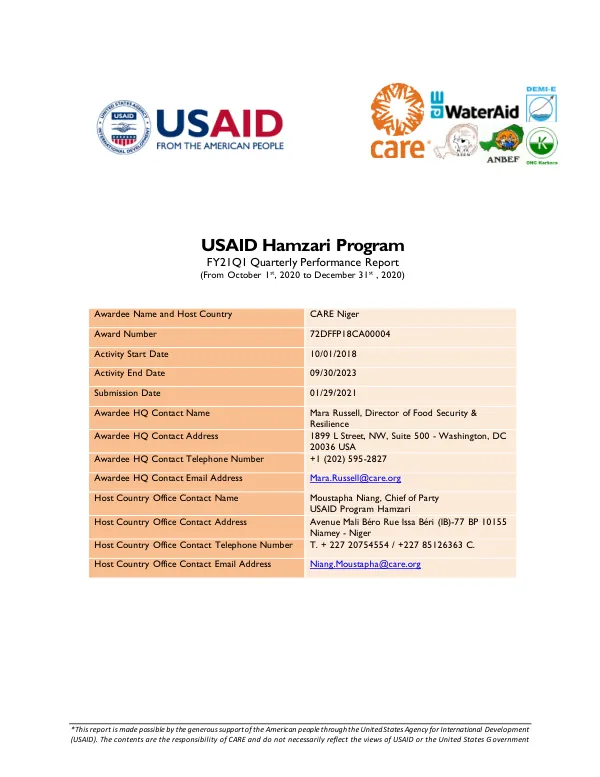
CARE Niger Hamzari - FY21Q1 Quarterly Performance Report
The Hamzari Program in Niger aims to achieve sustainable, equitable, and resilient food and nutrition security for vulnerable groups in the Maradi region.
2021 · 22 pages
Sign in to readA free account is required to download.
Abstract
The project targets all vulnerable households in three communes: Chadakori, Guidan Sori, and Guidan Roumdji in the Guidan Roumdji Department. The program's goal is to reduce extreme vulnerability for women, youth, and marginalized households in Maradi. The program consists of four purposes: (1) reducing extreme vulnerability, (2) improving nutritional status among children under 5 years of age, adolescent girls, and women of reproductive age, (3) improving access and use of equitable and sustainable WASH services, and (4) enhancing sustainable diversified livelihood opportunities for poor women, youth, and other vulnerable groups. The program has several sub-purposes, including increasing social capital and resilience within, between, and beyond communities, improving optimal maternal, infant, and young child feeding and reproductive maternal, newborn, child, and adolescent health practices, reducing disease due to fecal-oral transmission, and increasing access to water for women, youth, disabled, and vulnerable households. The program targets a total of 32,000 unique direct participant households, with a breakdown by program element and fiscal year. The roles and responsibilities of the program partners include technical leadership, financial management, monitoring, evaluation, and learning, sub-recipient management, and compliance with donor procedures and U.S. Government regulations. The program's geographic focus is on the Maradi region, with a specific emphasis on the communes of Chadakori, Guidan Sori, and Guidan Roumdji. The program's time frame is from October 1, 2018, to September 30, 2023. The program's quarterly performance report for FY21Q1 highlights the progress made during the quarter, including the implementation of technical activities, program management, partnerships, collaborations, and linkages. The report also discusses the challenges faced during the quarter and the lessons learned. The program's technical partners include WaterAid, Karkara, AREN, ANBEF, and DEMI-E, each responsible for leading specific aspects of the program. CARE Niger is the consortium lead and is accountable for overall program coordination and accomplishments. The overall security situation in the Nigerian border region is improving due to a more substantial presence of security forces. This improvement has created an environment conducive to the implementation of the Hamzari Program, which aims to achieve sustainable, equitable, and resilient food and nutrition security for vulnerable groups in the Maradi region. The program's implementation is focused on several key areas, including the development of self-governing collectives and platforms, the increase of absorptive and adaptive capacity, and the improvement of nutritional status among children under 5 years of age, adolescent girls, and women of reproductive age. The program also aims to improve access and use of equitable and sustainable WASH services and enhance sustainable diversified livelihood opportunities for poor women, youth, and other vulnerable groups. The program's technical partners are working together to implement the program's objectives, with CARE Niger serving as the consortium lead and accountable for overall program coordination and accomplishments. The program's quarterly performance report provides an update on the progress made during the quarter and highlights the challenges faced and lessons learned. The Hamzari Program is making progress in achieving its objectives, with a focus on improving the lives of vulnerable groups in the Maradi region. The program's quarterly performance report highlights the progress made during the quarter and provides an update on the challenges faced and lessons learned.
Related documents