USAID
Checklist for Assessing the Evaluation Context
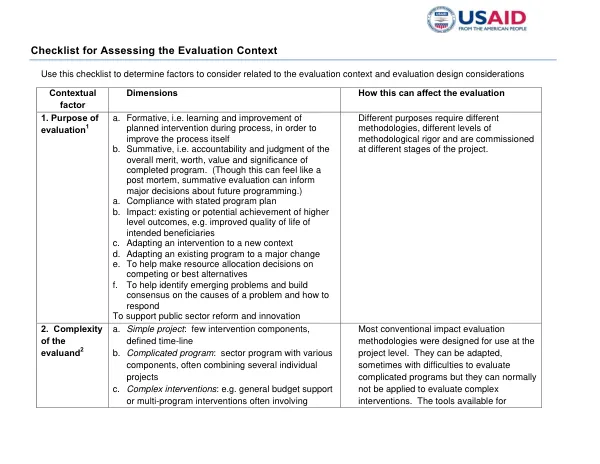
The checklist for assessing the evaluation context is a comprehensive framework for evaluating the suitability of an evaluation design for a particular project or program.
2011 · 4 pages
Sign in to readA free account is required to download.
Abstract
The framework considers various contextual factors that can influence the evaluation, including the purpose of the evaluation, the complexity of the evaluand, the local and national context, the level of the intervention, the scale of the intervention, the size of the evaluation budget, and the timing of the evaluation. The purpose of the evaluation is a critical factor in determining the evaluation design. Evaluations can be formative, aimed at improving the process of a planned intervention, or summative, aimed at assessing the overall merit and worth of a completed program. Different purposes require different methodologies, levels of methodological rigor, and are commissioned at different stages of the project. The complexity of the evaluand is another important factor to consider. Simple projects with few intervention components and a defined timeline can be evaluated using conventional impact evaluation methodologies. However, complicated programs with multiple components and complex interventions require more sophisticated evaluation designs. Complex interventions, such as general budget support or multi-program interventions, often involve multiple stakeholders and require specialized evaluation tools. The local and national context within which the evaluation will be implemented is also crucial. Economic, political, policy, and administrative contexts can all impact project outcomes and impacts. Contextual analysis should be a part of the evaluation design to ensure that the evaluation is relevant and effective. The level of the intervention is another factor to consider. Evaluations can be conducted at the local community level, program or sector level, multi-national or regional level, national level, or sub-national region level. The higher the level of the intervention, the more complex and often less precise the evaluation design. The scale of the intervention is also important. Small-scale interventions with fewer than 5,000 individuals or households can be evaluated using simple methodologies, while larger-scale interventions require more sophisticated designs. The size of the evaluation budget is also a critical factor, as small budgets can limit the sample size and precision of statistical estimates. The timing of the evaluation is another important consideration. Evaluations can be commissioned at the start of the intervention, mid-term, end of the intervention, or after the intervention has been completed. The later the evaluation is commissioned, the more limited the range of evaluation design options. The client who commissions the evaluation also plays a significant role in determining the evaluation design. Donor agencies, planning ministries, implementing agencies, civil society organizations, and other stakeholders can all influence the evaluation questions, methodology, and timing. Finally, the agency that conducts the evaluation can also impact the design. Internal evaluators, central government agencies, external consultants, donor agencies, and NGOs can all have different focuses and purposes, and may recommend or use different evaluation methodologies. Overall, the checklist for assessing the evaluation context provides a comprehensive framework for evaluating the suitability of an evaluation design for a particular project or program. By considering these various contextual factors, evaluators can ensure that their evaluation design is relevant, effective, and meets the needs of the project or program.