USAID DEC
Christmas tree worms of Indo-Pacific coral reefs: untangling the Spirobranchus corniculatus (Grube, 1862) complex
Sign inUSAID DEC
Christmas tree worms of Indo-Pacific coral reefs: untangling the Spirobranchus corniculatus (Grube, 1862) complex
The Spirobranchus corniculatus complex is a group of colorful serpulid polychaetes from the genus Spirobranchus that are symbionts of hermatypic corals.
2015 · 6 pages
Sign in to readA free account is required to download.
Abstract
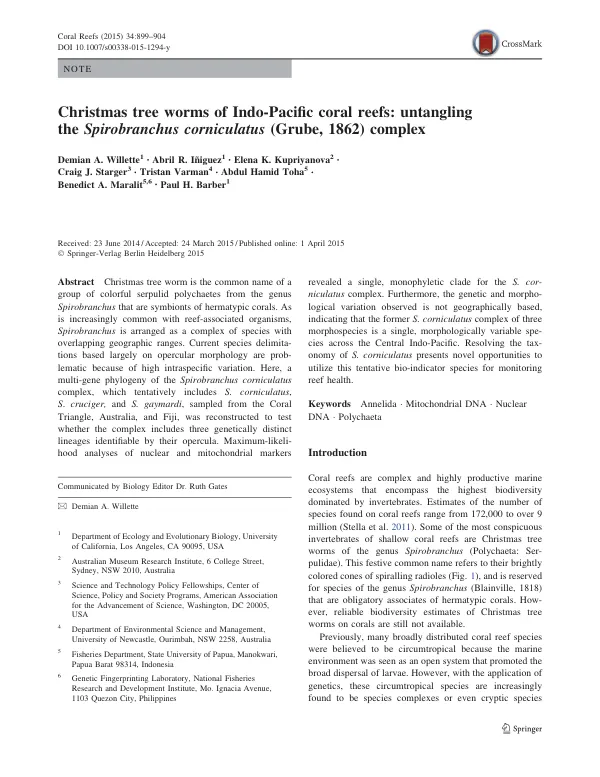
These organisms are commonly referred to as Christmas tree worms due to their brightly colored cones of spiraling radioles. The complex includes species such as Spirobranchus corniculatus, S. cruciger, and S. gaymardi, which are distinguished morphologically by the number and shape of spines on their opercula. Previous studies have suggested that the Indo-Pacific specimens of Spirobranchus giganteus are a subspecies, S. giganteus corniculatus, which is a complex of at least three full species. However, the use of DNA sequence data has led to significant changes in our understanding of species diversity. A multi-locus genetic study was conducted to determine whether the S. corniculatus complex is a single, widely distributed species or includes three full species. Specimens were collected from the Central Indo-Pacific in Australia, Fiji, Indonesia, and the Philippines. A total of 90 Spirobranchus specimens were sampled from eight locations, with approximately 57% identified as S. gaymardi, 22% as S. cruciger, and 21% as S. corniculatus. The geographic distribution of morphospecies was not partitioned based on locality, indicating that the genetic and morphological variation observed is not geographically based. Maximum-likelihood analyses of nuclear and mitochondrial markers revealed a single, monophyletic clade for the S. corniculatus complex. This suggests that the former S. corniculatus complex of three morphospecies is a single, morphologically variable species across the Central Indo-Pacific. The use of DNA sequence data has resolved the taxonomy of S. corniculatus, presenting novel opportunities to utilize this species as a bio-indicator for monitoring reef health. The study used a multi-locus genetic approach, including the cytochrome oxidase b (Cyt-b) gene, the 18S nuclear rDNA region, and the ITS2 nuclear rDNA region. A total of 339 bp, 1670 bp, and 628 bp fragments were amplified, respectively, and sequenced using dye terminator sequencing. The sequences were assembled, aligned, and deposited in GenBank. The results demonstrate minimal heterogeneity between alleles within a given morphospecies, indicating that the genetic variation observed is not geographically based. The findings of this study have significant implications for our understanding of species diversity and the taxonomy of Spirobranchus. The results suggest that the S. corniculatus complex is a single, morphologically variable species across the Central Indo-Pacific, and that the use of DNA sequence data has resolved the taxonomy of this species. This study highlights the importance of using genetic data to resolve species boundaries and to understand the evolutionary relationships between species.
Related documents
Documents in this collection
 2021
2021USAID DEC
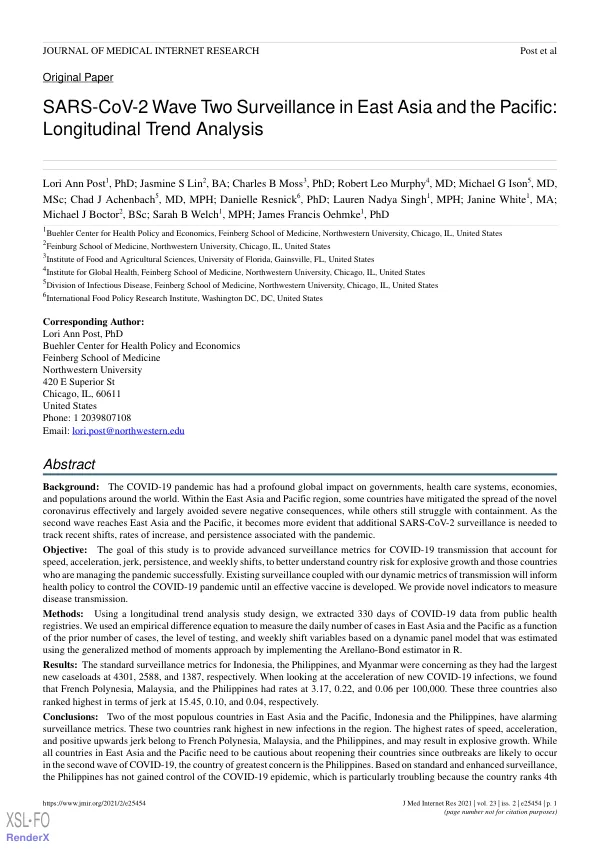
SARS-CoV-2 Wave Two Surveillance in East Asia and the Pacific: Longitudinal Trend Analysis
Open record 2024
2024USAID DEC