GOVERNMENT OF THE REPUBLIC OF ZAMBIA
Climate Change Adaptation in ZAMBIA
Climate change is already affecting Zambia, with projected impacts including rises in temperature, shifts in precipitation, and possible increases in the frequency and intensity of weather events.
2012 · 4 pages
Sign in to readA free account is required to download.
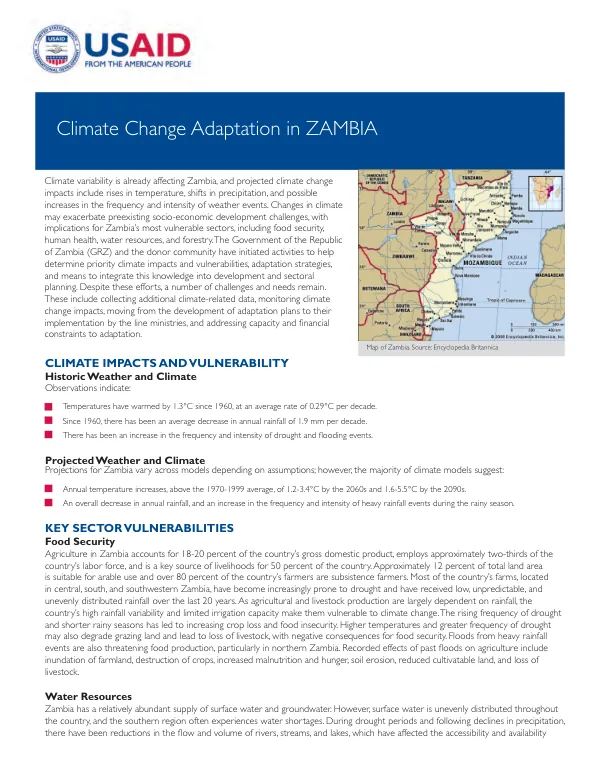
Abstract
These changes may exacerbate preexisting socio-economic development challenges, with implications for Zambia's most vulnerable sectors, including food security, human health, water resources, and forestry. Temperatures in Zambia have warmed by 1.3°C since 1960, at an average rate of 0.29°C per decade. There has been an average decrease in annual rainfall of 1.9 mm per decade, and an increase in the frequency and intensity of drought and flooding events. Projections for Zambia vary across models, but the majority suggest annual temperature increases of 1.2-3.4°C by the 2060s and 1.6-5.5°C by the 2090s, as well as a decrease in annual rainfall and an increase in the frequency and intensity of heavy rainfall events during the rainy season. Agriculture in Zambia accounts for 18-20 percent of the country's gross domestic product and employs approximately two-thirds of the country's labor force. The sector is vulnerable to climate change due to its dependence on rainfall, with the rising frequency of drought and shorter rainy seasons leading to increasing crop loss and food insecurity. Higher temperatures and greater frequency of drought may also degrade grazing land and lead to loss of livestock, with negative consequences for food security. Floods from heavy rainfall events are also threatening food production, particularly in northern Zambia. Zambia has a relatively abundant supply of surface water and groundwater, but surface water is unevenly distributed throughout the country, and the southern region often experiences water shortages. Reduced access and availability of water resources impact hydroelectric power, drinking water, agriculture, livestock rearing, and fisheries. Rising temperatures can increase the rate of evapotranspiration, and heavy rainfall and flooding events can increase siltation of water sources and carry pollutants, contaminating water sources and exacerbating health and sanitation problems. Climate variability has already begun to affect health in Zambia, and climate change is likely to directly and indirectly exacerbate current impacts. Climate-sensitive diseases that have persistently increased mortality and morbidity rates in urban and rural Zambia include malaria, diarrhea, cholera, and respiratory infections, with malaria having the highest rate of incidence. Increases in heavy rainfall events and rising temperatures may facilitate mosquito breeding, exposing more of the Zambian population to the disease. Zambia's grasslands and forests are of ecological, economic, and social importance, especially for rural populations. They provide food, fodder, fuel, and medicinal products to communities dependent on them for their health and livelihoods. Warmer temperatures, drought, and declines in precipitation may lead to a loss of vegetation and soil degradation, higher incidence of forest fires, and introduction of pests and pathogens that can impact tree growth and survival. More intense rainfall and flooding events can cause land and soil erosion. The Department of Environment and Natural Resources, under the Ministry of Tourism, Environment and Natural Resources (MTENR), is the climate change focal point under the United Nations Framework Convention on Climate Change. The National Adaptation Programme of Action (NAPA) identifies sectors most vulnerable to climate change and recommends relevant stakeholders, policies, programs, and projects to address the impacts of climate variability and change in the country. The National Climate Change Response Strategy (NCCRS) provides a comprehensive national institutional and implementation framework for climate change adaptation, mitigation, technology, financing, public education, and awareness-related activities in Zambia.
Related documents
Documents in this collection
 2012
2012USAID DEC
Climate Change Impact on Agricultural Production and Adaptation Strategies: Farmers’ Perception and Experiences Summary Results of Focus Group Interviews in Zambia, 2012
Open record 2012
2012USAID DEC