USAID DEC
Climate Change Vulnerability and Adaptation in East Africa
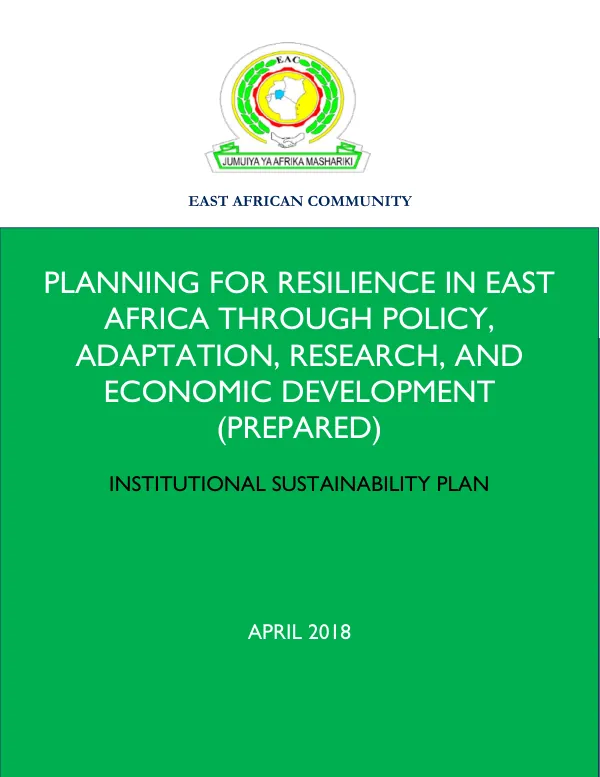
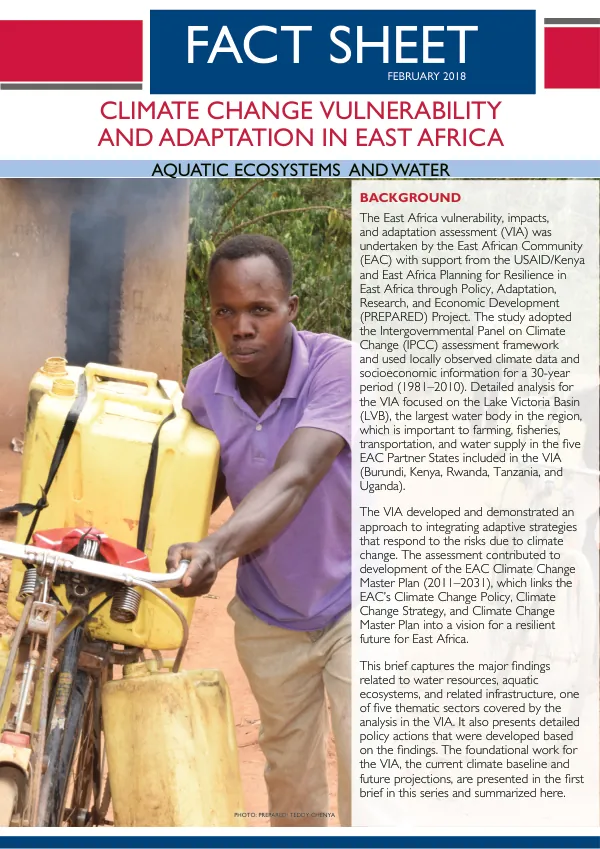
The East Africa vulnerability, impacts, and adaptation assessment (VIA) was undertaken by the East African Community (EAC) with support from the USAID/Kenya and East Africa Planning for Resilience in East Africa through Policy, Adaptation, Research, and Economic Development (PREPARED) Project.
2018 · 4 pages
Sign in to readA free account is required to download.
Abstract
The study adopted the Intergovernmental Panel on Climate Change (IPCC) assessment framework and used locally observed climate data and socioeconomic information for a 30-year period (1981–2010). Detailed analysis for the VIA focused on the Lake Victoria Basin (LVB), the largest water body in the region, which is important to farming, fisheries, transportation, and water supply in the five EAC Partner States included in the VIA (Burundi, Kenya, Rwanda, Tanzania, and Uganda). The VIA developed and demonstrated an approach to integrating adaptive strategies that respond to the risks due to climate change. The assessment contributed to the development of the EAC Climate Change Master Plan (2011–2031), which links the EAC’s Climate Change Policy, Climate Change Strategy, and Climate Change Master Plan into a vision for a resilient future for East Africa. This brief captures the major findings related to water resources, aquatic ecosystems, and related infrastructure, one of five thematic sectors covered by the analysis in the VIA. Data from 1981–2010 indicate a large variance in average annual rainfall variability across the region, with higher variability in the long rains of March-June (MAMJ). In aggregate, the patterns in monthly rainfall suggest that the short rains of October–December (OND) have increased, and the long rains have decreased in the LVB over most of the past century. Overall, rainfall has been declining 20–100 millimeters every 10 years and drier periods are getting longer and more pronounced during the long rains. Wet and dry periods have occurred in distinct 10-year cycles. With regard to surface temperatures, data for 1930–2016 indicate that the average monthly maximum temperature over the LVB has increased +0.7°C to +1.2°C and the average monthly minimum has increased +1.0°C to +1.1°C. The VIA projections for changes in rainfall and mean surface temperature for 2030, 2050, and 2070 are based on historical and downscaled future scenarios for maximum and minimum temperature data for scenarios representing low, mid, and high levels of emissions and concentrations (RCP2.6, RCP4.5, and RCP8.5). Generally, rainfall is projected to increase over East Africa under all future scenarios except for the June–September (JJAS) period in 2020. Mean annual maximum surface temperature projections increase 1.0°C to 2.0°C over most of the EAC by 2030. The projected warming will be greatest in March–May (MAM) and JJAS and least in October–December (OND). If no mitigating actions are taken, maximum daily temperatures are expected to increase 2.5°C to 3.5°C by 2050. Projections also indicate that East Africa can expect that rainfall and temperature events will become more extreme, episodic, and intense. East Africa is endowed with significant freshwater resources, including major rivers and lakes, one of which is Lake Victoria, the largest shared water resource in the region. The region has a total renewable water volume of 187 cubic kilometers per year. Other water resources include groundwater, riverine flows, and lacustrine swamps. These resources support most of the productive sectors in the EAC, including agriculture (both irrigated and rain-fed), livestock, and fisheries; they also provide water for domestic and commercial uses as well as supporting wildlife and a wealth of aquatic and terrestrial biodiversity. Climate change, climate variability, and socioeconomic conditions have combined to impose significant pressures on water availability, water accessibility, and water demand in the EAC. It is projected that this will aggravate the water stress currently faced by Burundi, Kenya, and Rwanda, while Tanzania and Uganda, which are not water stressed now will become so in the future. While water resources are finite, its use has continued to increase exponentially in the region. In part this is due to population pressure: over the last century populations in the EAC have increased rapidly (3.0–3.5 percent annually). This is most evident in the LVB, where population more than doubled between 1980 and 2015. Meanwhile the water resource has remained largely unchanged. Kenya, for example, is in a precarious situation, having about 681 cubic meters of water per capita per year, which compares poorly with the globally recommended 1,000 cubic meters per capita per year. Population projections indicate that per capita water availability will decline to 235 cubic meters by 2025. Rwanda and Burundi face similarly severe water scarcity now and in the future. Across the region, 75 percent of the rural population already lacks access to safe drinking water. The Lake Victoria Basin