USAID DEC
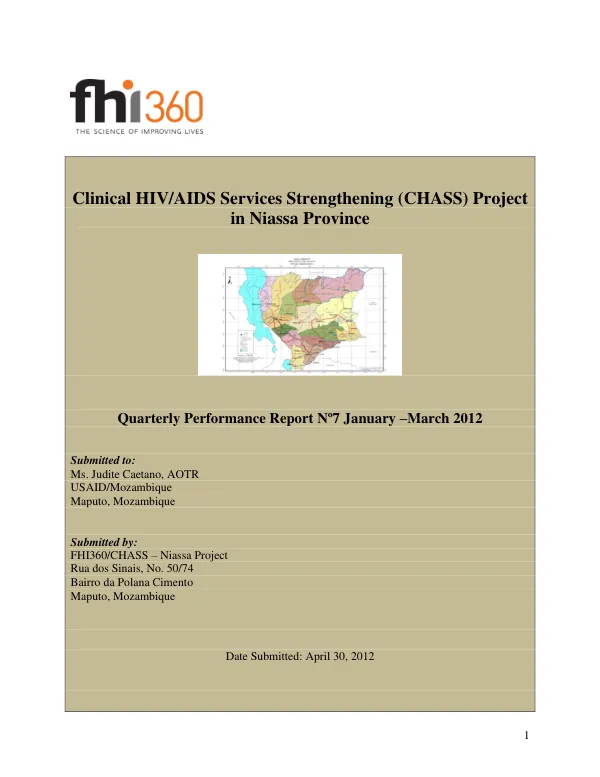
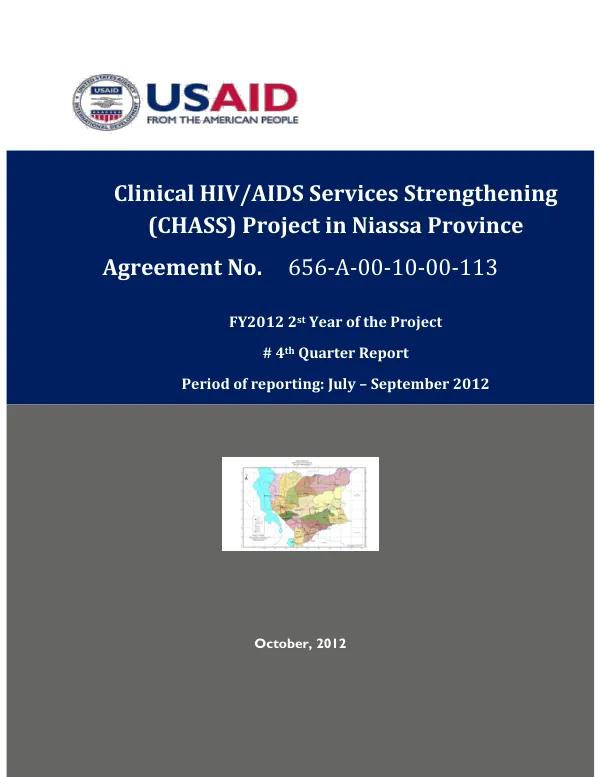
Clinical HIV/AIDS Services Strengthening (CHASS) Project in Niassa Province 4th Quarter Report FY2012
Sign inABT ASSOCIATES
Clinical HIV/AIDS Services Strengthening (CHASS) Project in Niassa Province 4th Quarter Report FY2012
The Clinical HIV/AIDS Services Strengthening (CHASS) Project in Niassa Province is a five-year initiative implemented by Family Health International (FHI 360) in partnership with Abt Associates and Food for the Hungry.
2012 · 32 pages
Sign in to readA free account is required to download.
Abstract
The project aims to strengthen the provincial health system and enhance the capacity of the District Public Health System (DPS) to manage its own health systems and finances. The project's objectives are to increase access, quality, and use of HIV care and treatment services to rural communities, provide a continuum of accessible HIV and related primary health care services, and support stronger and more sustainable Mozambican systems and institutions. The project focuses on seven areas: clinical treatment, laboratory services, prevention of mother-to-child transmission (PMTCT), adult care and treatment, pediatric care and treatment, palliative care, and prevention, diagnosis, and treatment of HIV-TB co-infection. Technical assistance is provided through continuing trainings, in-service training, mentoring, leading clinical seminars, pre-service trainings, and joint technical support visits (TSV). The TSV approach enables skills transfers, greater internalization, and greater chance of long-term sustainability of TSV activities. Quality Improvement activities are well integrated in the province through CLINIQUAL expansion to all ART sites. The Provincial Committee for Quality Management is working to build the capacity of District health facilities staff in quality management, supervise data collection, and the QI activities at the District and facility levels. The project is also collaborating with FANTA III in the implementation of a pilot QI of the nutrition services of PRN in Cuamba, Lichinga, and Muembe. Decentralized health facility and community modalities have been implemented to reduce the burden on health workers and health facilities and to improve retention in care for those on ART. The project supported the DPS effort to decentralize ARV treatment from the Rural Hospital to the Cuamba Health Center. One hundred and fifty-one HIV patients were transferred from the Rural Hospital of Cuamba to the health center, and a total of 165 HIV patients (66 are TB/HIV patients) are now receiving treatment at the Cuamba health center. The project is collaborating with the DPS in the implementation of the best mechanism for coordinating care across settings and promoting the elaboration of standard operating plans for information flow. Standardization of such a tool eliminates the need to re-enter data into the medical record at each setting, thereby reducing the potential for error and improving efficiency. The project is promoting the use of FHI360 universal transfer forms to manage care referrals from and to health facilities and the community. Monthly meetings of the HIV Positive Support Groups designated as Chá+ (chá positivo) expanded and continued to be successful. The project is working towards expanding these groups to all ART sites, as well as involving PLHIV to be active participants in the project. The project is also promoting the use of FHI360 universal transfer forms to manage care referrals from and to health facilities and the community. The project has witnessed significant progress in the systematic provision of technical assistance across 45 sites. The CHASS clinical team continues to provide technical support in the 21 supported ART sites, 14 TB/HIV sites, and 45 PMTCT sites. The project is working closely with the DPS/SDSMAS to develop mechanisms to promote early initiation of treatment. The pre-ART care period is divided into three stages, and patients can be lost (die, discontinue, or be lost to follow-up) in any stage.
Related documents