ABT ASSOCIATES
Year Two Work Plan Narrative: Efficiencies for Clinical HIV Outcomes (ECHO)
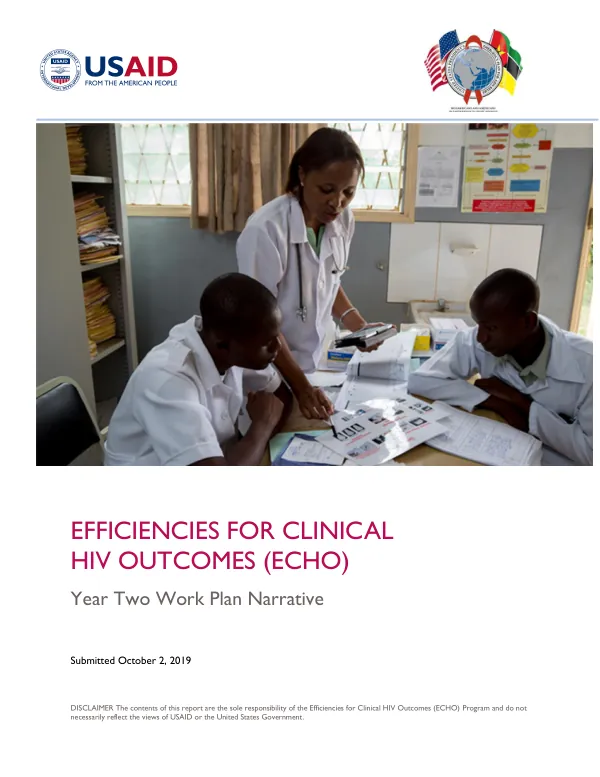
The Efficiencies for Clinical HIV Outcomes (ECHO) program is a USAID-funded initiative aimed at supporting the Government of Mozambique's achievement of HIV/AIDS epidemic control by 2024.
2019 · 98 pages
Sign in to readA free account is required to download.
Abstract
The program is implemented by Abt Associates in association with several partner organizations. The ECHO Activity is focused on provinces where USAID is the primary clinical support partner. The ECHO approach is based on several key principles, including strategic deployment of resources, integration of services, and community engagement. The program's strategic deployment of resources involves categorizing sites into different levels of support based on their needs and capacity. This approach enables the program to target its resources effectively and maximize its impact. In Year 2, the ECHO program will focus on several key activities, including the implementation of Pre-Exposure Prophylaxis (PrEP), HIV Testing Services (HTS), and Prevention of Mother-to-Child Transmission (PMTCT) and Early Infant Diagnosis (EID). The program will also work to strengthen retention in care and treatment, integrate TB and HIV care, and address gender-based violence. Additionally, the program will engage men and boys, work with key populations, and implement cervical cancer screening and prevention activities. The ECHO program will also focus on optimizing systems for viral load and other laboratory diagnostics, as well as pharmacy, supply chain, and logistics systems. The program will also work to strengthen information systems, build capacity, and transition to local partners. Community delivery of HIV services will also be a key focus area for the program. Monitoring, evaluation, and learning will be critical components of the ECHO program. The program will collect and report baseline and routine data, integrate systems and dashboards, and conduct data analysis. The program will also prioritize data quality and evaluation and learning activities. The ECHO program will be managed through a project management framework that includes project orientation and team building, quarterly project review meetings, and international travel planning. The program will also track its performance indicators through a performance indicator tracking table. The ECHO program has made significant progress in its first year, including the implementation of HTS and PMTCT/EID activities. The program has also established a strong presence in the provinces of Manica, Tete, and Niassa. The program's early results in these provinces have shown promising trends, including increased HTS positivity and yield, and improved retention rates for children and adolescents. Overall, the ECHO program is well-positioned to make a significant impact in Mozambique's fight against HIV/AIDS. The program's focus on strategic deployment of resources, integration of services, and community engagement will enable it to target its resources effectively and maximize its impact.
Related documents