USAID DEC
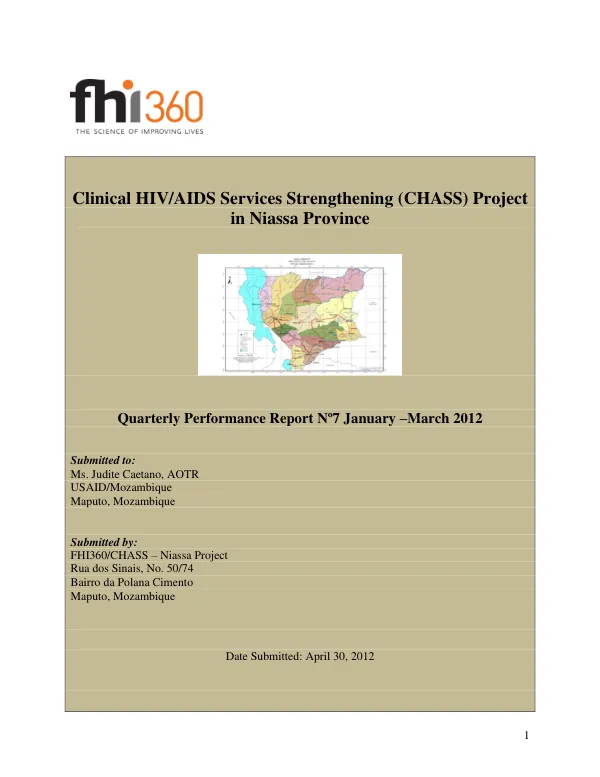
Quarterly Performance Report Nº7 January –March 2012: Clinical HIV/AIDS Services Strengthening (CHASS) Project in Niassa Province
Sign inABT ASSOCIATES
Quarterly Performance Report Nº7 January –March 2012: Clinical HIV/AIDS Services Strengthening (CHASS) Project in Niassa Province
The Clinical HIV/AIDS Services Strengthening (CHASS) Project in Niassa Province is a five-year initiative supporting the expansion of HIV/AIDS prevention, care, and support activities and capacity building in Niassa, Mozambique.
2012 · 41 pages
Sign in to readA free account is required to download.
Abstract
The project is implemented by Family Health International (FHI 360) in partnership with Abt Associates and Food for the Hungry (FH). CHASS/Niassa's goal is to strengthen the provincial health system and enhance DPS capacity to manage its own health systems and finances, increase human resources for health, improve quality and use of strategic information, strengthen local organizations, and align with national priorities and plans. The project's objectives are to increase access, quality, and use of HIV care and treatment services to rural communities by intervention in seven areas: counseling and testing, laboratory services, PMTCT, adult care and treatment, pediatric care and treatment, palliative care, and prevention, diagnosis, and treatment of HIV-TB co-infection. Additionally, the project aims to provide a continuum of accessible HIV and related primary health care services, including MCH and RH services, and to improve linkages and referrals within and between facilities and communities. During the reporting period from January to March 2012, the CHASS project made significant strides in meeting program objectives and targets to support clinical and community services in fourteen districts of Niassa province, covering 45 health facilities. Key services receiving ongoing technical support include pharmacy, laboratory, TB/HIV services in 14 sites, ART available in 21 sites, and HCT, PMTCT in 45 sites. The CHASS project has achieved notable successes, including increased access to ART services, with 591 new individuals initiated on ART, and a total of 5,920 individuals on treatment in the 21 CHASS ART-supported sites, reaching 88% of the annual target. The project collaborated with CMAM to build local capacity to forecast need, procurement, and supply of essential AIDS medicines. The CHASS project also introduced a partially integrated model in 14 ART sites where TB and ART clinics exist, and the MOH approved the expansion of delivery of ART services by delegating clinical care functions to lower-level health workers. Furthermore, the project expanded the new strategy to incorporate men into antenatal HIV counseling and testing (ANC), with 1,603 partners invited to accompany their spouses/partners to an ANC/PMTCT service, and 2,642 male partners participating from October 2011 to March 2012, surpassing the annual target by 119%. Community Case Managers (CCMs) continued to have success in locating patients lost to follow-up, referring 976 individuals from community to health facilities, and from the total referred, 469 (48%) arrived and received services at the health center. From the health facilities, the CCMs received a list of 948 patients lost-to-follow-up patients, out of which 627 (66%) were found by CCMs and 557 (59%) have re-initiated treatment.