GLOBAL COMMUNITIES
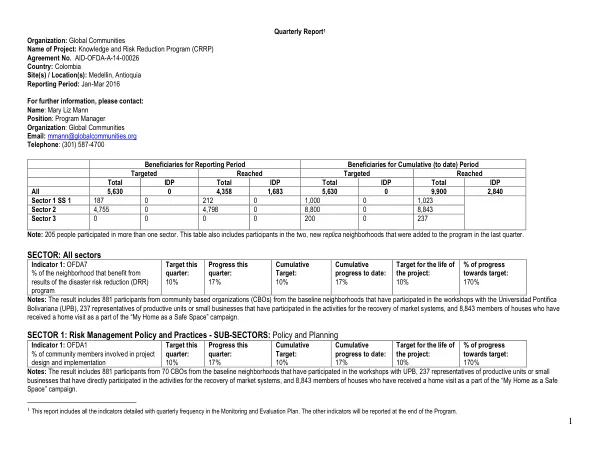
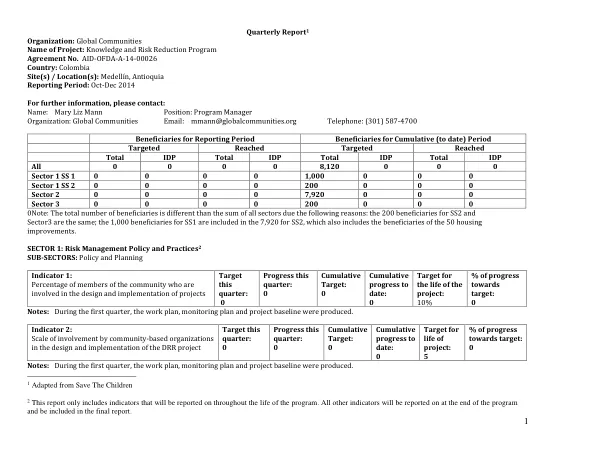
Colombia - CRRP - Jan-March 2015 Quarterly Report
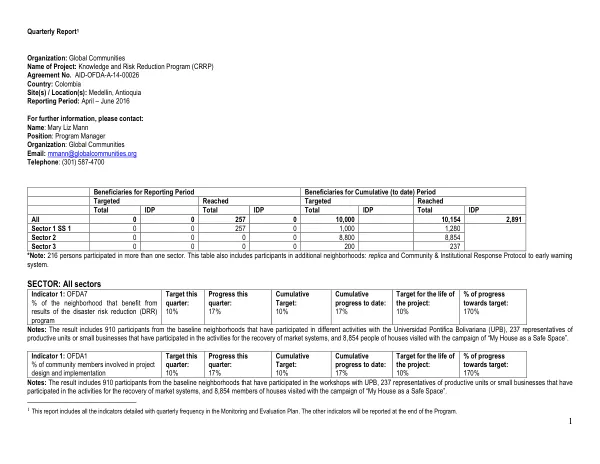
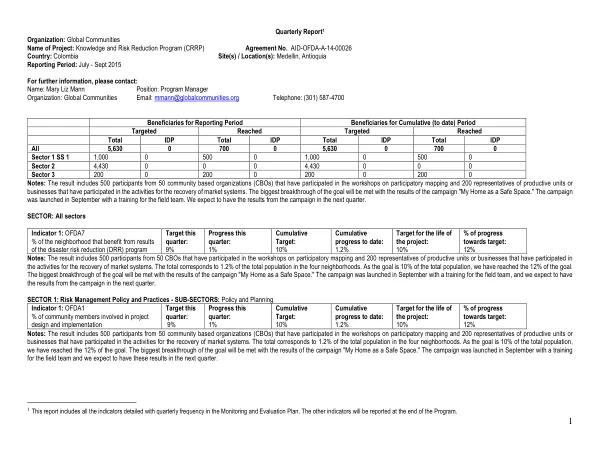
The Knowledge and Risk Reduction Program (CRRP) in Medellin, Colombia, aims to reduce disaster risk and promote community resilience.
2016 · 5 pages
Sign in to readA free account is required to download.
Abstract
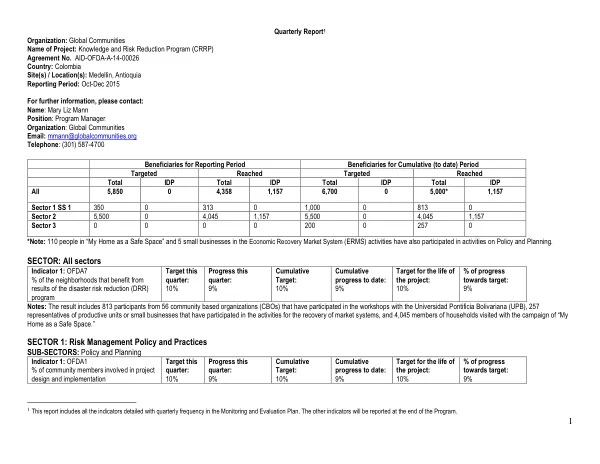
The program is implemented by Global Communities, with funding from the United States Agency for International Development (USAID). The program's primary focus is on disaster risk reduction, with a specific emphasis on community-based initiatives. The program's methodology involves engaging community members in the design and implementation of disaster risk reduction strategies. This is achieved through participatory planning workshops, where community members work together to identify hazards, develop plans, and implement corrective measures. The program also focuses on building partnerships with local government institutions, community-based organizations, and private sector entities to leverage resources and expertise. The program's geographic focus is on the city of Medellin, with a specific emphasis on the neighborhoods of Santa Margarita-Commune 7 and Belalcazar-Commune 5. The program's target population includes vulnerable groups such as women, youth, elderly, and persons with disabilities. The program's implementation details include the establishment of community-based organizations (CBOs) to facilitate community engagement and participation. The program also involves the development of Neighborhood DRR Plans, which are designed to identify hazards, develop corrective measures, and promote community resilience. The program's key findings and conclusions include the following: * The program has engaged 813 community members in participatory planning workshops, with 75% of participants being women. * The program has established partnerships with 56 CBOs, 15 private sector institutions, and 8 public sector institutions. * The program has reached 100% of small businesses and 50% of private sector institutions through public-private partnerships. * The program has trained 169 members of 18 CBOs on the contents of the "My Home as a Safe Space" booklet. The program's recommendations include the following: * Continue to engage community members in participatory planning workshops to develop Neighborhood DRR Plans. * Strengthen partnerships with local government institutions, community-based organizations, and private sector entities to leverage resources and expertise. * Expand the program to new neighborhoods and communities to promote community resilience and disaster risk reduction. The program's timeframes include the following: * The program is expected to run for a period of 24 months, with quarterly reporting. * The program's midterm evaluation is scheduled for the first quarter of 2016. * The program's final evaluation is scheduled for the end of the project period.