GLOBAL COMMUNITIES
Colombia CRRP FY2016Q2 Quarterly Report Jan-Mar 2016
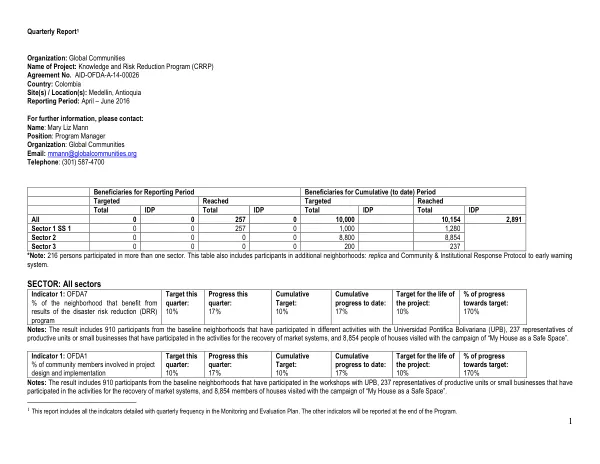
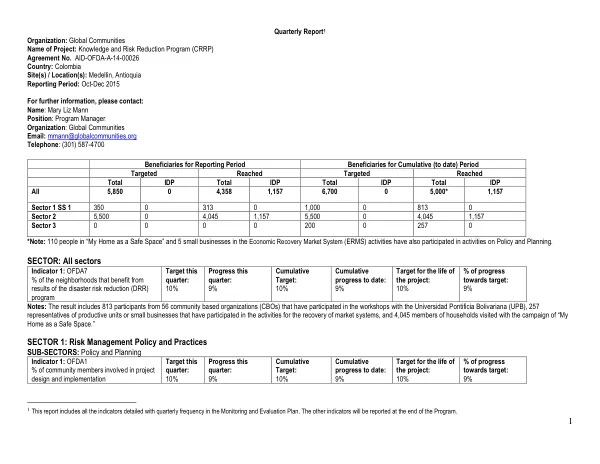
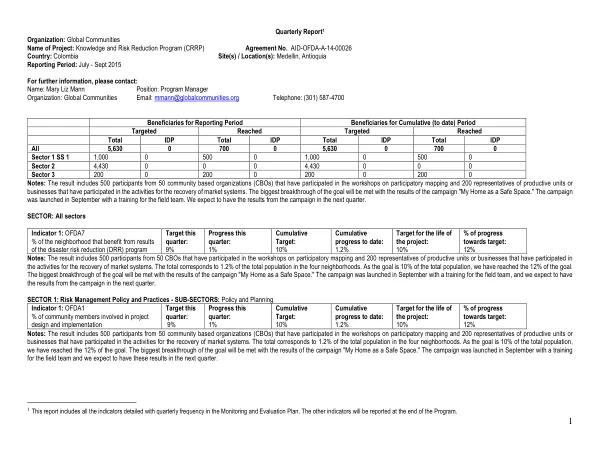
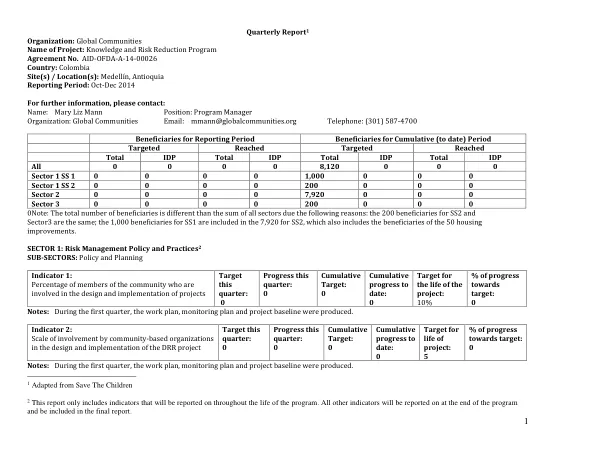
The Knowledge and Risk Reduction Program (CRRP) in Medellin, Colombia, is a project implemented by Global Communities under Agreement No.
2016 · 5 pages
Sign in to readA free account is required to download.
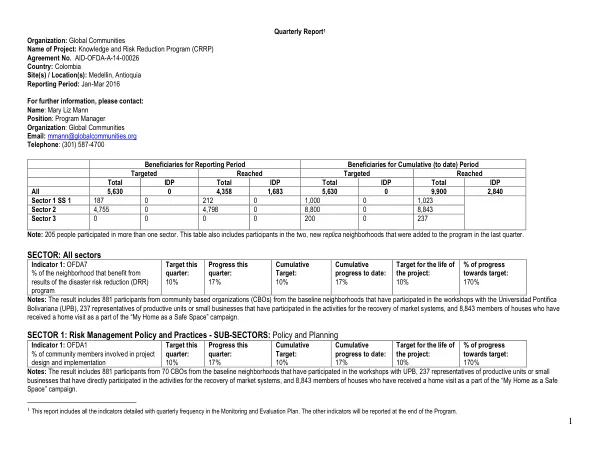
Abstract
AID-OFDA-A-14-00026. The program aims to reduce disaster risk and promote community resilience in the target area. The reporting period for this quarterly report is January to March 2016. During this quarter, the program reached a total of 4,358 beneficiaries, with 1,683 identified as internally displaced persons (IDPs). The cumulative total of beneficiaries reached to date is 5,630, with 0 IDPs. The program has also engaged 1,023 community members in various activities, including 237 representatives of productive units or small businesses. The program has made significant progress in achieving its targets, particularly in Sector 1: Risk Management Policy and Practices. In the sub-sector of Policy and Planning, the program has achieved a 17% increase in community members involved in project design and implementation, exceeding the target of 10%. The program has also established partnerships with 10 local government units working in Risk Management. In the sub-sector of Public-Private Partnerships, the program has formalized 11 private sector partnerships, exceeding the target of 10. The program has also engaged 221 private sector businesses in response or DRR-related activities, achieving 100% of the target. Additionally, 100% of local businesses working with the program are in the target business category, critical markets, as identified through Emergency Market Mapping and Analysis (EMMA) Methodology. The program has also made progress in Sector 2: Shelter and Settlements, particularly in the sub-sector of Shelter and Settlements Hazards Mitigation. The program has trained 237 people, and 55% of the people participating in the program's activities are women, 5% are persons with disabilities, 17% are youth, and 11% are elderly people. The program has also engaged representatives or members of 14 new organizations in the development of plans, policies, and strategies. The program has also held weekly meetings in two new replica neighborhoods to complete the participatory mapping and hazards identification exercises. Additionally, the program has begun a consultancy to support the Departamento Administrativo de Gestión del Riesgo de Desastres's (DAGRD) in the design and development of community response protocols that will support the municipal early warning system. The program has achieved significant progress in its indicators, including a 17% increase in community members involved in project design and implementation, exceeding the target of 10%. The program has also established partnerships with 10 local government units working in Risk Management and has engaged 221 private sector businesses in response or DRR-related activities, achieving 100% of the target. The program has also made progress in engaging representatives or members of new organizations in the development of plans, policies, and strategies. The program's brief sector narrative highlights the challenges faced by the program in designing neighborhood plans that would guide the implementation phase of the Neighborhood Approach. However, the program has adapted to these challenges and has made significant progress in engaging community members in various activities. The program has also established partnerships with local government units and private sector businesses, and has made progress in engaging representatives or members of new organizations in the development of plans, policies, and strategies. The program's progress in achieving its targets and engaging community members in various activities demonstrates its commitment to reducing disaster risk and promoting community resilience in the target area. The program's adaptability and ability to overcome challenges have enabled it to make significant progress in its objectives.