GLOBAL COMMUNITIES
Quarterly Report1: Knowledge and Risk Reduction Program (CRRP) in Colombia
The Knowledge and Risk Reduction Program (CRRP) in Colombia, implemented by Global Communities, aims to reduce disaster risk and promote community resilience in Medellin, Antioquia.
2016 · 5 pages
Sign in to readA free account is required to download.
Abstract
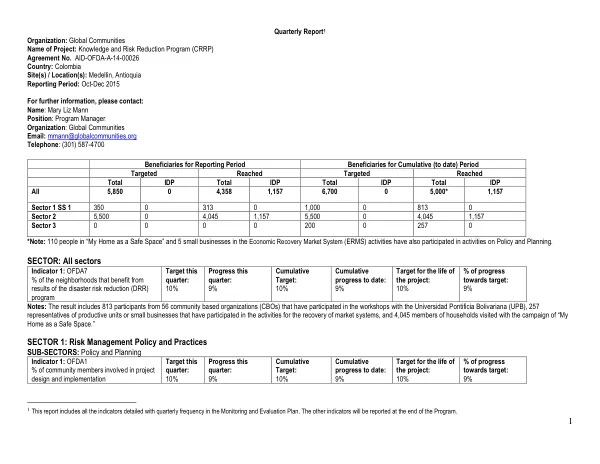
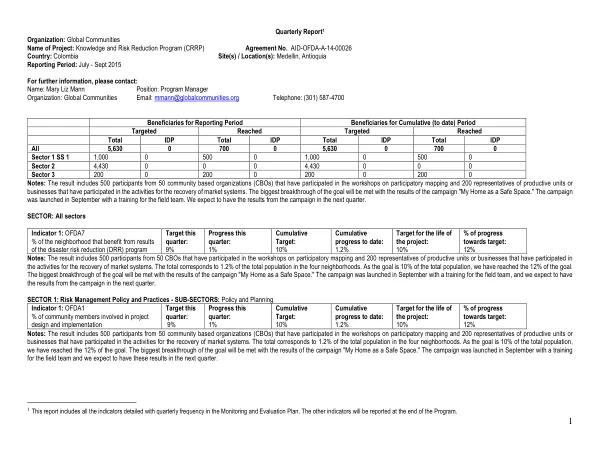
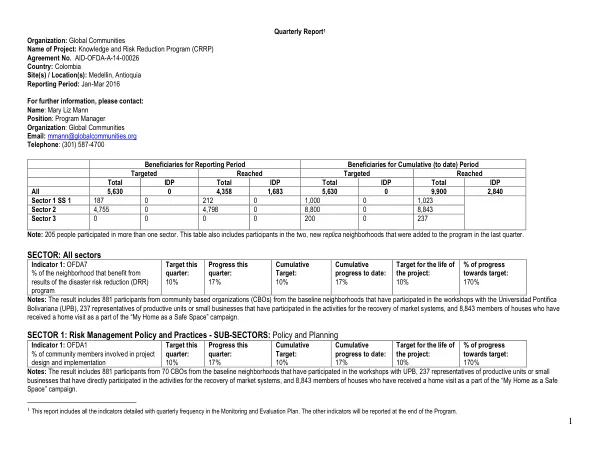
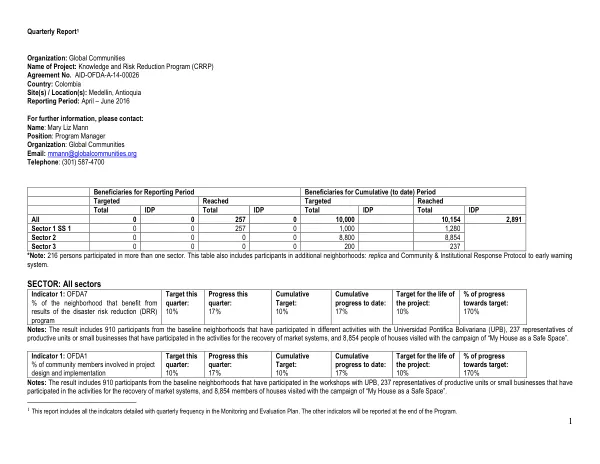
The program is funded by USAID's Office of U.S. Foreign Disaster Assistance (OFDA) under Agreement No. AID-OFDA-A-14-00026. The reporting period for this quarterly report spans April to June 2016. During this quarter, the program made significant progress in engaging community members in project design and implementation. The percentage of community members involved in project design and implementation reached 17%, exceeding the quarterly target of 10%. This progress is attributed to the participation of 910 individuals from baseline neighborhoods, 237 representatives of productive units or small businesses, and 8,854 people who visited houses with the "My House as a Safe Space" campaign. The program also achieved notable results in risk management policy and practices. The score of involvement by community-based organizations in the design and implementation of the DRR project reached 3, exceeding the quarterly target of 5. This progress is attributed to the evaluation made by the implementing partner, Universidad Pontificia Bolivariana. Additionally, the local government's involvement in the DRR project reached 5, meeting the quarterly target. In the sector of shelter and settlements, the program made significant progress in training people on disaster risk reduction (DRR) knowledge. The percentage of trained people that retain DRR knowledge 3 and 6 months after training reached 99%, exceeding the quarterly target of 90%. This progress is attributed to the testing of households on principles explained in the "My House as a Safe Space" booklet through a 10-question game. The program also made progress in incorporating DRR measures into shelters. The number of shelters incorporating DRR measures reached 52, exceeding the quarterly target of 50. This progress is attributed to the partnership between the program and the municipality, which led to improvements in the conditions of overcrowded homes. The program's engagement with private sector partners also showed significant progress. The number of private sector partners supporting DRR activities in Medellin reached 6, exceeding the quarterly target of 0. This progress is attributed to new partnerships, including donations of housing and construction materials for communas 1 and 8, gardening materials for workshops around hazard mitigation construction works, and a partnership with a microfinance organization that is promoting savings and credit for the commercial sector of these neighborhoods. The program's brief sector narrative highlights the importance of community participation and engagement in project design and implementation. The program's activities, including neighborhood fairs, participatory mapping, and workshops, demonstrate the program's commitment to reducing disaster risk and promoting community resilience in Medellin.
Related documents