GLOBAL COMMUNITIES
Quarterly Report1
The Knowledge and Risk Reduction Program in Colombia began in 2014 with the goal of reducing disaster risk and promoting community resilience.
2014 · 6 pages
Sign in to readA free account is required to download.
Abstract
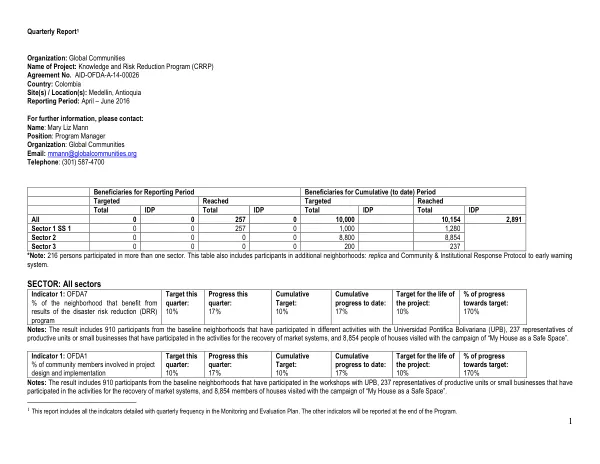
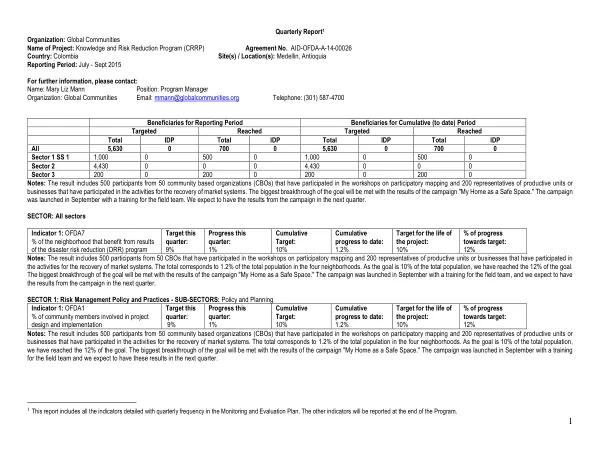
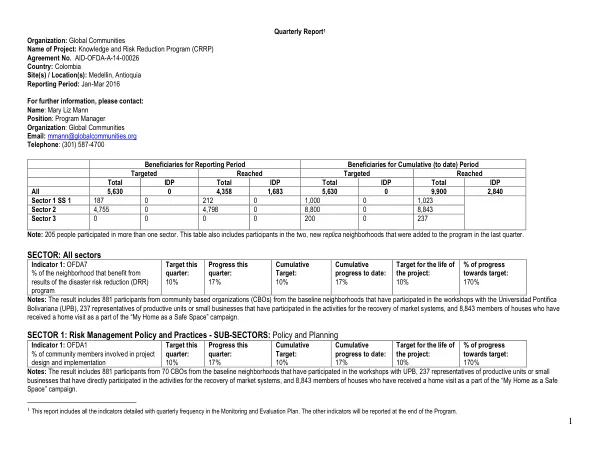
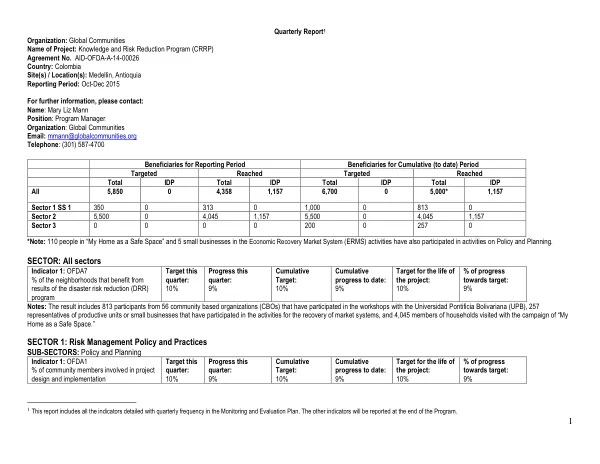
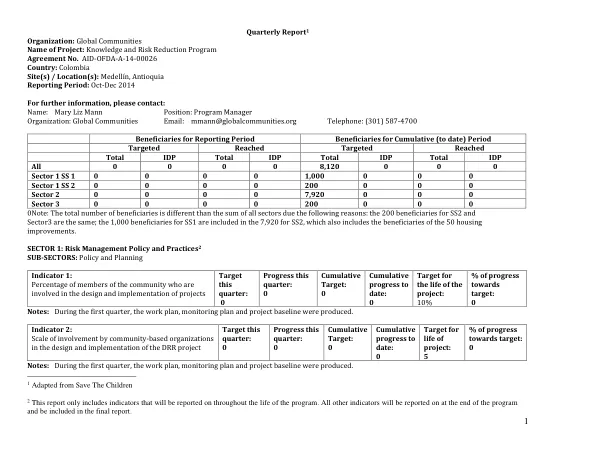
The program is implemented by Global Communities in partnership with local organizations, including Universidad Pontificia Bolivariana, FENALCO, and Corporacion Ayuda Humanitaria. The program focuses on three sectors: Risk Management Policy and Practices, Shelter and Settlements, and Economic Recovery and Market Systems. In the Risk Management Policy and Practices sector, the program aims to increase community involvement in disaster risk reduction (DRR) activities. During the first quarter, the program team verified indicators to measure program outputs and outcomes, and designed and implemented three surveys to gather information from the target community. The surveys were conducted in the general community, the market systems rehabilitation sub-sector, and existing grassroots organizations in the neighborhoods. The program also aims to increase private sector involvement in DRR activities. However, during the first quarter, no private sector partners were engaged in supporting DRR activities in Medellín. The program team plans to continue working with private sector partners to achieve this goal. In the Shelter and Settlements sector, the program focuses on hazards mitigation and shelter construction. During the first quarter, the program team defined the strategy and policies for establishing which households may participate in the activities proposed for this sector. Meetings were held with key municipal and neighborhood stakeholders, including ISVIMED and the EDU, to discuss the program's approach. In the Economic Recovery and Market Systems sector, the program aims to rehabilitate market systems and promote economic recovery. During the first quarter, the program team administered a survey to 318 traders and individuals or households that carry out commercial activities in the neighborhood. The survey gathered information on key consumer habits and commercial dynamics, which will help the program understand the location's commercial dynamics and supply sources. The program's main results for the period relate to completing the structuring of work plans, monitoring and evaluation, and baseline creation. Three surveys were designed and implemented to gather information from the target community, and meetings were held with key stakeholders to discuss the program's approach. The program's beneficiaries for the reporting period include 8,120 people, with 0 IDPs (Internally Displaced Persons) among them. The program's cumulative beneficiaries to date include 0 IDPs. The program's target beneficiaries for the life of the project include 10% of the community involved in the design and implementation of projects, 5% of community-based organizations involved in the design and implementation of the DRR project, and 5% of local government involvement in the DRR project. The program's indicators for the Risk Management Policy and Practices sector include the percentage of community members involved in the design and implementation of projects, the scale of involvement by community-based organizations in the design and implementation of the DRR project, and the scale of local government involvement in the DRR project. The program's indicators for the Shelter and Settlements sector include the percentage of trained people that retain DRR knowledge and the number of shelters incorporating DRR measures. The program's indicators for the Economic Recovery and Market Systems sector include the total number of critical market actors directly assisted through market system rehabilitation activities and the total USD amount channeled into the program area through sub-sector activities. The program's brief sector narratives provide additional information on the program's approach and activities in each sector. The narratives highlight the program's focus on community involvement, private sector engagement, and market system rehabilitation, and provide details on the program's surveys, meetings, and other activities.