USAID DEC
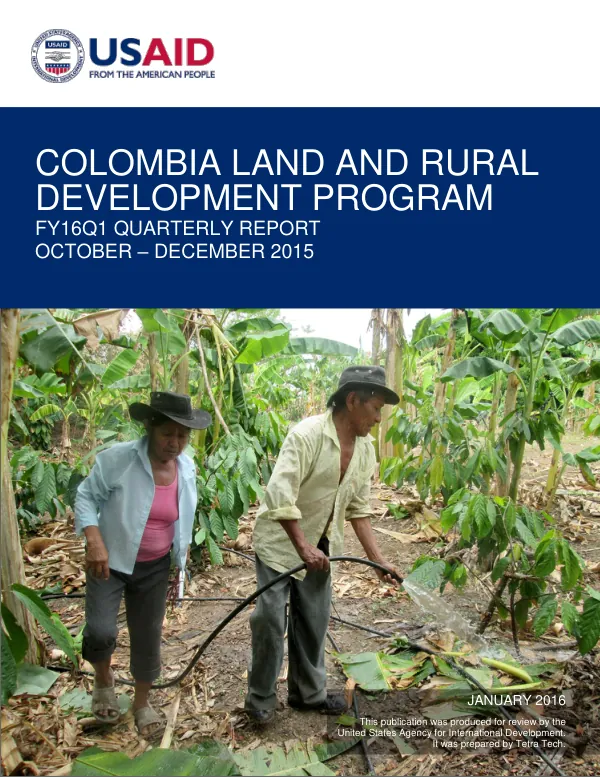
Colombia Land and Rural Development Program FY16Q1 Quarterly Report (October–December 2015)
Sign inGOVERNMENT OF COLOMBIA
Colombia Land and Rural Development Program FY16Q1 Quarterly Report (October–December 2015)
The Colombian government's institutional framework for land and rural development underwent significant changes in December 2015.
2016 · 46 pages
Sign in to readA free account is required to download.
Abstract
President Santos issued a series of decrees aimed at restructuring the framework to advance land and rural development policy in a post-conflict environment. The decrees mandated the dissolution of the Colombian Institute for Rural Development (INCODER) and created three new agencies: the National Land Agency, the Rural Development Agency, and the Agency for Renewal of the Territories. Additionally, a land restitution council and a directorate for rural women were established. The National Land Agency will be responsible for implementing policy related to the management of public lands and facilitating rural citizens' access to and secure tenure of productive land. The Rural Development Agency will implement the Ministry of Agriculture and Rural Development's (MARD) rural development policy to promote better livelihoods for Colombia's rural population. The Agency for Renewal of the Territories will support the integration of conflict-affected rural communities into the government's strategy to revive the rural economy and increase quality of life for these populations. The new institutional framework presents both challenges and opportunities for the USAID's Land and Rural Development Program (LRDP). The program is poised to take a leadership role among the international donor community and help the government of Colombia (GOC) quickly install and begin implementation of the new institutions. The GOC's efficiency in establishing these institutions is a critical factor for promoting the peace accords and lasting peace in rural Colombia. During the first quarter of FY2016, LRDP continued to achieve important development impact. The program has established excellent relationships with GOC counterparts in the regions and is seen as an honest and unbiased broker in areas where mistrust has existed for years. LRDP supported the writing and production of 12 regional radio dramas that seek to raise rural women's awareness of their land rights. These efforts have contributed to the program's recognition as a relevant actor promoting land and rural development reform at both the national and regional levels. The new institutional framework is expected to foster greater land tenure security for Colombia's rural population and facilitate economic development in areas affected by the armed conflict. The creation of the National Land Agency, the Rural Development Agency, and the Agency for Renewal of the Territories will help to address the challenges faced by rural communities and promote better livelihoods for Colombia's rural population. The directorate for rural women will develop, promote, and implement policies and instruments to improve the quality of life for women in rural areas. The liquidation process of INCODER will conclude by December 6, 2016, and the new agencies will replace the functions previously implemented by INCODER. The new institutional framework presents opportunities for LRDP to continue making significant contributions to land policy and the GOC's rural reform priorities. The program's relationships with GOC counterparts and its reputation as an honest and unbiased broker position it well to continue promoting land and rural development reform in Colombia.