MINISTRY OF THE ENVIRONMENT
Colombia’s Mandatory Environmental Compensation System: Key Structure and Takeaways
Colombia's mandatory environmental compensation system is based on the country's original compensation legislation of 1994, which was later modified in 2012 with the help of The Nature Conservancy (TNC).
2019 · 2 pages
Sign in to readA free account is required to download.
Abstract
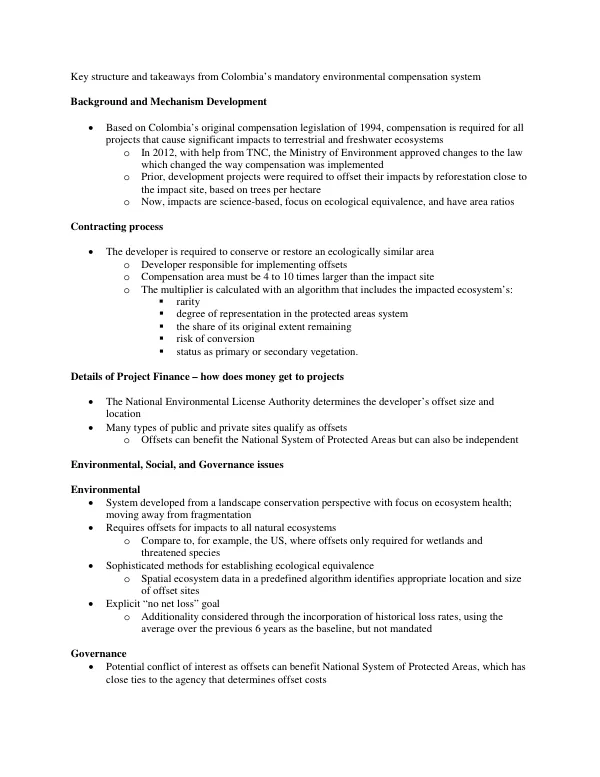
The updated law requires compensation for all projects that cause significant impacts to terrestrial and freshwater ecosystems. This approach focuses on ecological equivalence, rather than simply reforestation, and uses area ratios to determine the size of the compensation area. The contracting process involves the developer conserving or restoring an ecologically similar area, which must be 4 to 10 times larger than the impact site. The multiplier is calculated using an algorithm that takes into account the impacted ecosystem's rarity, degree of representation in the protected areas system, share of its original extent remaining, risk of conversion, and status as primary or secondary vegetation. The National Environmental License Authority determines the developer's offset size and location, and many types of public and private sites qualify as offsets. The system has been developed from a landscape conservation perspective, with a focus on ecosystem health and moving away from fragmentation. It requires offsets for impacts to all natural ecosystems, including terrestrial and freshwater ecosystems, which is a more comprehensive approach than some other countries, such as the United States, where offsets are only required for wetlands and threatened species. The system also uses sophisticated methods for establishing ecological equivalence, including spatial ecosystem data in a predefined algorithm to identify the appropriate location and size of offset sites. One of the strengths of the system is that developers have many compensation options, and the focus on ecological equivalence may lead to more effective conservation outcomes. However, there are also several weaknesses, including the lack of intermediaries and institutions to reduce transaction costs for offset buyers and sellers, and the uncertainty regarding total compensation costs for developers. Additionally, the system ignores time lags and lacks a mechanism for long-term funding, and offsets must last the duration of the development project only, although monitoring is required at both the impact and offset sites for the entire duration of the impact. The Colombian system has been studied and referenced in various academic and professional publications, including articles in PLOS ONE and Ecosystem Marketplace, as well as a report by the Conservation Strategy Fund. These studies provide further insight into the system's design and implementation, and highlight the potential benefits and challenges of this approach to environmental compensation.