CREATIVE ASSOCIATES INTERNATIONAL INC.
Community Education and Conflict Assessment - June 2016
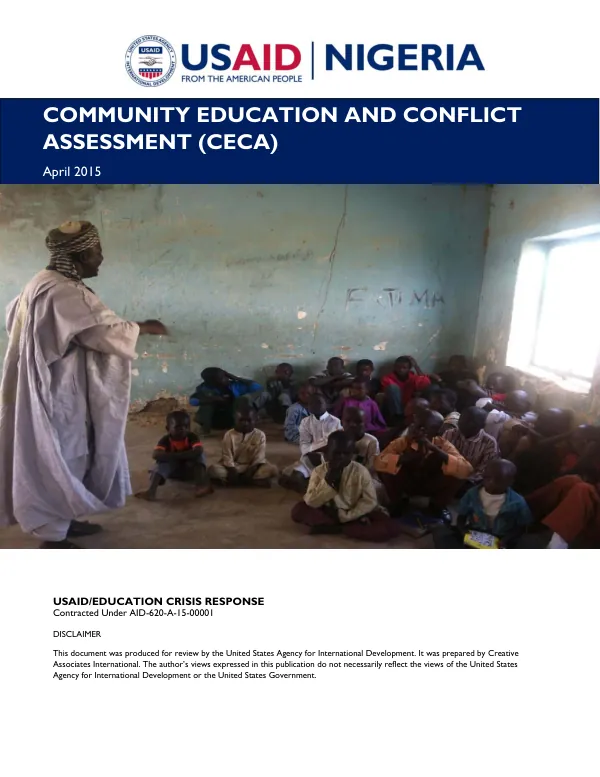
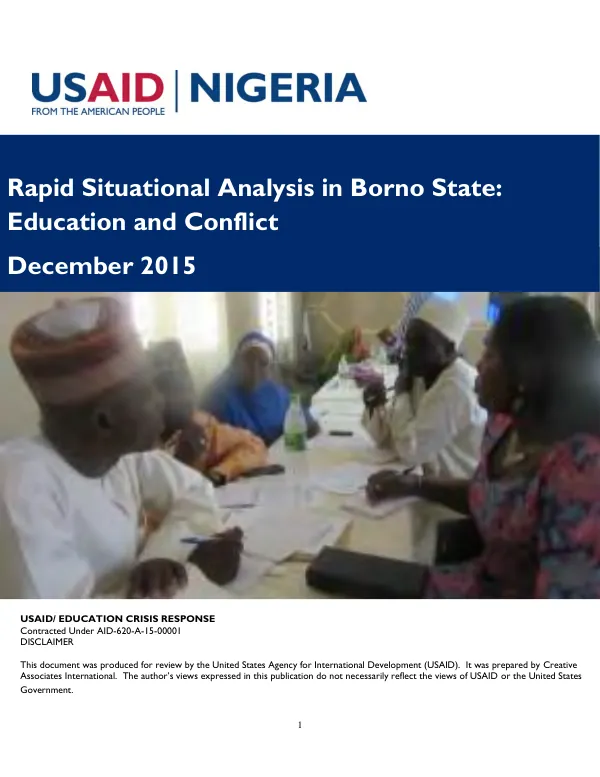
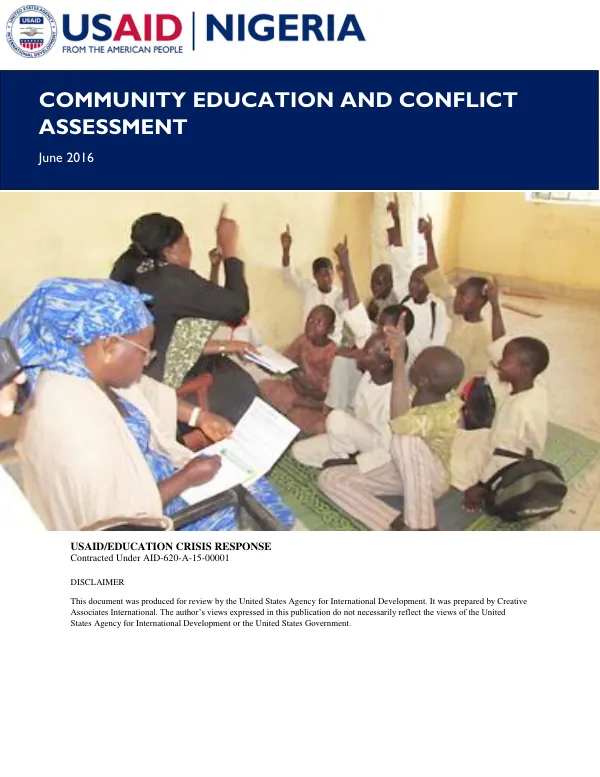
The Community Education and Conflict Assessment (CECA) in Nigeria's North-East region was conducted to understand the impact of the Boko Haram insurgency on education.
2016 · 66 pages
Sign in to readA free account is required to download.
Abstract
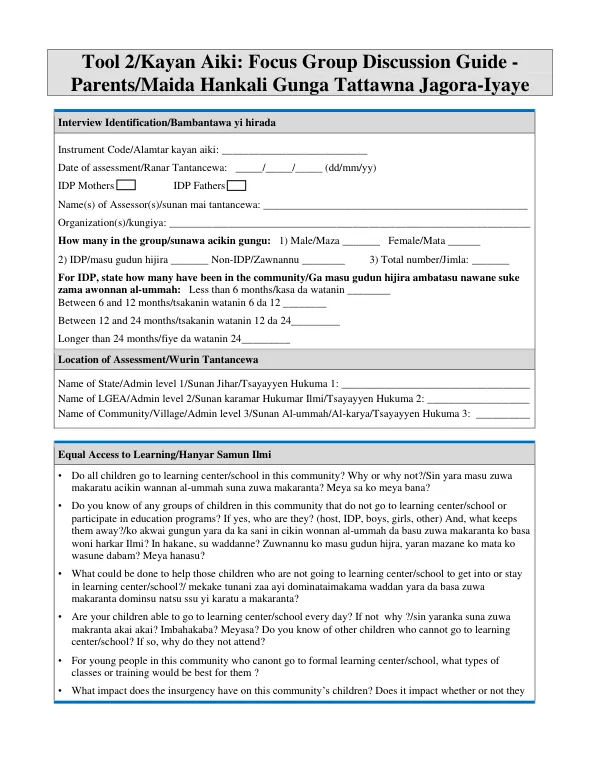
The assessment aimed to identify key challenges and opportunities for improving educational access and quality in the affected areas. The CECA was conducted in Bauchi, Gombe, and Adamawa states, with a focus on Internally Displaced Persons (IDPs) and vulnerable groups. The assessment used a mixed-methods approach, combining quantitative and qualitative data from in-depth interviews, focus group discussions, and secondary data collection. The data was collected from over 150 IDPs, 96 children, 48 parents, and 24 teachers. The findings and conclusions were presented in five domains: IDPs and vulnerable groups, equitable access to education, protection and well-being, teaching and learning, and parental and community participation. The assessment identified the most vulnerable groups as IDPs, orphans, the poor, and itinerant learners. These groups face challenges due to lack of resources and the types of work or activities they engage in. Children and youth are also vulnerable due to their involvement in activities that make them susceptible to harm. In terms of equitable access to education, the assessment found that more boys are attending school than girls, especially in Adamawa. There is a demand for vocational programs and vocational training for girls and boys. The assessment also highlighted the need for more vocational and other training activities for girls and boys. The protection and well-being domain revealed that girls are more at risk than boys, especially with regard to abductions and sexual violence. Parents, teachers, and leaders are the primary sources of support for children and youth. Children and youth tend to go to parents, teachers, and other community members for support rather than forming their own groups. The teaching and learning domain found that peace and health education are the most frequent topics taught. However, there is a need for other education-related support, such as psychological support, psychological support, and social and emotional learning. Teachers and community members advocate for more teachers and teacher training. The parental and community participation domain highlighted the importance of community organizations, including Parent-Teacher Associations (PTAs), in supporting education. The assessment also emphasized the need for more community involvement in education, including the provision of resources and support for teachers. The CECA provided actionable recommendations to inform the design of interventions to improve educational access and quality in the affected areas. The recommendations focused on addressing the challenges faced by IDPs and vulnerable groups, improving equitable access to education, enhancing protection and well-being, and promoting teaching and learning. The assessment also highlighted the need for more community involvement in education and the provision of resources and support for teachers. The CECA was conducted to inform the design of interventions under the Education Crisis Response (ECR) program. The assessment aimed to provide a comprehensive understanding of the education and conflict context in Bauchi, Gombe, and Adamawa states. The findings and recommendations of the CECA will inform the development of targeted interventions to address the challenges faced by IDPs and vulnerable groups and to improve educational access and quality in the affected areas.
Related documents