CREATIVE ASSOCIATES INTERNATIONAL INC.
Yobe Community Education and Conflict Assessment
The Community Education and Conflict Assessment (CECA) for Yobe State was conducted in December 2015.
2015 · 46 pages
Sign in to readA free account is required to download.
Abstract
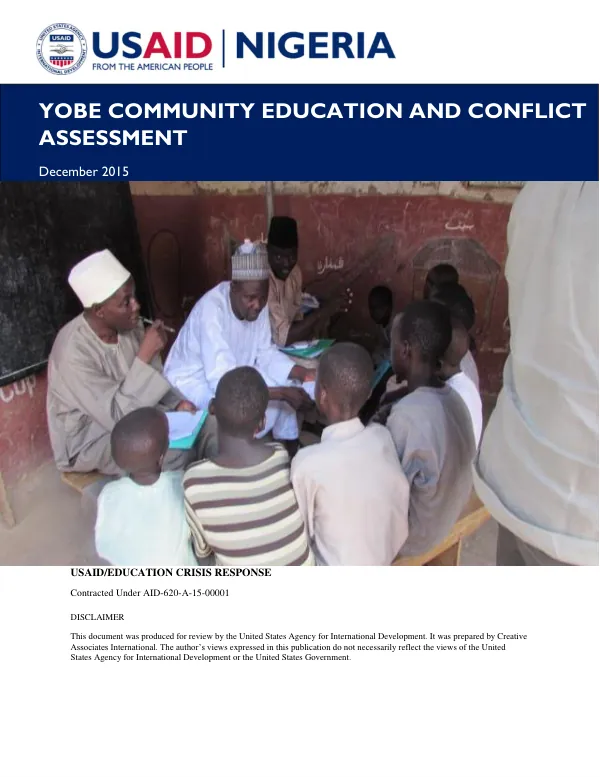
The assessment aimed to identify the education needs of Internally Displaced Persons (IDPs) and host community members in Yobe State, Nigeria. The CECA was implemented by Creative Associates International in partnership with the Education Crisis Response Project Team, the Monitoring and Evaluation Advisor, and State Team Leaders. The assessment involved the contribution of 18 Nigerian enumerators, 50% of whom were women, who participated in all stages of the assessment, including planning, data collection, and validation of findings. The enumerators conducted interviews, focus group discussions, and secondary data collection to elicit responses from a wide range of stakeholders, including IDPs and host community members. The CECA team acknowledges the assistance of Nigerian Governmental agencies, NGOs, and local CBOs, which helped to identify key communities with high numbers of IDPs, contextualized the language and appropriateness of the tools being used, and provided valuable input on methodology and locations. Special thanks go to the Ministry of Education (MOE) and the local NGO community who assisted with the CECA data collection process. The assessment aimed to inform the Education Crisis Response Project, which seeks to increase access to safe, protective education and learning amidst crisis and widespread displacement of learners and their families. The CECA findings are presented in this report, which provides an overview of the education situation in Yobe State, including the impact of the Boko Haram insurgency, the location of IDPs, and the current access to education. The assessment reveals that the Boko Haram insurgency has had a devastating impact on education in Yobe State, with many schools destroyed or used as shelters for IDPs. The report highlights the need for a comprehensive education response that addresses the protection and well-being of learners, as well as their access to education. The CECA findings are expected to inform the development of an effective education crisis response strategy for Yobe State. The report presents a range of data and findings, including figures and tables that provide an overview of the education situation in Yobe State. The data includes information on the displacement of Nigerians, the number of IDPs by LGA, and the out-of-school children in Yobe State. The report also presents a theory of change framework for CECA analysis, which outlines the key components of the education crisis response strategy. The CECA findings highlight the need for a comprehensive education response that addresses the protection and well-being of learners, as well as their access to education. The report recommends that the education crisis response strategy should prioritize the protection of learners, provide access to safe and protective education, and address the needs of excluded groups, including women and girls. The report also recommends that the strategy should be implemented in partnership with national, state, and community level partners, and that it should be monitored and evaluated regularly to ensure its effectiveness.