DAI
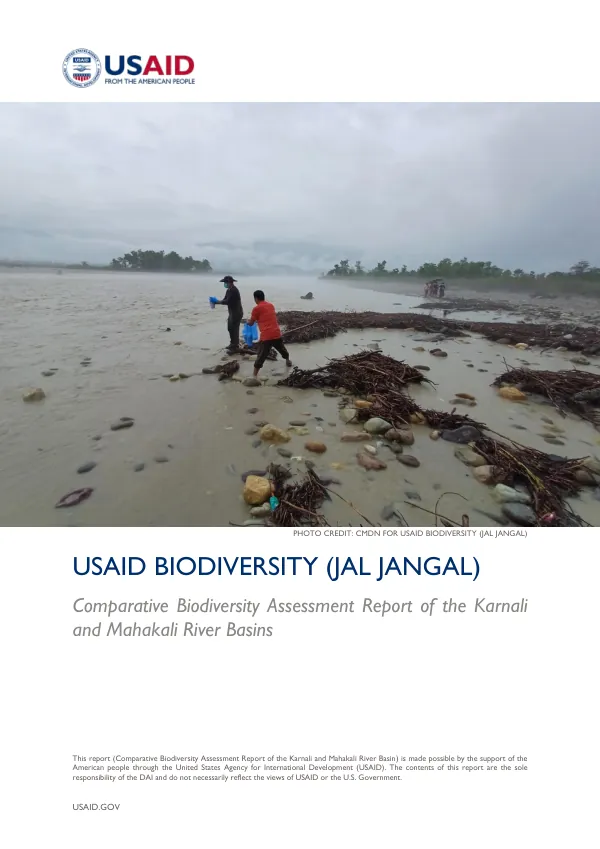
Comparative Biodiversity Assessment Report of the Karnali and Mahakali River Basin
The Mahakali River Basin, a vital water resource shared by Nepal and India, has been assessed for its aquatic biodiversity using cutting-edge environmental DNA (eDNA) technology.
2024 · 27 pages
Sign in to readA free account is required to download.
Abstract
This study, conducted under the USAID Biodiversity (Jal Jangal) program, aimed to enhance understanding of the ecological richness of the river. The research employed a combination of eDNA sampling and traditional voucher specimen collection to assess the aquatic biodiversity of the river. The study compared the fish data of the Karnali River Basin with the present data of the Mahakali River Basin. eDNA sampling initiatives were carried out across various projects, including the ongoing USAID Biodiversity (Jal Jangal) activity in Mahakali (2023), the Nepal Fish Biodiversity Project (NFBP, 2016–18), and the USAID PAANI (PAANI, 2018–19) in Karnali. A total of 19 Operational Taxonomic Units (OTUs) in the Mahakali and 46 OTUs in the Karnali were assigned a taxonomy at either family, genus, or species level. Among these, 12 OTUs were common in both river basins. The OTU values were higher across the board in Karnali than Mahakali. Most of the freshwater fishes from both study systems belonged to the Cypriniformes order, with the Cyprinidae family having the highest relative abundance. In Mahakali, the most abundant fish OTU obtained was Schizothorax spp., followed by Triplophysa spp., whereas in the case of Karnali, it was Barillius spp. followed by Schizothorax spp. A key discovery involved identifying Tor species in both the Karnali and Mahakali rivers, with significantly higher abundance in the Mahakali river (227,286) compared to the Karnali river (102). To validate these findings, DNA barcoding was employed on voucher specimens collected from respective sampling sites in both river systems, confirming the presence of the identified Tor species. This discovery serves as a crucial starting point for studying migratory patterns and critical habitats of these species. The study found that Karnali showed double the fish diversity compared to Mahakali. However, the data for the Karnali is based on seasonal sampling of 3 seasons (2 pre-Monsoon and 1 post-Monsoon) while Mahakali is based on seasonal sampling of one season (Monsoon). To comprehensively analyze fish diversity and abundance, it is essential to conduct additional seasonal sampling in the Mahakali River. A follow-up round of sampling (fall season) and eDNA analysis, along with the collection of fish vouchers from all the sampling sites, is essential. Moreover, to establish an absolute baseline for precise fish checklists native to any river/tributary system, sampling efforts should be continued in both river basins.
Related documents