COASTAL RESOURCES CENTER
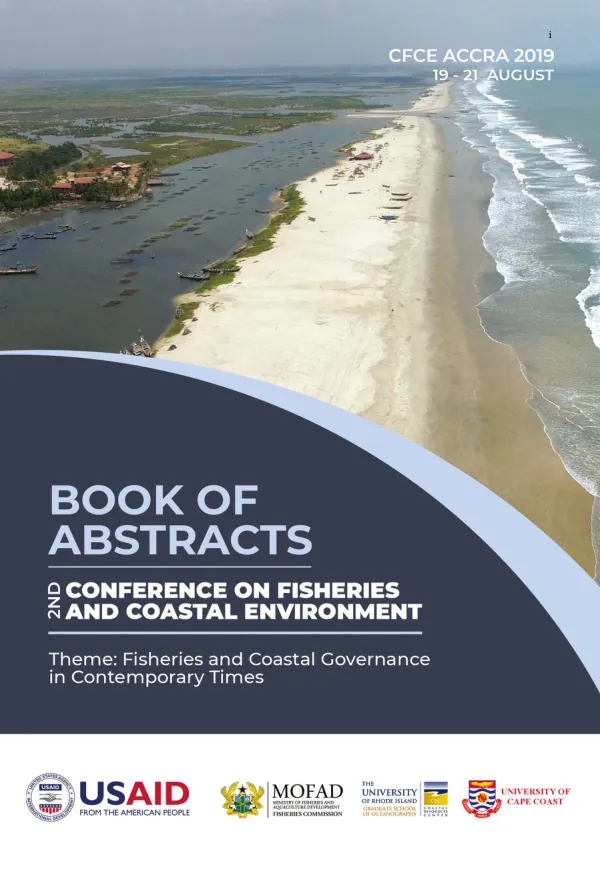
Conference on Fisheries and Coastal Environment, Accra, 2019, Book of Abstracts
The Conference on Fisheries and Coastal Environment (CFCE) is a joint initiative of the Centre for Coastal Management (CCM), the Department of Fisheries and Aquatic Sciences of the University of Cape Coast (UCC), the Sustainable Fisheries Management Project of the Coastal Resources Center (CRC) - University of Rhode Island (URI), and the Ministry of Fisheries and Aquaculture Development (MoFAD) Ghana.
2019 · 96 pages
Sign in to readA free account is required to download.
Abstract
The conference aims to strengthen policy linkages and facilitate a holistic discussion on coastal and marine resources, which are shared by millions of people but threatened by poor management. The second edition of the CFCE, held in Accra in 2019, features panel discussions, keynote presentations, and session papers. The conference provides a platform for researchers, journalists, and think tanks to connect their voices to the sustainable fisheries and coastal development agenda of Ghana. The event is funded by the United States Agency for International Development (USAID) through the University of Cape Coast (USAID/UCC Fisheries and Coastal Management Capacity Building Support Project) and the University of Rhode Island (USAID/GHANA Sustainable Fisheries Management Project). The Centre for Coastal Management (CCM) is a pioneering institution that has played a key role in fostering demand-driven research, professional education, and community services. The centre works with a broad range of experts, including fisheries scientists, climatologists, oceanographers, coastal ecologists, chemists, geographers, geologists, health professionals, and economists. CCM's technical advisory services and decision support tools make it an important reference point for students, university faculty, and research scientists to engage in interdisciplinary research or dialogue to promote understanding of the complex coastal environmental and social challenges. The Department of Fisheries and Aquatic Sciences at the University of Cape Coast offers undergraduate and postgraduate programs in fisheries and aquatic sciences. The department's curriculum and capacity-building strategy are driven by three major development goals: maintaining a high ecological health integrity of aquatic ecosystems and resources, improving the livelihoods of people dependent on these aquatic systems, and sustainably increasing fish production to meet the country's food and nutrition security objectives. The Coastal Resources Center (CRC) at the University of Rhode Island catalyzes the aspirations of coastal communities to help them become more effective stewards of their marine resources. CRC's work is focused on safe, local, abundant, and sustainable seafood, thriving coastal communities, and vibrant, well-managed oceans, coasts, and watersheds. The CRC team partners with stakeholders to apply science and promote innovation, facilitating collaboration, advancing knowledge, building capacity, and providing management tools. The conference is a significant event that reaffirms the commitment of the University of Cape Coast to the sustainability of Ghana's fisheries and coastal resources. The partnership between UCC's Fisheries and Coastal Management Capacity Building Support Project and the University of Rhode Island's Sustainable Fisheries Management Project has led to the development of a dual degree program for the universities, promoting academic and research exchanges and other important academic partnerships. The conference provides an important platform for researchers, journalists, political representatives, and representatives from civil society groups to connect around issues of vital importance to the country's food security, employment, and poverty alleviation.