GEORGE WASHINGTON UNIVERSITY CIBER
Counter Gender-Based Violence Project, Quarter 3 Report, FY20
The USAID Counter Gender-Based Violence Project (CGBV or "Tushinde Ujeuri" in Swahili) is a comprehensive project to help communities respond to and prevent gender-based violence and Trafficking in Persons (TIP) in the Democratic Republic of Congo (DRC).
2020 · 63 pages
Sign in to readA free account is required to download.
Abstract
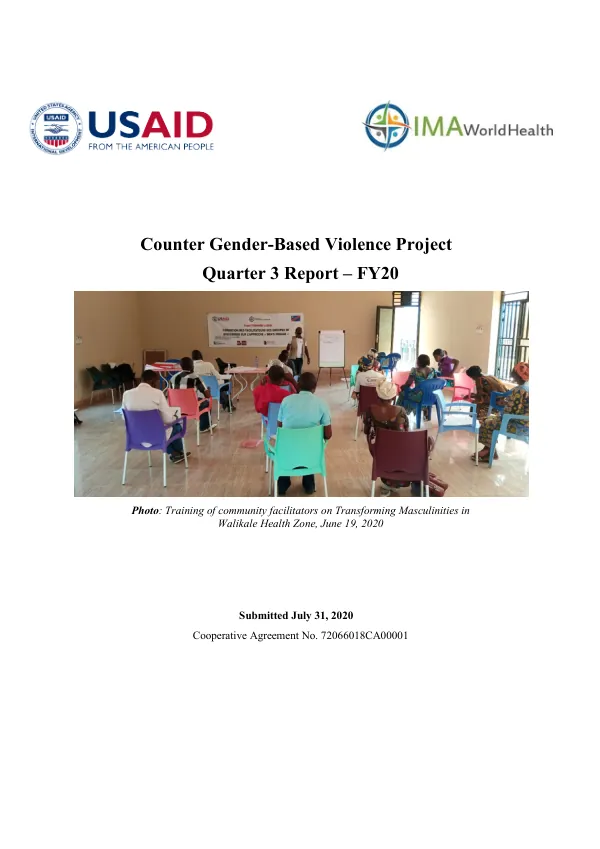
The project is implemented in five Health Zones (HZs) in the North and South Kivu Provinces of the DRC. The project's overarching goals are to strengthen community-based prevention of and response to gender-based violence (GBV), reduce GBV incidence, and improve the quality of and access to holistic care for survivors, particularly among vulnerable groups including LGBTQI. The project is implemented in North Kivu Province in two HZs, Walikale and Karisimbi, by Heal Africa, while Panzi Foundation is implementing in South Kivu Province (three HZs, Nyangezi, Bunyakiri, and Katana). Additional consortium technical partners include Search for Common Ground (SFCG), the American Bar Association Rule of Law Initiative (ABA-ROLI), and the University of Washington (UW)/Johns Hopkins University (JHU). During the reporting period, the security situation was relatively calm in the intervention areas, despite isolated cases of insecurity reported in Walikale, Katana, and Nyangezi Health Zones. In Walikale Health Zone, the security environment remains relatively calm, with activities conducted without facing a challenging security issue. The implementation of activities without threats and/or attacks from armed groups surrounding the area of project implementation could be in part due to the campaigns conducted by the project against violence in general but especially against women. In Katana Health Zone, the presence of an armed group by the name "Chance" has continuously been a challenge for the people of the Mabingu Health Area. Several women and girls had been abducted and raped, and several children forcibly enlisted into this group. Thanks to the collaboration between the project and the military auditor, one of the commanders of "Chance's" group was arrested and incarcerated in the Bukavu Central Prison. The project is conducting sensitization campaigns through the radio partner of the project in the Katana HZ, in order to promote the services of the project so more people are aware of psychological, medical, and legal support available to victims of these atrocities. In Nyangezi Health Zone, the security situation remains somewhat volatile, with reported cases of armed robbery, strangulation, murder, and kidnapping. The project works with community leaders and community groups to support victims of violence and to facilitate access to justice as far as GBV cases are concerned. The project also invests in its goal of changing norms through promoting its alternative dispute resolution approach (ADR). The project has made significant progress in achieving its intermediate results (IRs) during the reporting period. IR 1: Target Communities Demonstrate Greater Acceptance of Positive Gender Roles, has seen a significant increase in the number of community members who have adopted positive gender roles. IR 2: Availability of community-level GBV-related services improved, has seen an increase in the number of community-level GBV-related services available to survivors. IR 3: Perceptions of stigma surrounding reintegrated survivors reduced, has seen a significant reduction in the perceptions of stigma surrounding reintegrated survivors. The project has also made significant progress in implementing its activities, including the training of community facilitators on Transforming Masculinities, the establishment of community-level GBV-related services, and the promotion of alternative dispute resolution approaches. The project has also invested in its goal of changing norms through promoting its alternative dispute resolution approach (ADR). The project has also conducted sensitization campaigns through the radio partner of the project in the Katana HZ, in order to promote the services of the project so more people are aware of psychological, medical, and legal support available to victims of these atrocities. The project has also worked with community leaders and community groups to support victims of violence and to facilitate access to justice as far as GBV cases are concerned. The project has also made significant progress in achieving its goals, including reducing GBV incidence, improving the quality of and access to holistic care for survivors, and strengthening community-based prevention of and response to GBV. The project has also invested in its goal of changing norms through promoting its alternative dispute resolution approach (ADR). The project has also conducted a midterm evaluation, which revealed a significant reduction in GBV incidence, an increase in the number of community-level GBV-related services available to survivors, and a significant reduction in the perceptions of stigma surrounding reintegrated survivors. The project has also made significant progress in achieving its intermediate results (IRs) during the reporting period. The project has also invested in its goal of changing norms through promoting its alternative dispute resolution approach (ADR). The project has also worked with community leaders and community groups to support victims of violence and to facilitate access to justice as far as GBV cases are concerned. The project has also conducted sensitization campaigns through the radio partner of the project in the Katana H