USAID DEC
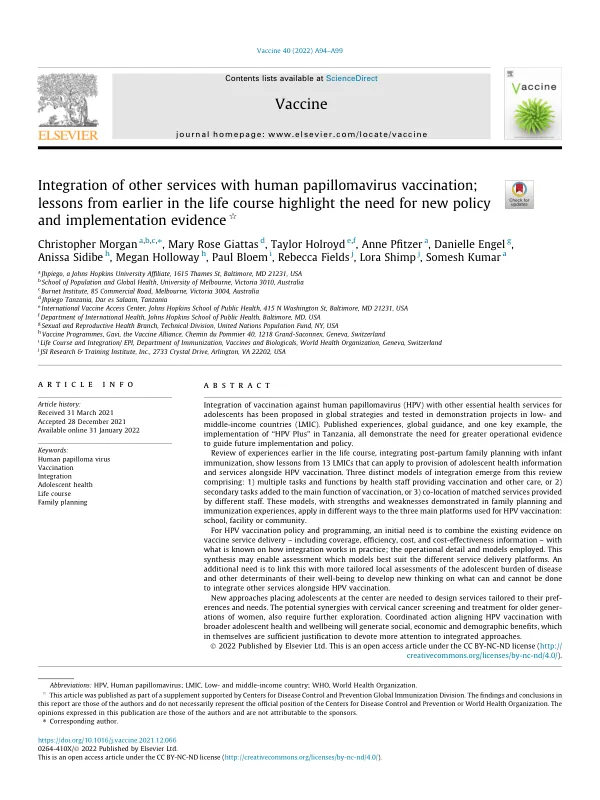
Integration of other services with human papillomavirus vaccination; lessons from earlier in the life course highlight the need for new policy and implementation evidence
Sign inCARE
Integration of other services with human papillomavirus vaccination; lessons from earlier in the life course highlight the need for new policy and implementation evidence
The integration of human papillomavirus (HPV) vaccination with other essential health services is a priority in the global Immunization Agenda 2030.
6 pages
Sign in to readA free account is required to download.
Abstract
However, there is a need for greater operational evidence to guide future implementation and policy. A review of experiences from earlier in the life course, particularly in low- and middle-income countries (LMICs), shows lessons that can be applied to the provision of adolescent health information and services alongside HPV vaccination. In LMICs, integration of vaccination with other essential health services can increase coverage and access. The World Health Organization (WHO) has published guidance on HPV vaccine integration, and a 2018 WHO integration resource describes platforms suited to adolescent health alongside HPV vaccination. However, there is a need for clear description of how these work in practice and what policy is supportive. One example of HPV vaccine integration is the "HPV-PLUS" program in Tanzania, which advocates for health education, deworming, nutrition, and vision screening alongside HPV vaccination in schools, health facilities, and community outreach. However, reports from earlier in Tanzania's introduction highlight implementation challenges. Experiences from earlier in the life course, particularly in the first years of life, have shown that integration of other services with vaccination can be effective. For example, a supplement to Vaccine in 2012 documented examples of providing hearing screening, HIV services, vitamin supplements, deworming, malaria treatment or bed-nets, family planning, growth monitoring, and health education alongside infant immunization. A review of published experiences from the past decade has shown that integration of post-partum family planning education or distribution alongside infant immunization has been effective in LMICs. Most of these experiences measured encouraging outcomes, including improved family planning knowledge, attitudes, and behaviors, including contraceptive uptake. The integration of HPV vaccination with other essential health services is essential for increasing coverage and access, particularly in LMICs. However, there is a need for greater operational evidence to guide future implementation and policy. A stronger measurement agenda is needed to assess the effectiveness of different models of integration and to identify the operational details that drive optimal integration strategies. The integration of HPV vaccination with other essential health services can have social, economic, and demographic benefits, particularly in LMICs. However, there is a need for coordinated action to place adolescents at the center of service design and to develop new approaches to integration that are tailored to their needs and preferences.
Related documents