BANK FOR WEST AFRICAN DEVELOPMENT
D.R. Congo Country Plan
The Democratic Republic of the Congo (DRC) is one of the most freshwater-rich countries in Africa, yet water security is low due to poor access to safe drinking water and basic sanitation.
2020 · 4 pages
Sign in to readA free account is required to download.
Abstract
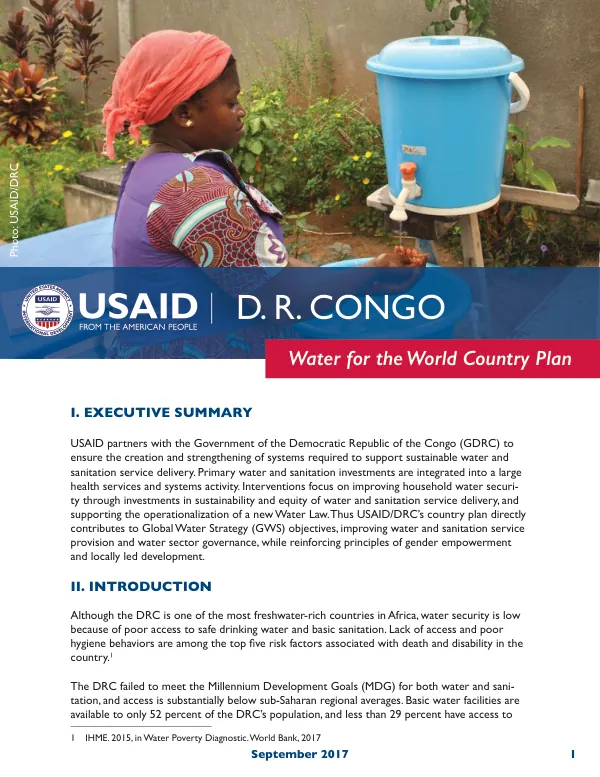
The country failed to meet the Millennium Development Goals (MDG) for both water and sanitation, and access is substantially below sub-Saharan regional averages. Basic water facilities are available to only 52 percent of the DRC's population, and less than 29 percent have access to basic sanitation. The DRC aims to eliminate open defecation and provide 100 percent access to basic sanitation by 2021, the end of the National Strategic Development Plan (2017-2021) implementation period. The country's goal is that 65 percent of the population has access to a safely managed water supply and 45 percent to safely managed sanitation by 2021. These ambitious targets represent the Government of the DRC's strong commitment to meeting the Sustainable Development Goal (SDG) of universal access to safely managed drinking water and sanitation by 2030. The DRC's new policy framework, which includes a National Water Law, a National Hygiene Policy, and a National Sanitation Strategy and Policy, represents a major advance and an opportunity to increase water security and rapidly meet the country's water and sanitation objectives. The law recognizes that access to water services is a right for all and provides criteria for equitable tariff setting and cost recovery. Private sector participation in water provision is also allowed, which may increase innovation with regard to sustainable models of service delivery. However, the DRC's water and sanitation sector faces several key challenges, including poor governance, equity, sustainability, and financing. The sector struggles to absorb funding efficiently, hindered by weak institutions, outdated institutional frameworks, and a lack of qualified technicians and managers. The DRC economy, which relies heavily on minerals, is in steep decline, and there is an estimated financing gap of $2.4 billion annually to meet the SDGs. The government's absorptive capacity and ability to spend efficiently and effectively is low, with utilization of investments generally less than 50 percent in public projects. The DRC's population growth rate is estimated at 2.4 percent, which would impede access to basic services such as water and sanitation. Women and girls are disproportionately affected by lack of WASH and shoulder the largest burden in water collection. Despite these challenges, there are opportunities for new technologies, products, and business models to improve access to sustainable water and sanitation services. USAID/DRC has made significant investments in water programming since 2008, focusing on supporting direct water and sanitation service provision and promoting adoption of improved hygiene behaviors as part of the implementation of the government's "Healthy Village" program. USAID's overall goal in the DRC is to support the country's long-term transition to more effective and empowering development. The WASH activities will focus on sustainability and equity, while supporting the operationalization of the new Water Law. Objectives include strengthening WASH governance, increasing access to quality, integrated WASH products and services, and increasing adoption of evidence-based WASH behaviors. Gender empowerment is a cross-cutting theme that will be integrated throughout the WASH activities.