USAID
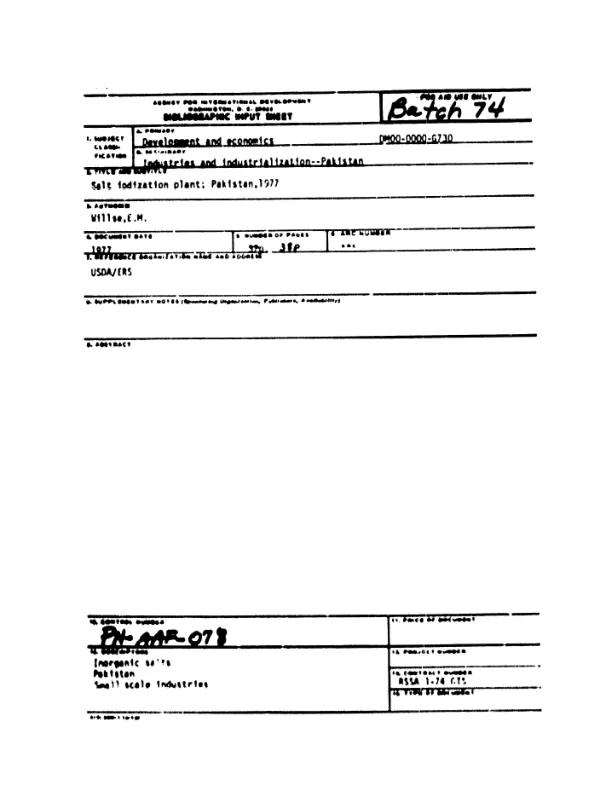
Design and Construction of a Salt Plant in Pakistan
The Pakistan Salt Works plant was built near Peshawar, North West Frontier Province (N.W.F.P.), in 1977.
38 pages
Sign in to readA free account is required to download.
Abstract
The plant was designed to produce salt from seawater, with a capacity to produce 14,000 tons of salt per year. The plant's equipment included a 120-diameter boiler, a 40-horsepower motor, and a 14-foot-long conveyor belt. The plant's process involved the following steps: First, seawater was pumped into the plant's storage tank, where it was treated with a chemical to remove impurities. The treated seawater was then fed into a series of tanks, where it was mixed with a solution of potassium iodate to prevent the growth of bacteria. The mixture was then heated in a boiler to produce steam, which was used to drive a turbine to generate electricity. The steam was then passed through a series of heat exchangers to produce hot water, which was used to dissolve the salt from the seawater. The resulting solution was then passed through a series of filters to remove impurities, and the salt was then crystallized out of the solution. The crystallized salt was then dried and packaged for shipment. The plant's equipment also included a 12-foot-long by 31.6-inch-wide conveyor belt, which was used to transport the salt from the crystallization tanks to the packaging area. The plant's process was designed to produce a high-quality salt that was free from impurities. The plant's equipment was also designed to be efficient and cost-effective, with a capacity to produce 14,000 tons of salt per year. The plant's operation was overseen by a team of engineers and technicians, who monitored the plant's equipment and processes to ensure that they were running smoothly and efficiently. The plant's operation was also subject to regular maintenance and repairs to ensure that it continued to produce high-quality salt. The plant's equipment included a variety of components, including a 120-diameter boiler, a 40-horsepower motor, a 14-foot-long conveyor belt, and a series of heat exchangers. The plant's process involved a series of steps, including the treatment of seawater, the mixing of the treated seawater with a solution of potassium iodate, the heating of the mixture in a boiler, and the crystallization of the salt out of the solution. The plant's operation was designed to produce a high-quality salt that was free from impurities. The plant's equipment was also designed to be efficient and cost-effective, with a capacity to produce 14,000 tons of salt per year. The plant's operation was overseen by a team of engineers and technicians, who monitored the plant's equipment and processes to ensure that they were running smoothly and efficiently.