USAID DEC
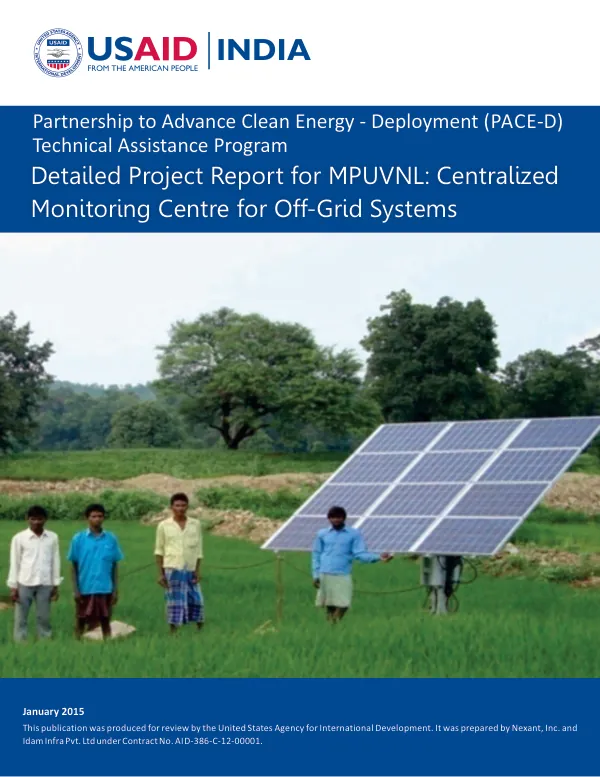
Detailed Project Report for MPUVNL: Centralized Monitoring Centre for Off-Grid Systems
Sign inUSAID
Detailed Project Report for MPUVNL: Centralized Monitoring Centre for Off-Grid Systems
The Partnership to Advance Clean Energy - Deploy (PACE-D) Technical Assistance Program is a program aimed at promoting the development of clean energy in India.
2015 · 73 pages
Sign in to readA free account is required to download.
Abstract
The program is supported by the United States Agency for International Development (USAID) and is implemented by Nexant, Inc. and Idam Infra Pvt. Ltd. The program focuses on the development of a Centralized Monitoring Centre (CMC) for off-grid solar systems in Madhya Pradesh. The CMC is designed to monitor and manage the performance of off-grid solar systems, providing real-time data on system performance, energy production, and other key metrics. The CMC is a critical component of the program, as it enables the effective management and optimization of off-grid solar systems. The CMC is designed to provide a centralized platform for monitoring and controlling the performance of off-grid solar systems, allowing for real-time data analysis and decision-making. The program also focuses on the development of a user-friendly interface for the CMC, which will enable users to easily access and analyze data on system performance. The interface will provide a range of features, including data visualization, data analysis, and reporting. The program has identified several key stakeholders, including MPUVNL, PACE-D Technical Assistance Program, off-grid vendors, and CMC IT system developers. Each stakeholder has a critical role to play in the development and implementation of the CMC. The program has also developed a detailed project report, which outlines the scope, objectives, and timeline for the CMC development. The report provides a comprehensive overview of the program's goals, objectives, and deliverables, as well as the expected outcomes and benefits of the CMC. The program has also identified several key technical requirements for the CMC, including user roles and access rights, web-based user interface, hosting of database, CMC application, communication, and system security. The program has also outlined the technical specifications for the CMC, including the hardware and software requirements, software development, and testing. The program has also developed a detailed budget and cost estimate for the CMC development, which includes the development phase, CMC system operation phase, and development of the CMC system by IT system developer. The program has also outlined the expected costs for hardware, infrastructure, software, network and communication, services, and implementation. The program has also developed a detailed timeline for the CMC development, which includes the project initiation, requirements gathering, system design, development, testing, and testing. The program has also outlined the expected milestones and deliverables for each phase of the project. The program has also identified several key risks and mitigation strategies for the CMC development, including technical risks, project management risks, and financial risks. The program has also outlined the expected mitigation strategies for each risk, including contingency planning, risk assessment, and risk management. The program has also developed a detailed annexure, which includes several key appendices, including details of financial assistance to off-grid systems in MP, user interface of different off-grid vendors, and details on cloud computing. The program has also identified several key figures and tables, including the roles and responsibilities of different stakeholders, the status of off-grid SPV systems installation in Madhya Pradesh, the comparison of off-grid facility-level meter integrated centralized monitoring system and vendor-based monitoring system, the user roles and access rights, the comparison of cloud-based database and in-house database, the estimated cost of hardware, the estimated cost of infrastructure, the estimated cost of software, the estimated cost of network and communication, the estimated cost of services, the estimated cost of implementation, the recurring cost of CMC system, and the timeline of CMC system development. The program has also identified several key acronyms, including AC, CMC, DC, DLMS, GPRS, GSM, HDMI, and HDMI.