USAID DEC
Developing a Community of Practice to Address Women’s Land Rights: Civil Society Discussion on Gender Equal Land Governance in Burma
Sign inTETRA TECH
Developing a Community of Practice to Address Women’s Land Rights: Civil Society Discussion on Gender Equal Land Governance in Burma
The Land Tenure Project in Burma aimed to address women's land rights through a community of practice.
2018 · 25 pages
Sign in to readA free account is required to download.
Abstract
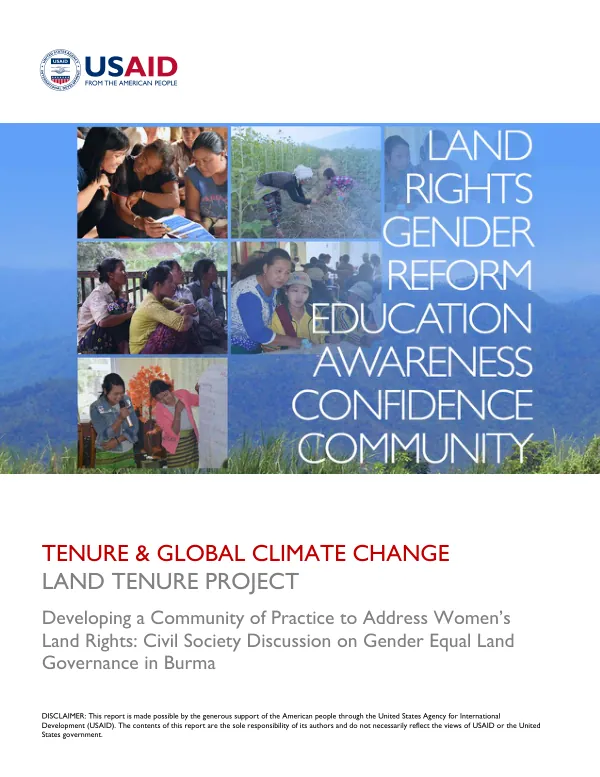
A two-day workshop was convened by the USAID-funded Tenure and Global Climate Change program in early December 2017, bringing together organizations and individuals working on land and gender in Burma. The workshop sought to serve as an initial forum to discuss the subject, as women's land rights still do not feature prominently in civil society and government discussions. The workshop used participatory methodologies to encourage organizations to share and learn from each other's work, explore collaborations, and develop a deeper understanding of the land and gender problematics across Burma. Day 1 focused on building knowledge of the existing country context and building trust among participants. Participants worked together to develop common agreements on the existing land and gender problems in different regions of Burma, exchanged their experiences of working on land and gender projects, and explored more theoretical questions through a group work exercise. The discussions highlighted the complex nature of women's relationship to land and the strong correlation between a variety of social issues, women's property rights, and their involvement in land governance. Conversations covered topics such as children's education, household dynamics, law reform, government administration processes, traditional inheritance practices, literacy, land confiscation, and violence—both in and outside the home. Central to the discussions was the idea that women farmers need to be treated as a diverse group, with individual circumstances and needs, depending on their customary practices, education, religion, livelihood practices, and other external circumstances. The workshop also highlighted the need for reform of law and land registration processes to expressly support and provide for joint titling. Participants recommended working to change traditional attitudes around land, which consider land governance to be a man's responsibility, and building the confidence of women to join these discussions. The workshop emphasized the importance of involving women in decision-making and representation in decision-making bodies, as women continue to be largely excluded from participation in decision-making around land at the local and national levels. The discussions brought forward a number of recommendations, including law and policy reform, advocacy and developing a community of practice, training, awareness raising, and confidence building, and comprehensive projects and funding. The workshop highlighted the need for more focus on the relationship between political changes in Burma and changes in regional and national land governance, to ensure that a diverse representation of women's voices are part of these national conversations. The workshop provided a condensed overview and reflection of the views of in-country practitioners into thematic and technical aspects of working on land and gender. The brief also provides suggestions for project design and development around land and gender moving forward. The recommendations aim to support the development of a community of practice to address women's land rights in Burma, and to promote gender equal land governance in the country. The workshop was a significant step towards addressing the complex issues surrounding women's land rights in Burma. The recommendations and proposals presented in this brief aim to support the development of a community of practice to address women's land rights in Burma, and to promote gender equal land governance in the country. The brief provides a condensed overview and reflection of the views of in-country practitioners into thematic and technical aspects of working on land and gender, and provides suggestions for project design and development around land and gender moving forward. The Land Tenure Project staff member leads a participatory mapping activity in Yway Gone Village Tract, highlighting the importance of involving women in decision-making and representation in decision-making bodies. The workshop emphasized the need for more focus on the relationship between political changes in Burma and changes in regional and national land governance, to ensure that a diverse representation of women's voices are part of these national conversations. The workshop brought together organizations and individuals working on land and gender in Burma, recognizing that despite a number of organizations now developing work in this area, it is still not a topic which features in wider civil society discussions. The workshop sought to serve as that initial forum, providing a platform for organizations to share and learn from each other's work, explore collaborations, and develop a deeper understanding of the land and gender problematics across Burma.
Related documents