BANYAN GLOBAL
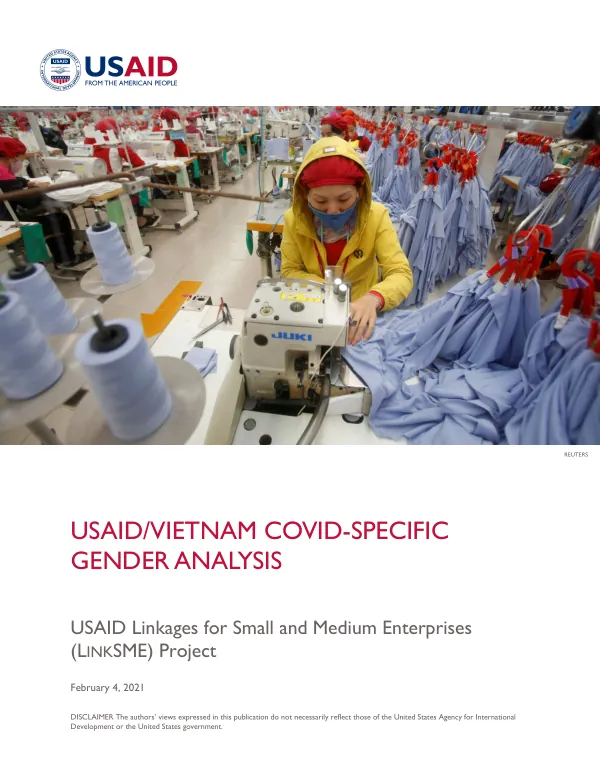
USAID/Vietnam COVID-Specific Gender Analysis
The COVID-19 pandemic has had a significant impact on the small and medium enterprise (SME) sector in Vietnam, with over 75 percent of surveyed Vietnamese enterprises reducing working hours, suspending contracts, cutting wages, and/or conducting layoffs as a coping mechanism.
2021 · 40 pages
Sign in to readA free account is required to download.
Abstract
The pandemic has also exacerbated pre-existing gender inequalities in access to digital technology, with women less likely to use the Internet or own a smartphone. Employer support for COVID-19 is gendered, with more men receiving paid leave and technical assistance, and more women receiving support for mental health and access to flexible work arrangements. The pandemic has also increased women's vulnerability to gender-based violence (GBV), as companies have been forced to halt operations or switch to working from home. Within the context of LinkSME, SMEs generally adopted the sexual harassment policy of their foreign buyer, if it existed. However, discussion of sexual harassment and other forms of GBV in the workplace is taboo, and women workers generally do not know their rights related to GBV in the workplace. Multiple stakeholders generally lacked knowledge of what GBV is and its prevalence in the workplace. The COVID-19 pandemic has also highlighted the need to promote business and networking opportunities for women. Recommendations include hosting break-out business and network sessions for women-owned and women-led SMEs during mixed-gender trade fairs, continuing to expand networking opportunities for women-owned, women-led SMEs and women managers, and exploring training opportunities that focus on building technical sector-specific knowledge. The analysis also emphasizes the need to work at the organizational and government-policy level to address gender inequality issues within the workplace. This includes requesting business support organizations (BSOs) to encourage leadership at targeted SMEs to support a pipeline for women managers and leaders, incorporating childcare support criteria as a component of LinkSME's pre-evaluation assessment, and working with SMEs to create flexible and alternative working arrangements during COVID-19, particularly for women. A dedicated long-term staff person or short-term consultant with gender and GBV expertise is also recommended to assist with the activity's gender integration and to develop a GBV risk-mitigation plan. This person should work at the program and organizational levels to support decreases in GBV in the workplace and to ensure that the activity does not do any harm. The SME sector in Vietnam is deeply affected by the COVID-19 lockdown and ensuing economic slowdown. The pandemic has exacerbated pre-existing gender inequalities in access to digital technology, with women less likely to use the Internet or own a smartphone. Employer support for COVID-19 is gendered, with more men receiving paid leave and technical assistance, and more women receiving support for mental health and access to flexible work arrangements. The pandemic has also increased women's vulnerability to GBV, as companies have been forced to halt operations or switch to working from home. Within the context of LinkSME, SMEs generally adopted the sexual harassment policy of their foreign buyer, if it existed. However, discussion of sexual harassment and other forms of GBV in the workplace is taboo, and women workers generally do not know their rights related to GBV in the workplace. Multiple stakeholders generally lacked knowledge of what GBV is and its prevalence in the workplace. The COVID-19 pandemic has highlighted the need to promote business and networking opportunities for women, including hosting break-out business and network sessions for women-owned and women-led SMEs during mixed-gender trade fairs.