MINISTRY OF HEALTH
Developmental Evaluation Final Report: Jalin
The Developmental Evaluation for USAID Jalin was a three-and-a-half-year evaluation implemented by Social Impact, Inc.
2021 · 20 pages
Sign in to readA free account is required to download.
Abstract
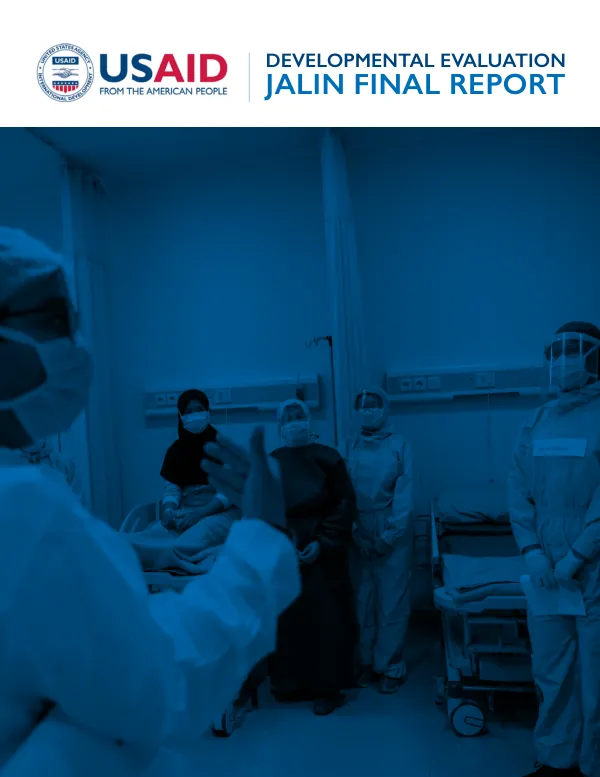
to present findings and recommendations to USAID, the Government of Indonesia's Ministry of Health, and the USAID Jalin Project. The evaluation's objective was to generate lessons learned and options for rapid course corrections for Jalin to accelerate reductions in preventable maternal and newborn deaths. Reductions in maternal and newborn mortality in Indonesia have slowed in recent years. In response to this complex challenge, USAID designed Jalin with a cocreation approach of facilitating partnerships with stakeholders to catalyze local solutions to improve maternal and newborn health outcomes. Recognizing the constraints inherent in changing strategies, USAID paired Jalin with a Developmental Evaluation to cultivate new ways to learn, improve decision-making, and manage adaptively. The Developmental Evaluation Process involved assessing Jalin's adherence to core principles, its management and stakeholder relationships, and its operating context. The evaluation addressed these objectives through 20 evaluation questions (EQs), which it designed collaboratively with USAID, the MOH, and Jalin. The Evaluation also conducted numerous emergent tasks in response to its partners' rapidly developing needs. The Evaluation designed a methodology for each EQ with a framework, methods, data sources, limitations, and mitigation plans. After data collection and analysis, the DE delivered recommendations supported by findings and conclusions from its research via user-friendly learning products. It then worked with USAID, the MOH, Jalin, and stakeholders through daily discussions, meetings, and events to promote their use to inform decision-making and improve development outcomes. The Evaluation gathered the following topline findings and conclusions through its research: Jalin's design was appropriate for the MNH context in Indonesia, and its theory of change and assumptions were valid. The Project partnered with 305 subnational and 18 national stakeholders in six provinces to cocreate 72 ideas for local solutions. It then implemented 26 of these innovations, replicating 6 in new areas, and scaling 2 nationally. Jalin's primary successes were engaging subnational actors in cocreation and collaborating with the MOH via an embedded secretariat. The Project's subnational stakeholder engagement advanced its core principles of cocreation, a whole-of-market approach, and sustainability. The MOH supported Jalin's Year 3 Work Plan results framework and activities to improve MNH quality of care and emergency referral systems. The Evaluation tracked the uptake of 106 of its 129 recommendations, of which 73 were utilized by their intended users (69%) and produced outcomes. The DE was unable to track the other 23 recommendations because it delivered them near the conclusion of its period of performance in the E-Kohort, MPDN, and hospital mentoring assessments. The Developmental Evaluation at a Glance highlights the major lessons for the USAID team, including realizing that DE can provide a flexible mechanism to improve a project, beyond the expectations of the formal evaluation question reports. The Evaluation also strengthened Indonesian ownership of the cocreation process, focused Jalin's cocreation on a coherent set of MNH interventions, and supported the MOH's national initiatives to accelerate mortality reduction. The Evaluation's findings and recommendations generated the following outcomes: DE can systematically verify outcomes while contributing to their impacts; DE requires an evaluator or team of evaluators with diverse experiences and skill sets; DE is an inherently adaptable approach responsive to changes in needs; and DE offers a useful complement to traditional, top-down MEL systems. The Developmental Evaluation for USAID Jalin demonstrated the effectiveness of the DE approach in generating lessons learned and options for rapid course corrections. The Evaluation's findings and recommendations have contributed to the growth of the knowledge base on the DE approach in general, across USAID and in Indonesia.