DAI
Diseases, Mites and Nematode Pests of Vegetables in Liberia
The agricultural development initiative in peri-urban areas of Liberia focuses on crop protection for vegetables.
2012 · 14 pages
Sign in to readA free account is required to download.
Abstract
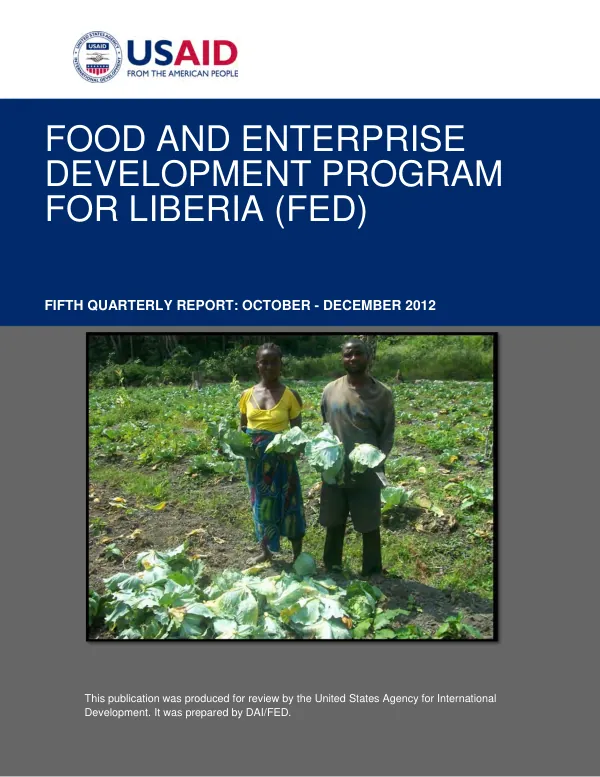
The Food and Enterprise Development (FED) Program for Liberia, funded by USAID, aims to improve crop yields and market access for small-scale farmers. The program targets peri-urban agriculture, which involves the production of vegetables for sale as fresh produce or minimally processed. Mites are a significant pest in vegetable production in Liberia, causing damage to leaves and fruit. The life cycle of mites consists of the egg, larva, protonymph, deutonymph, and adult stages. Adults have four pairs of legs, while the larva has three pairs of legs. Mites damage leaves and fruit by sucking out the cell contents, causing symptoms such as chlorosis, rusetting, and galls. The broad mite, in particular, causes severe leaf distortion, which can be mistaken for herbicide or other damage. The broad mite, Tetranychus evansi, Two-spotted mite (TSM), Tetranychus ludeni Zacher, and Tomato russet mite (Aculops lycopersici) are some of the mites that affect vegetable production in Liberia. Mites are present all year round, but are likely to be more active during warmer, dryer periods. High temperatures of 21o to 27oC coupled with high relative humidity favor the development of broad mites. A small number of mites are not a cause for concern, but high populations can be damaging. Biological controls for mites include the use of predatory mites. A number of Phytoseiid species have been found to occur naturally in Senegal and other parts of West Africa, including Neoseiulus californicus, Amblyseius swirskii, Paraphytoseius horrifer, Phytoseius amba, and Amblyseius. These predatory mites can be used to control mite populations and reduce the need for chemical pesticides. The FED Program for Liberia has developed a comprehensive approach to crop protection, including the use of biological controls, integrated pest management (IPM) strategies, and training for farmers and extension staff. The program aims to improve crop yields, reduce pesticide use, and increase market access for small-scale farmers in peri-urban areas of Liberia.
Related documents