USAID DEC
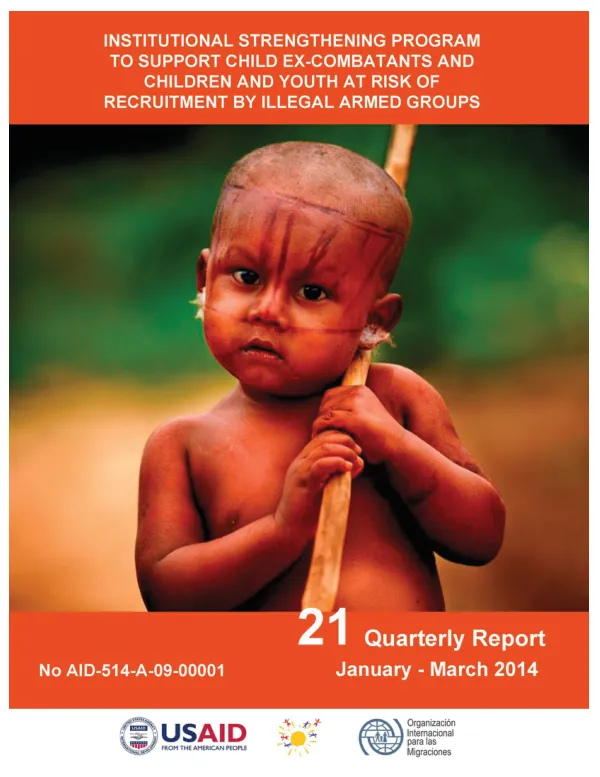
Disengaged Child Soldiers and Adolescents at Risk of Recruitment Program (CHS) Quarterly Report No. 21 January – March 2014
Sign inGOVERNMENT OF COLOMBIA
Disengaged Child Soldiers and Adolescents at Risk of Recruitment Program (CHS) Quarterly Report No. 21 January – March 2014
The Disengaged Child Soldiers and Adolescents at Risk of Recruitment Program (CHS) is a strategic initiative aimed at strengthening the capacity of the Government of Colombia (GOC) to assist disengaged child soldiers and youth at risk.
2014 · 38 pages
Sign in to readA free account is required to download.
Abstract
The program's objective is to contribute to the achievement of three intermediate results: IR 1, IR 2, and IR 3. IR 1 focuses on the Colombian Family Welfare Institute (ICBF) implementing policies for disengaged child soldiers, while IR 2 involves the GOC implementing policies to reduce vulnerabilities to recruitment in high-risk areas. IR 3 aims to improve knowledge management through the collaboration of ICBF and the Inter-Sectorial Commission on the Prevention of Recruitment and Use of Child Soldiers (CIPRUNA). During the second quarter of FY 2014 (January 1, 2014 – March 31, 2014), efforts focused on the development and approval of joint work plans with ICBF and CIPRUNA's Technical Secretariat. Despite the challenges posed by internal institutional changes within the ICBF and national elections, the CHS Program adapted and managed to coordinate activities with strategic GOC partners. Significant progress was achieved during the reporting period, including the enrollment of 72 children and adolescents disengaged from illegal armed groups in the ICBF Assistance Program, achieving 47% of the established target for FY 2014. The CHS Program also made progress in reducing vulnerabilities to recruitment in high-risk areas, with 22,747 children and adolescents at risk of recruitment being new beneficiaries of activities carried out by the CHS Program at the local level. Additionally, the process of transferring the Narrative Exposure Technique model to GOC institutions was completed, achieving 25% of the target for FY 2014 during the quarter. In total, 50% of the target for FY 2014 has been achieved, with two of four models transferred: the MVRO model in the 43 municipalities and the Narrative Exposure Technique. The implementation of the CHS Program has been impacted by the ongoing peace process between the GOC and the Revolutionary Armed Forces of Colombia (FARC). Peace negotiations continue, with a draft agreement on the issue of illegal drugs being developed during the 20th round of talks. Discussions continued in the 21st round, at the end of which the FARC proposed a 50-point anti-drug policy, with a focus on recognition of the problem of drug consumption as a public health issue and the state's responsibility for its resolution. The CHS Program has also been involved in mass mobilizations, with some 276,500 Colombians united in their indignation against child recruitment, to support the "Dreaming is a Right" campaign and the implementation of local prevention plans. The program has also produced analytical documents, with ICBF's Child Welfare Observatory producing 3 bulletins and two books, and the Observatory of CIPRUNA's Technical Secretariat producing 2 bulletins. In this quarter, 23% of the target for FY 2014 was achieved, and in total 70% of the target for FY 2014 has been achieved. The CHS Program has adapted to the challenges posed by the ongoing peace process, internal institutional changes within the ICBF, and national elections. Despite these challenges, the program has managed to coordinate activities with strategic GOC partners and achieve significant progress in reducing vulnerabilities to recruitment in high-risk areas and improving knowledge management.
Related documents