INTERNATIONAL COMMITTEE FOR THE RED CROSS
Disengaged Children and Adolescents
The Colombian government's efforts to address the issue of disengaged children and adolescents have been ongoing since 1999.
2019 · 4 pages
Sign in to readA free account is required to download.
Abstract
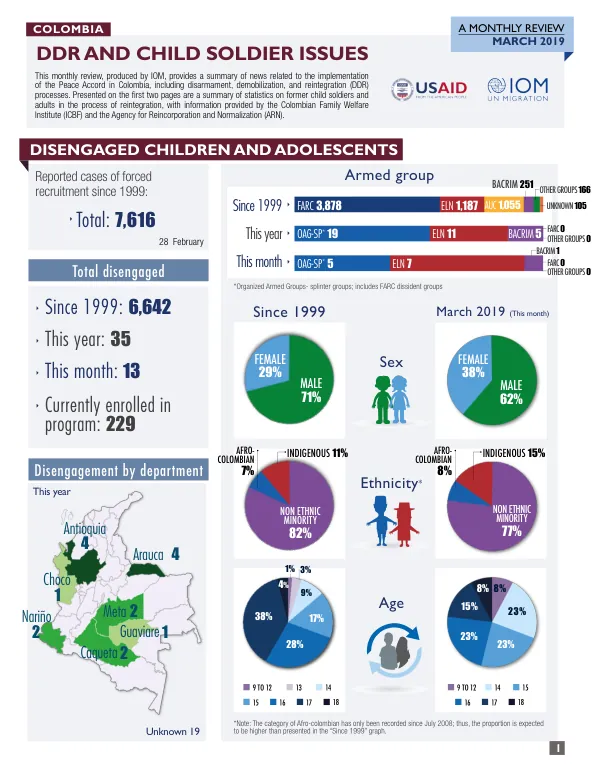
According to reported cases, a total of 6,642 children and adolescents have been forced into recruitment by armed groups since 1999. In the current year, 35 cases have been reported, with 13 cases occurring in the past month. Currently, 229 children and adolescents are enrolled in a program aimed at their reintegration. The majority of children and adolescents recruited by armed groups are male, accounting for 71% of cases since 1999. The most common age range for recruitment is between 13 and 17 years old, with 38% of cases falling within this range. The majority of children and adolescents are from non-ethnic minority groups, accounting for 82% of cases since 1999. The most common armed groups responsible for recruitment are the FARC, ELN, and BACRIM. The implementation of the Peace Accord in Colombia has led to a significant decrease in the number of children and adolescents recruited by armed groups. However, challenges remain, particularly in the departments of Chocó, Nariño, Guaviare, Caqueta, and Antioquia. The Colombian government has established programs aimed at the reintegration of children and adolescents, including the Agency for Reincorporation and Normalization (ARN). As of March 2019, 41 children and adolescents were actively participating in the reintegration process, with 116 new entrants in the current year. The Colombian government has also established the Special Jurisdiction for Peace (JEP) to address the issue of forced recruitment and other human rights violations. The JEP has opened cases 006 and 007, which focus on the systematic victimization of the Unión Patriótica political party and the recruitment and use of minors, respectively. The JEP has also been investigating the participation of State agents, public forces, paramilitary groups, and civilian third parties in the systematic victimization of the Unión Patriótica political party. The implementation of the Peace Accord has also led to a significant increase in forced displacement, particularly in the departments of Córdoba, Cauca, Catatumbo, and Chocó. The Colombian government has established programs aimed at addressing the root causes of forced displacement, including the provision of land and economic support to former combatants. However, challenges remain, particularly in the areas of land distribution and economic support. The Colombian government has also faced criticism for its handling of the "Jesús Santrich" case, which involves the extradition of a former FARC leader to the United States. The JEP has closed its period of seeking evidence, and the case is now being reviewed by the Inspector General's office. The JEP has also been investigating the participation of State agents, public forces, paramilitary groups, and civilian third parties in the systematic victimization of the Unión Patriótica political party. The Colombian government has also established the Truth Commission to address the issue of human rights violations and breaches of international humanitarian law. The Truth Commission has been investigating cases of forced recruitment, forced displacement, and other human rights violations. The Colombian government has also established the Unit for the Search of Disappeared Persons (UBPD) to address the issue of disappeared persons. The UBPD has been searching for disappeared persons and providing support to their families. The Colombian government has also faced criticism for its handling of the protests in Southwestern Colombia, which have been sparked by the blockading of a crucial highway. The protests have led to confrontations with security forces, with over 25 protestors wounded and one death reported. The Colombian government has demanded that the blockades be lifted and the de facto routes ceased.