USAID DEC
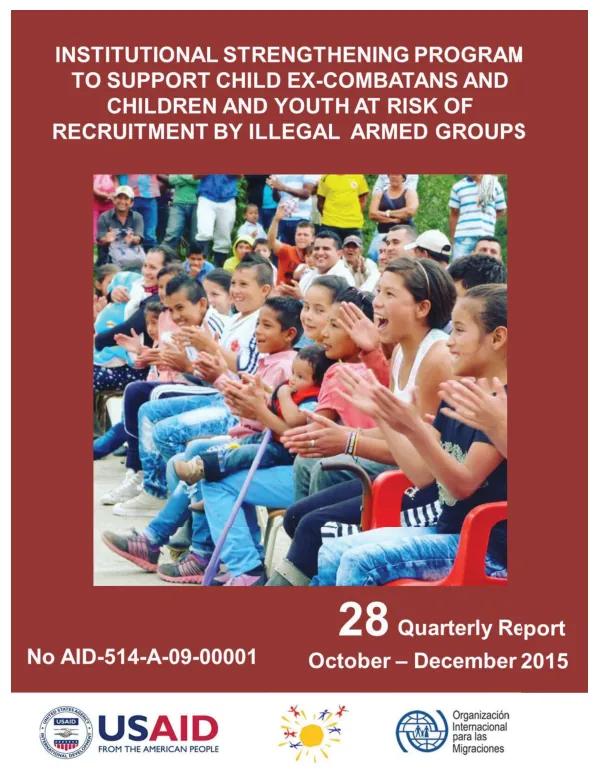
Disengaged Children and Youth at Risk of Recruitment Program Quarterly Report No. 28 October - December 2015
Sign inGOVERNMENT OF COLOMBIA
Disengaged Children and Youth at Risk of Recruitment Program Quarterly Report No. 28 October - December 2015
The Disengaged Children and Youth at Risk of Recruitment Program is a strategic initiative aimed at strengthening the capacity of the Government of Colombia to assist disengaged child soldiers and youth at risk.
2015 · 56 pages
Sign in to readA free account is required to download.
Abstract
The program's objective is to achieve four intermediate results (IR) that contribute to the achievement of its strategic objective. IR 1 focuses on the Colombian Family Welfare Institute (ICBF) implementing policies for disengaged child soldiers, while IR 2 involves the Government of Colombia implementing policies to reduce vulnerabilities to recruitment in high-risk areas. IR 3 aims to improve knowledge management through the Inter-Sectoral Commission on the Prevention of Recruitment and Use of Children and Adolescents (CIPRUNA), and IR 4 involves monitoring, tracking, and knowledge management. During the quarter, significant progress was achieved in implementing community-based reintegration models in Cauca, Bogota, Caquetá, and Antioquia. A total of 905 children and adolescents who had disengaged from illegal armed groups were assisted, including 53 in the ICBF Assistance Program and 576 in community-based models. Prevention activities focused on concluding efforts to monitor implementation of 15 prevention plans designed in 2013, with the final 8 monitored during the quarter. Technical assistance was provided to departmental and local government agencies to ensure that the plans are included within prevention and protection policies and consolidated within the new government agendas. Peace pedagogy activities continued during the quarter, with a focus on restorative justice, social and educational inclusion, peace education, and cultural entrepreneurship projects. This included working with Misak indigenous youth to improve educational and social inclusion, support to strengthen local cultural-entrepreneurial initiatives together with the Ministry of Culture, and continued participation in "Educational Partnerships for Building a Culture of Peace," a network of national and international organizations aimed at improving peace education. A total of 447 people have participated in processes to share knowledge on peace pedagogy, exceeding the target for FY2015-2016. Knowledge management efforts included support for ICBF's Child Welfare Observatory to compile information, produce and share bulletins, and hold working groups on topics such as trafficking, child labor, adolescent criminal responsibility, adolescent pregnancy, peace, and post-conflict. Information was gathered from target municipalities for the study "Assessing the phenomenon of trafficking of children and adolescents for sexual and labor exploitation in the department of Nariño," based on the methodology developed by IOM. The Observatory also compiled information on the implementation of the Participation Protocol for CH&A victims and the transfer of the Meaningful Reparations Toolbox to professional teams from ICBF, the Victims Unit, and ACR. The program's progress during the quarter includes the conclusion of projects and activities, including the implementation of community-based reintegration models, prevention plans, and peace pedagogy projects. A total of 4,620 new beneficiaries were reached through prevention projects, and 447 people participated in processes to share knowledge on peace pedagogy. The program's knowledge management efforts have also contributed to the compilation and sharing of information on topics such as trafficking, child labor, and adolescent pregnancy.
Related documents