USAID DEC
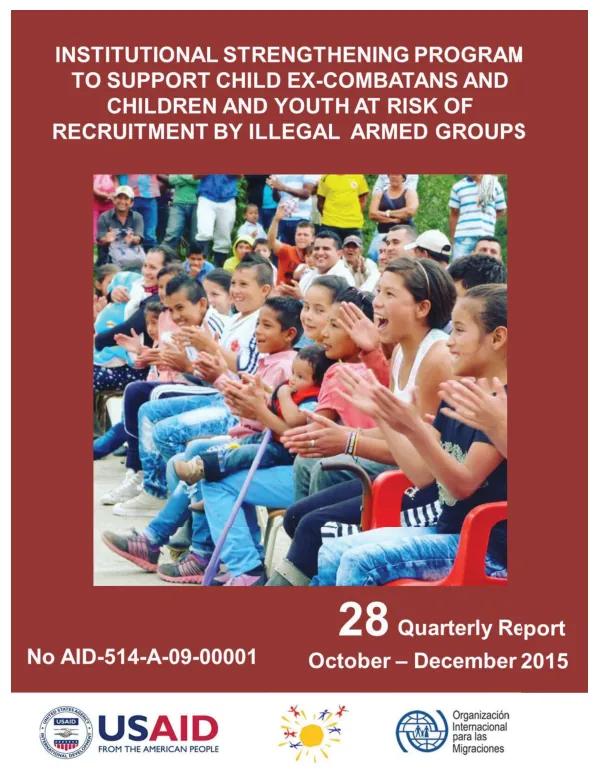
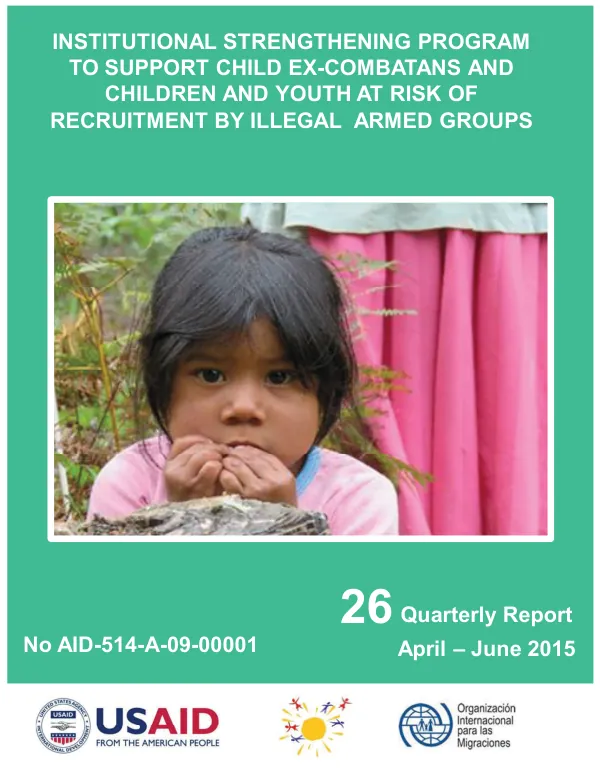
Disengaged Children and Youth at Risk of Recruitment Program Quarterly Report No. 26 April – June 2015 (Q3 FY2015)
Sign inGOVERNMENT OF COLOMBIA
Disengaged Children and Youth at Risk of Recruitment Program Quarterly Report No. 26 April – June 2015 (Q3 FY2015)
The Disengaged Children and Youth at Risk of Recruitment Program (CHS) aims to strengthen the capacity of the Government of Colombia (GOC) to assist disengaged child soldiers and youth at risk.
2015 · 46 pages
Sign in to readA free account is required to download.
Abstract
The program's strategic objective is to achieve four intermediate results (IR) from October 2011 to December 2015. IR 1 focuses on the Colombian Family Welfare Institute (ICBF) implementing policies for disengaged child soldiers, while IR 2 involves the GOC implementing policies to reduce vulnerabilities to recruitment in high-risk areas. IR 3 aims to improve knowledge management through ICBF and the Inter-Sectoral Commission on the Prevention of Recruitment and Use of Children and Adolescents (CIPRUNA), and IR 4 involves monitoring, tracking, and knowledge management. During the third quarter of FY 2015 (April 1 – June 30), significant progress was achieved under the results framework established in the Work Plan and the PMEP, approved by USAID in January 2015. Assistance efforts with ICBF focused on implementing community-based reintegration models in Cauca (indigenous model) and Bogota (urban model), with local coordination to support implementation in Caquetá (rural model). Two technical committees were held with the ICBF Protection Directorate and the Sub-Directorate for Reestablishment of Rights, resulting in ICBF articulating a need to coordinate their Mobile Unit initiative with these new community-based reintegration models. A total of 84 CH&A who had disengaged from illegal armed groups (IAG) were assisted during the quarter, including 64 who enrolled in the ICBF Assistance Program and 20 assisted through community-based models. Prevention activities continued to focus on monitoring implementation of the 15 prevention plans designed in 2013, ensuring inclusion in local protection and prevention policies and in the next administrative period following the upcoming local and departmental elections. In the context of prevention strategies, 15,506 CHA&Y participated in MVRO workshops. CHS continued to support actions under a joint work plan with SENA (Colombia's National Apprenticeship System), including techno-academies, ensuring access to training for rural youth, entrepreneurship training, and transfer of methodologies. A variety of prevention projects continued with 18,649 new beneficiaries, thereby achieving 202% of the target for FY 2015. CHS also continued to support the Ombudman's Office and the Inspector General's Office. Peace pedagogy activities included a reconciliation project to pilot and evaluate a 'family constellation' methodology, a project working with Misak indigenous youth to improve educational and social inclusion, support to strengthen local cultural-entrepreneurial initiatives together with the Ministry of Culture through its National Workshop Schools Program, and CHS participation in the "Educational Partnerships for Building a Culture of Peace," a network of national and international organizations aimed at improving peace education. On justice issues, a document is being finalized to compile information on restorative justice practices and CHS is supporting proposals for structural reform of the judicial system to include transitional justice related to recruitment, use, and sexual violence against CH&A. Training in education, communication, and citizen mobilization began in Recreational Centers as a pedagogical strategy for peace, and planning is underway with Red PaPaz to develop peace pedagogy strategies including a "Peace Kit" (on peacebuilding, citizenship, family, and community, and reconciliation). To date, 135 people have participated in processes to share knowledge and experiences on peace pedagogy and restorative justice practices.