ENCOMPASS, LLC
Education Brief: Djibouti
The education sector in Djibouti faces significant challenges, with a large proportion of the population out of school.
2020 · 4 pages
Sign in to readA free account is required to download.
Abstract
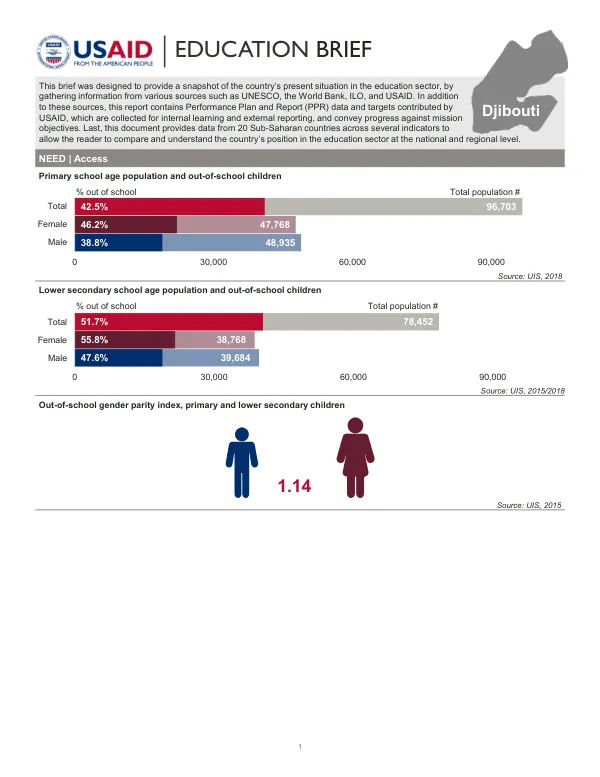
According to UNESCO data, the out-of-school gender parity index for primary and lower secondary children in Djibouti is 1.14, indicating a significant disparity between boys and girls. The total population of primary school age and out-of-school children in Djibouti is approximately 96,703, with 38.8% of the total population out of school. The country's capacity to address these challenges is also a concern. The USAID self-reliance capacity, overall score, is 0.29, indicating that Djibouti has a relatively low capacity to manage its own development. The government expenditure on education as a percentage of GDP is 4%, which is below the UNESCO benchmark for SDG 4. The fragility index, which measures the level of state stability, is 3, indicating a high level of fragility. Despite these challenges, there are efforts underway to improve the education sector in Djibouti. The USAID-assisted workforce development programs have shown positive results, with 1,117 individuals completing the programs and 4 individuals achieving new or better employment. The programs have also improved the skills of 2,000 individuals, with 1,000 individuals achieving new or better employment. The education sector in Djibouti also faces challenges in terms of access to education. The number of individuals who complete USG-assisted workforce development programs is low, with a target of 4,000 individuals. The number of individuals with improved skills following completion of USG-assisted workforce development programs is also low, with a target of 2,000 individuals. However, the number of individuals with new or better employment following completion of USG-assisted workforce development programs is higher, with a result of 4 individuals. The education sector in Djibouti also faces challenges in terms of governance and funding. The government expenditure on education as a percentage of GDP is low, and the country's capacity to manage its own development is relatively low. However, there are efforts underway to improve the education sector, including the implementation of USAID-assisted workforce development programs. These programs have shown positive results, and there is a need for continued support to improve the education sector in Djibouti.
Related documents