USAID DEC
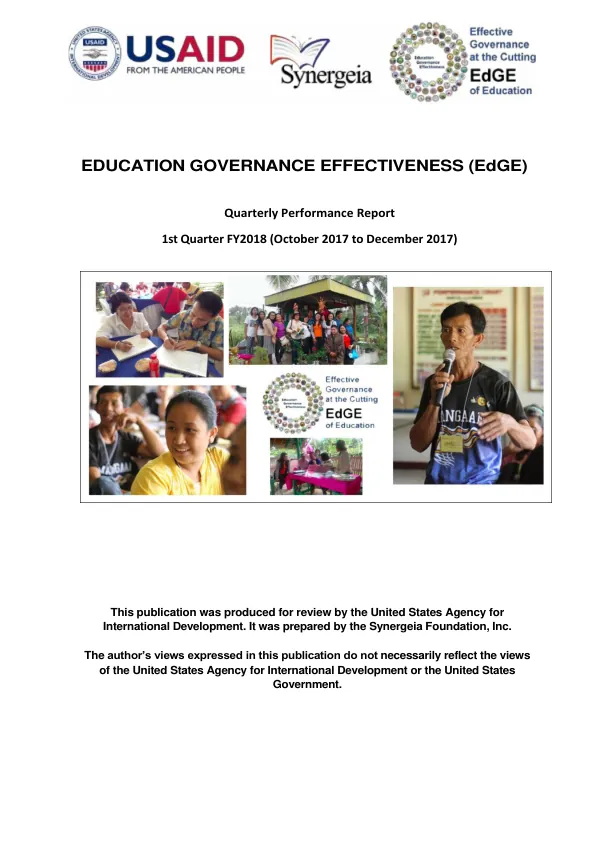
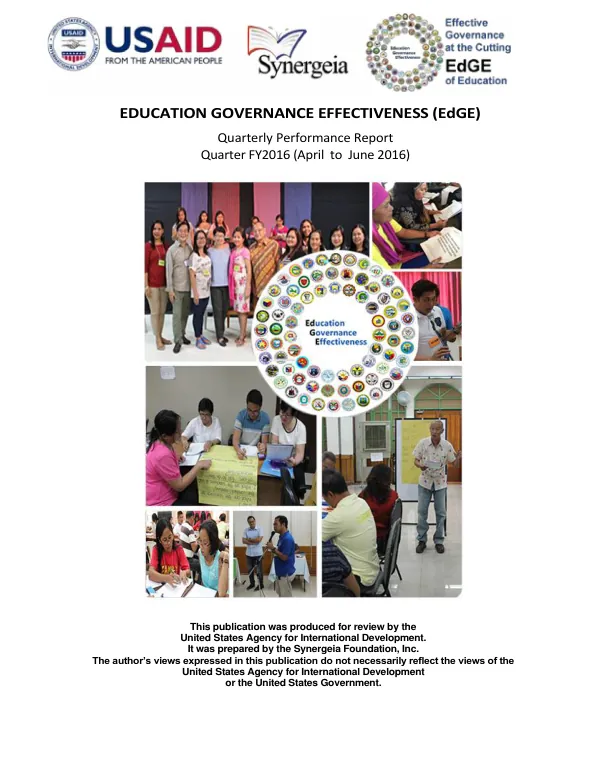
EDUCATION GOVERNANCE EFFECTIVENESS (EdGE) Quarterly Performance Report Quarter FY2016 (April to June 2016)
Sign inUSAID
EDUCATION GOVERNANCE EFFECTIVENESS (EdGE) Quarterly Performance Report Quarter FY2016 (April to June 2016)
The Education Governance Effectiveness (EdGE) initiative aims to strengthen government effectiveness for education at the local level, increase transparency and accountability, and enhance participation of stakeholders in education policy formulation and implementation.
2016 · 38 pages
Sign in to readA free account is required to download.
Abstract
EdGE has built the capacity of 3,350 administrators on education governance, exceeding its target of 2,900 by 114%. This capacity building has resulted in new values, better processes, and skills in governance, with 272 School Governing Councils (SGCs) and 31 Local School Boards (LSBs) assessed to have better education governance. EdGE has also made significant progress in implementing remedial reading programs, with over 1,000 schools conducting the programs and involving 13,300 students during the quarter. The results of the 2015 Language Assessment for Primary Grades (LAPG) show that 61% of grade 3 students under EdGE obtained scores from 51% to 100% in reading comprehension, indicating improved reading skills. Furthermore, 75 barangays increased financial support to schools, and 31 LSBs increased their spending for education. The EdGE initiative has also established partnerships with various organizations to support education governance and improve reading skills. A Public Private Sector Project (PPP) is being implemented in North Upi, Maguindanao, with a classroom worth P1.7 billion being constructed. The partners are implementing 32 PPPs, exceeding the target of 25. The EdGE initiative is guided by its revised Monitoring and Evaluation (M&E) plan, which focuses on improving education governance and reading skills of children. The M&E plan has been streamlined to ensure that data collection is efficient and effective. The initiative has also simplified its reporting templates to focus on accomplishments, challenges, and work plans. In terms of capacity building, the EdGE initiative conducted four Regional SGC Workshops, which were attended by 198 participants from Cabatuan, Guimbal, and San Enrique, Iloilo Province; 94 participants from Alabel, Sarangani; and 198 participants from Pili, Camarines Sur. The workshops aimed to develop skills on organization, management, and project implementation, as well as provide technical assistance to SGCs and LSBs on School Improvement Plan (SIP) implementation. The EdGE initiative has made significant progress in strengthening government effectiveness for education at the local level, increasing transparency and accountability, and enhancing participation of stakeholders in education policy formulation and implementation. The initiative continues to work towards its targets, with a focus on improving education governance and reading skills of children. The EdGE initiative has also established partnerships with various organizations to support education governance and improve reading skills. The partners are implementing 32 Public Private Sector Projects (PPPs), exceeding the target of 25. The PPPs aim to improve education infrastructure and provide support to schools. In terms of financial performance, the EdGE initiative has exceeded its target for expenditures on education governance, with PHP 2,411,113.97 spent on training administrators and officials. The initiative has also exceeded its target for expenditures on transparency and accountability, with PHP 2,229,014.75 spent on increasing education spending in LGUs and barangays. The EdGE initiative continues to work towards its targets, with a focus on improving education governance and reading skills of children. The initiative is guided by its revised M&E plan, which focuses on improving education governance and reading skills of children. The M&E plan has been streamlined to ensure that data collection is efficient and effective. In terms of results, the EdGE initiative has exceeded its target for the number of administrators and officials trained, with 313 trained. The initiative has also exceeded its target for the number of laws, policies, regulations, or guidelines developed or modified to improve primary grade reading programs or increase equitable access to education. The initiative has also exceeded its target for the number of LGUs and barangays with increased education spending.
Related documents