USAID DEC
Eligible Uses of Section 202(e); Internal Transportation, Storage and Handling; Inland Freight, Monetization Proceeds; and Community Development Funds for FFP Awards
Sign inUSAID
Eligible Uses of Section 202(e); Internal Transportation, Storage and Handling; Inland Freight, Monetization Proceeds; and Community Development Funds for FFP Awards
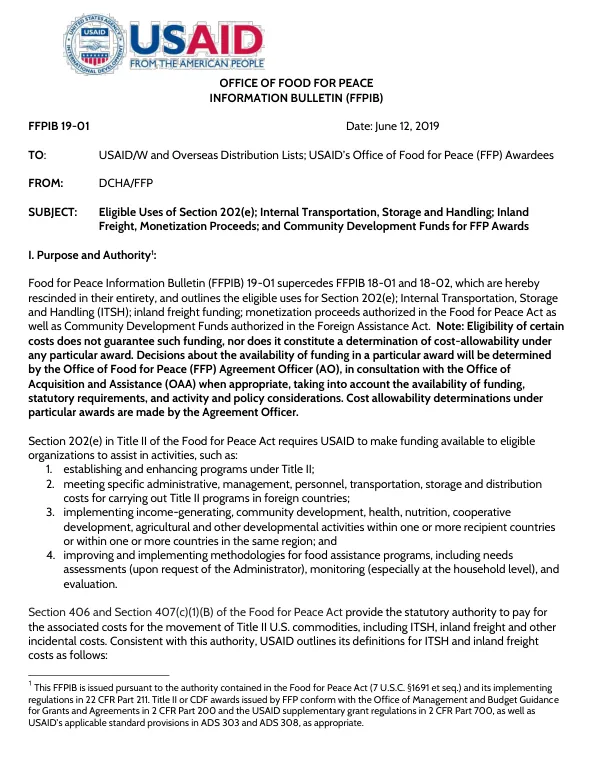
The Office of Food for Peace Information Bulletin (FFPIB) 19-01 outlines the eligible uses of Section 202(e) funding, internal transportation, storage, and handling (ITSH), inland freight, monetization proceeds, and community development funds for Food for Peace (FFP) awards.
2019 · 8 pages
Sign in to readA free account is required to download.
Abstract
This bulletin supersedes FFPIB 18-01 and 18-02, which are hereby rescinded in their entirety. Section 202(e) of the Food for Peace Act requires USAID to make funding available to eligible organizations to assist in activities such as establishing and enhancing programs under Title II, meeting specific administrative, management, personnel, transportation, storage, and distribution costs, and implementing income-generating, community development, health, nutrition, cooperative development, agricultural, and other developmental activities. Eligible organizations for Section 202(e) funding include Private Voluntary Organizations (PVOs) or Cooperatives, Intergovernmental Organizations such as the U.N. World Food Program (WFP), and foreign governments for emergency awards. Eligible uses for Section 202(e) funding include direct administrative costs to implement Title II programming, costs associated with USG commodity when ITSH is not available, development program interventions, market-based assistance, and emergency program essential complementary activities. ITSH costs include direct costs of all Title II emergency awards or non-emergency awards in a least developed country (LDC) associated with the in-country movement, management, program implementation, and monitoring of Title II U.S. agricultural commodities. Inland freight costs include costs required to move commodities through the transit country in the case of landlocked countries or instances when commodities cannot be delivered to a port in the destination country due to conflict, natural disaster, or other port or logistical constraints. Monetization is an activity allowed under Section 203 of the Food for Peace Act in which donated commodities are sold in local markets in part to generate cash resources for award implementation. Monetization proceeds can be used to support ITSH or Section 202(e) costs. USAID aims to reduce its reliance on monetization to the extent practicable, and the use of monetization requires AO approval. The bulletin outlines the definitions for ITSH and inland freight costs, as well as the eligible uses for Title II funding, including interventions that fall into two general categories: 202(e) and 202(e) Enhanced. The bulletin also provides guidance on the use of Section 202(e) funding in emergency and non-emergency programs, including direct administrative costs, costs associated with USG commodity, development program interventions, market-based assistance, and emergency program essential complementary activities. The bulletin emphasizes that all uses of funding must be reasonable, allowable, and allocable, and are subject to the AO's determination that the facts of the particular situation support the use of that funding. The bulletin also provides guidance on the reporting requirements for non-emergency programs, including the use of the comprehensive budget and the annual budget pipeline subtotals. Overall, the FFPIB 19-01 provides guidance on the eligible uses of Section 202(e) funding, ITSH, inland freight, monetization proceeds, and community development funds for FFP awards, and outlines the requirements for eligible organizations and the use of funding in emergency and non-emergency programs.
Related documents