USAID
Food for Peace - Modality Decision Tool
The Food for Peace Modality Decision Tool (MDT) is a standardized process for selecting the most suitable modality for food assistance programs.
2016 · 2 pages
Sign in to readA free account is required to download.
Abstract
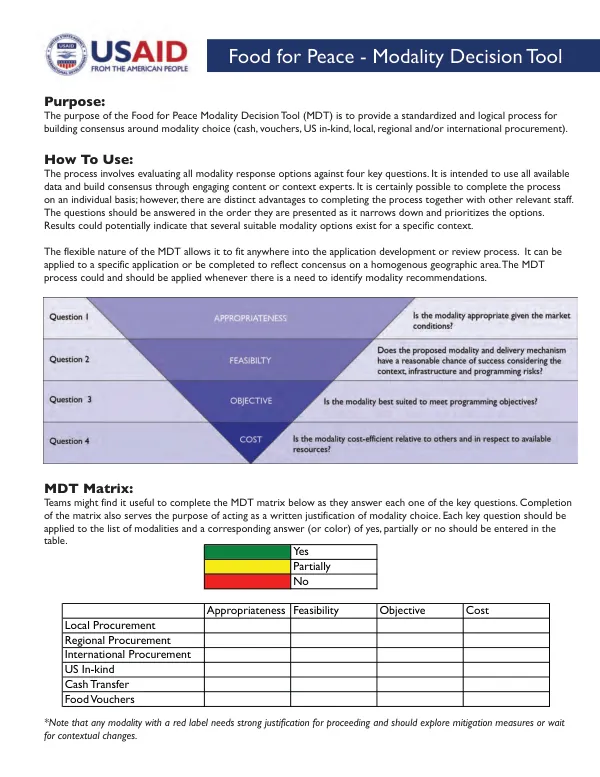
The tool evaluates modality response options against four key questions, which are designed to build consensus among stakeholders and ensure a logical and data-driven decision-making process. The first question assesses the appropriateness of a modality given the market conditions. This involves evaluating factors such as market functionality, availability of commodities, competition, price stability, market integration, trade barriers, and market accessibility. The goal is to identify modalities that minimize the risk of market distortions and ensure a stable market environment. The second question evaluates the feasibility of a modality and delivery mechanism, considering factors such as timeliness, market accessibility, security risks, market infrastructure, financial infrastructure, and risk mitigation measures. This question helps to determine whether a modality is feasible and can be implemented successfully in the given context. The third question focuses on the suitability of a modality to meet programming objectives, including considerations such as gender, protection, conflict sensitivity, cultural sensitivity, and consumption habits. This question helps to identify modalities that are tailored to the specific needs and preferences of the target population. The fourth question assesses the cost-efficiency of a modality relative to others and in respect to available resources. This involves conducting price comparisons across modalities, evaluating the cost ratio between transfer costs and total costs, and considering available resources for the context. The goal is to identify the most cost-efficient modality that can be implemented within the available budget. The MDT process involves completing a matrix that summarizes the answers to each question for each modality. The matrix serves as a written justification of modality choice and helps to identify the most suitable modality for a specific context. The tool is flexible and can be applied to a specific application or to a broader geographic area, and it can be used at any stage of the application development or review process. The MDT process is designed to be completed by a team of stakeholders, including content or context experts, and it is intended to build consensus around modality choice. While it is possible to complete the process individually, there are distinct advantages to completing it with a team, including the ability to share knowledge and expertise and to ensure a more comprehensive and nuanced understanding of the context.
Related documents
Documents in this collection
 2019
2019USAID DEC
Eligible Uses of Section 202(e); Internal Transportation, Storage and Handling; Inland Freight, Monetization Proceeds; and Community Development Funds for FFP Awards
Open record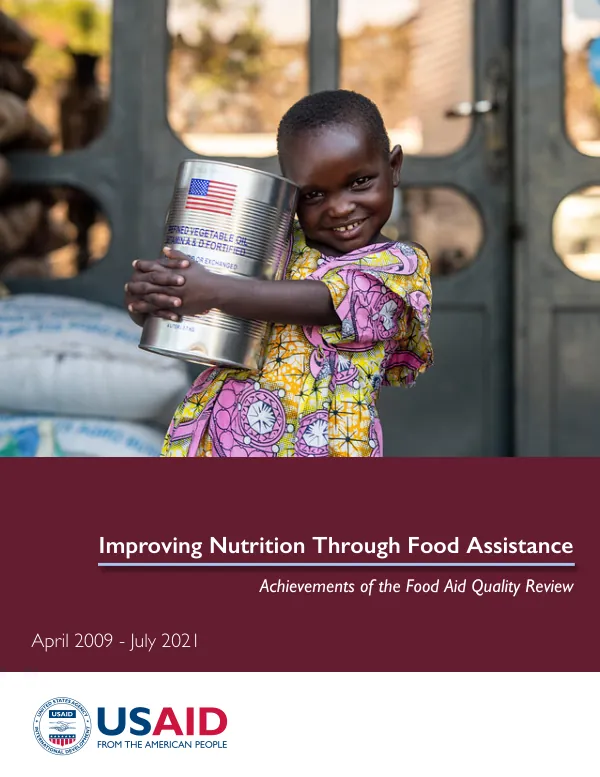 2021
2021USAID DEC
Improving Nutrition Through Food Assistance: Achievements of the Food Aid Quality Review
Open record