USAID DEC
Emergency Assistance to Conflict Affected Populations (EACAP) FY16 Q1 Quarterly Report
Sign inINTERNATIONAL ORGANIZATION FOR MIGRATION
Emergency Assistance to Conflict Affected Populations (EACAP) FY16 Q1 Quarterly Report
The humanitarian crisis in northeast Nigeria, caused by Boko Haram and the counter-insurgency, has resulted in a significant displacement of people.
2016 · 18 pages
Sign in to readA free account is required to download.
Abstract
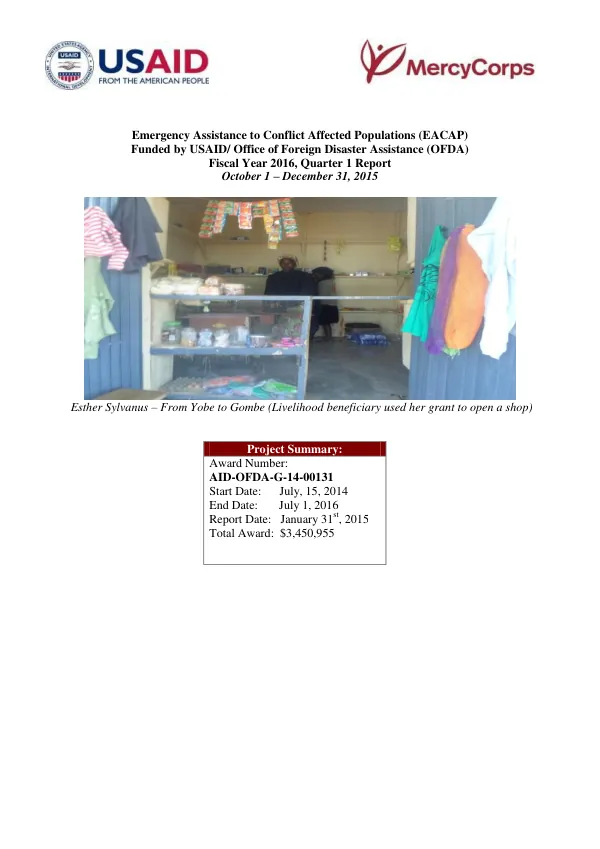
As of 2015, 14.8 million people out of a population of 15.2 million in the four states of Borno, Yobe, Adamawa, and Gombe are affected by the crisis. The conflict has disrupted livelihoods and limited access to markets and agricultural land, leading to a reliance on negative coping strategies by host communities. The Emergency Assistance to Conflict Affected Populations (EACAP) program, funded by USAID's Office of Foreign Disaster Assistance (OFDA), aims to respond to the relief needs of conflict-affected communities in Gombe State. The program expansion, which builds on the Strengthening Opportunities and Access to Resilience (SOAR) project, targets 100,874 individuals, including 72,975 internally displaced persons and 27,899 vulnerable host community members. During the quarter under review, the number of internally displaced persons (IDPs) remained above 2.1 million, with 84.5% displaced due to the insurgency. The ongoing insurgency and counter-insurgency measures continue to result in significant protection risks and human rights violations, impacting the most vulnerable civilian populations, including women and children. The EACAP program implemented several activities during the quarter, including providing displaced households and host communities with resources to meet immediate needs and sustain local markets. A total of 740 livelihoods grants were disbursed, benefiting 2,532 individuals, and applications for an additional 468 beneficiaries were compiled and submitted for review and approval. Village agents recruited and trained under the Village Savings and Loans (VSLA) intervention successfully established eight additional groups, out of which five have formally registered with the State Ministry of Cooperative and Poverty Alleviation. The program also continued to support the adoption and utilization of reporting and monitoring tools by the Ministry of Animal Husbandry, and 538 livestock farmers received training through the trained paravets. Additionally, a joint assessment was conducted with the Women Refugee Commission (WRC) to pilot the Cohort Livelihood and Risk Analysis (CLARA) tool, which assesses protection and gender risks and considerations around livelihoods activities undertaken by both IDP and host communities. Furthermore, the program provided vulnerable households with essential non-food items, consolidated a master database for beneficiaries, and established 33 community relief committees (CRCs) in all intervention communities. Plans are being developed to support the coordination of the GBV subsector working group in Gombe state, specifically to facilitate the establishment of a referral network. The security context in Gombe State remained calm during the quarter, with no incidents reported. However, Abuja was targeted by suicide bombings, and the regional dimension of the humanitarian crisis and security situation needs to be monitored closely to adapt operational measures necessary to ensure the safety of beneficiaries and resources.