USAID DEC
Responsive Economic Assistance to Conflict-Affected Households (REACH) 2: FY2016 Q3 Quarterly Report
Sign inACTION AGAINST HUNGER
Responsive Economic Assistance to Conflict-Affected Households (REACH) 2: FY2016 Q3 Quarterly Report
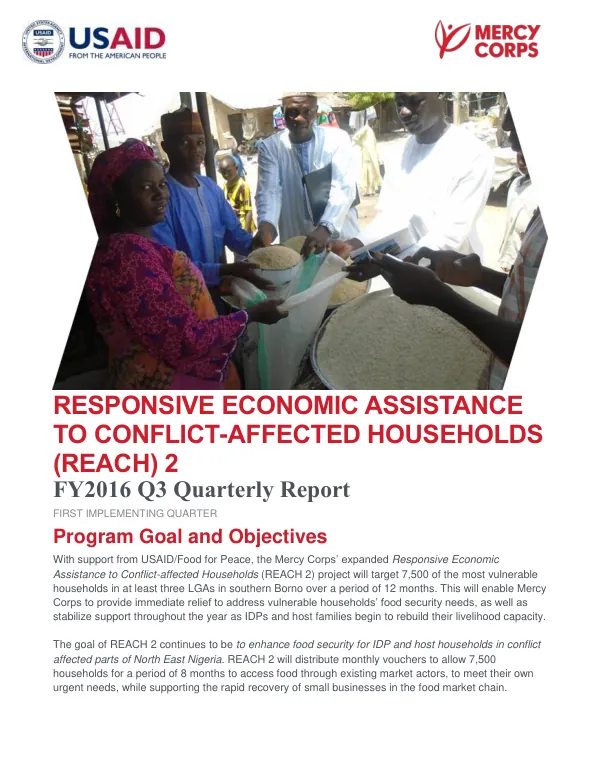
The Responsive Economic Assistance to Conflict-affected Households (REACH) 2 project, implemented by Mercy Corps with support from USAID/Food for Peace, aims to enhance food security for internally displaced persons (IDPs) and host households in conflict-affected areas of North East Nigeria.
2016 · 7 pages
Sign in to readA free account is required to download.
Abstract
The project targets 7,500 of the most vulnerable households in at least three Local Government Areas (LGAs) in southern Borno over a period of 12 months. REACH 2 will distribute monthly vouchers to allow 7,500 households for a period of 8 months to access food through existing market actors, meeting their own urgent needs while supporting the rapid recovery of small businesses in the food market chain. The project also includes a community infrastructure component, where participating households will contribute to Cash for Work (CfW) projects to earn wages in line with local wage and labor laws. Community Infrastructure Component The community infrastructure component of REACH 2 involves Cash for Work (CfW) projects, where participating households contribute to community development projects in exchange for wages. The projects will be selected by recipient communities, with practices in place to ensure the input, needs, and perspectives of all community members, including women, men, and youth, IDPs, and host families. Nutrition-Sensitive Approach REACH 2 will take a special focus on ensuring that all components are nutrition-sensitive by incorporating key nutrition messages throughout project activities. The project will promote nutritional awareness in targeted areas by developing and deploying information, education, and communication (IEC) messages and materials. Start-up Activities The main activities in the first quarter of the project were focused on the start-up of REACH 2 program activities. The program had its external kickoff meeting on May 7, 2016, in Biu, attended by local government heads, traditional leaders, and community leaders. The meeting outlined the program purpose, discussed how beneficiaries would be identified, and provided a venue for leaders to input their ideas into the program. Beneficiary Registration In preparation for beneficiary registration, REACH 2 reviewed the beneficiary registration process of its previous programs to understand which areas could be improved. The project transitioned from a manual paper registration process to an electronic platform that will also be used to manage the cash transfers and electronic vouchers that will be implemented under REACH 2. Coordination Mercy Corps coordinates closely with other international NGOs, including Save the Children, ICRC, and the Nigerian Red Cross. The project has been coordinating with ICRC since May 2016 to provide support in Biu, Hawul, and Damboa LGAs. Mercy Corps attended a coordination meeting in Maiduguri, the capital of Borno State, with a focus on understanding the current state of southern Borno. Unconditional Cash Food Vouchers REACH 2 signed contracts with 33 vendors in Biu who have the capacity and willingness to participate in the intervention. The project sought applications from vendors who were interested in participating in REACH 2, a process initiated during the kickoff meetings.